
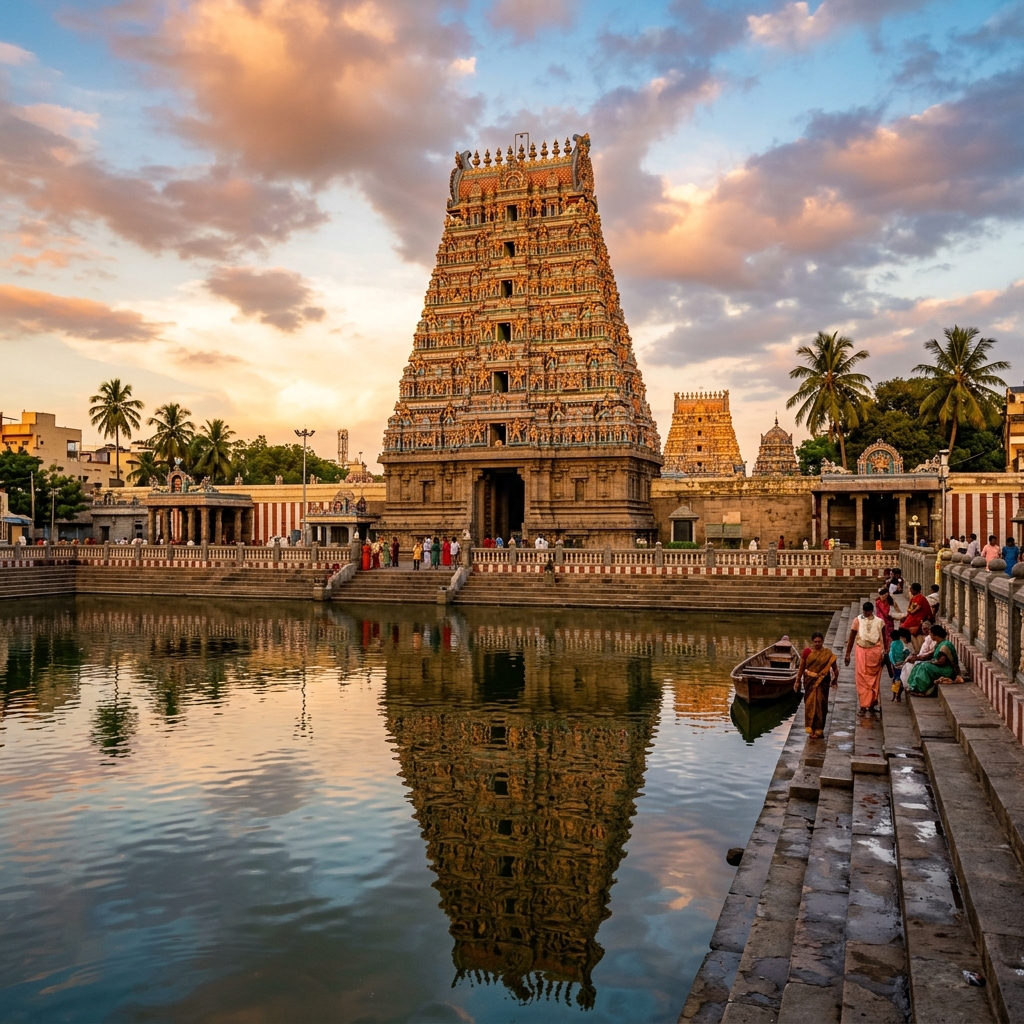
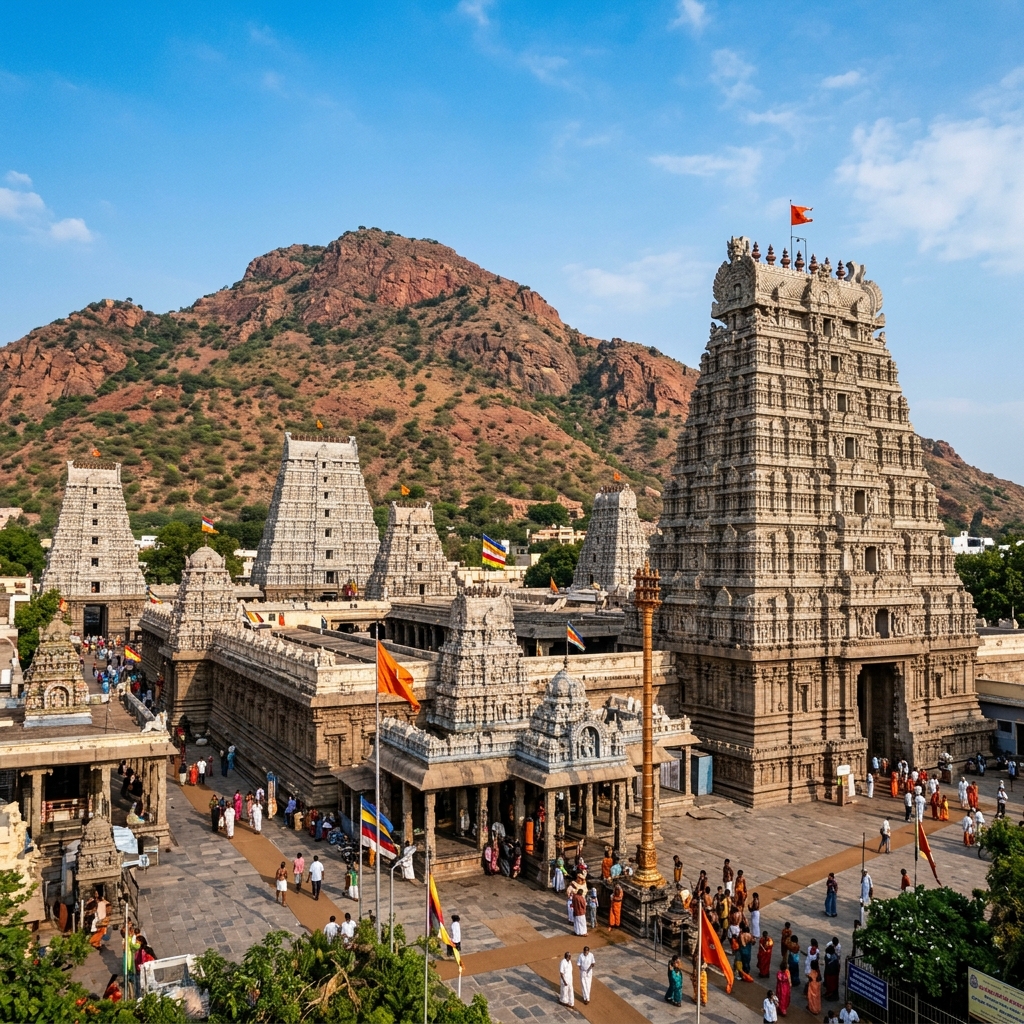
- Spiritual & Architectural Overview: Arulmigu Arunachaleswarar Temple, spanning 25 acres at the foot of the sacred Arunachala Hill, is one of the largest temple complexes in India. As the Fire Element (Agni Sthalam) among the Pancha Bhoota Sthalams, Lord Shiva is worshipped here as an unyielding column of cosmic light. The temple is dominated by the monumental 66-meter (217 feet) tall 11-tiered Eastern Raja Gopuram, built by Vijayanagara Emperor Krishnadevaraya. The complex encloses four massive stone enclosures (Prakarams), nine towers, a 1,000-pillared hall (Aayiram Kaal Mandapam), and the sacred Sivaganga tank.
- Sacred Geography & Setting: Dramatically situated at the base of the red granite Arunachala Hill (Annamalai), an extinct volcanic landform revered as the physical form of Lord Shiva himself.
- Core Spiritual Identity: The origin site of the cosmic light pillar and the world-renowned Karthigai Deepam festival, where a massive holy beacon flame is lit atop the 2,668-foot Arunachala Hill summit using 3,500 kg of pure ghee. Millions of barefoot pilgrims perform the 14-km circumambulation (Girivalam) around the sacred hill on full moon nights (Pournami).
Pancha Bhoota Sthalams
Arunachaleswarar Temple, Tiruvannamalai (Agni Sthalam)
Lord Arunachaleswarar / Annamalaiyar (Swayambhu Agni Lingam - Pillar of Cosmic Fire) • Tiruvannamalai, Nadu Nadu
About the Sacred Destination
Presiding Deity
Lord Arunachaleswarar / Annamalaiyar (Swayambhu Agni Lingam - Pillar of Cosmic Fire)
Consort & Sub-Shrines
Lord Arunachaleswarar / Annamalaiyar (Swayambhu Agni Lingam - Pillar of Cosmic Fire) & Goddess Unnamalai Amman (Apeethakuchambal)
Era & Dynasty
Chola Dynasty stone foundations (9th–11th Century CE); Hoysala Dynasty capital expansion under King Ballala III (14th Century CE); Vijayanagara Empire grand Rajagopuram construction under Krishnadevaraya (1516–1536 CE).
Sacred Status & Classification
Agni Sthalam (Fire Element) among the 5 Sacred Pancha Bhoota Sthalams; Paadal Petra Sthalam (Nadu Nadu Shrine #1); Holy Girivalam 14 km Barefoot Pilgrimage Circuit.
Sthala Puranam & Authentic Legends
Divine Manifestation & Primary Origin Narrative (Sthala Puranam):
According to the Skanda Purana (Arunachala Mahatmya) and Lingam Purana, Lord Brahma (the Creator) and Lord Vishnu (the Preserver) engaged in a fierce argument over who was the supreme ruler of the universe. To shatter their ego and vanity, Lord Shiva manifested between them as a boundless, glowing column of infinite cosmic fire (Jyotirlingam) that pierced through the upper heavens and lower underworlds.
Lord Shiva challenged both deities to find the crown (top) or the soles (bottom) of the fire pillar. Vishnu took the form of a formidable wild boar (Varaha) and burrowed deep into the earth for thousands of years, but failed to reach the bottom. Brahma transformed into a swan (Hamsa) and flew upwards into the cosmos. As Brahma soared higher, he saw a Pandanus flower (Ketaki / Thazhambu) falling from Shiva's head. Brahma persuaded the flower to falsely testify that Brahma had reached the summit.
Infuriated by Brahma's deception, Lord Shiva emerged from the pillar of fire as Kala Bhairava, severed Brahma's fifth head, and decreed that Brahma would have no dedicated temples on earth. Shiva also banned the Ketaki flower from being used in Saivite worship. Upon the earnest prayers of Brahma and Vishnu, Lord Shiva pacified his fiery manifestation into the red granite Arunachala Hill and established the Agni Lingam at its eastern base.
Ramana Maharshi & Saint Legends:
Tiruvannamalai is the sacred abode where Bhagavan Ramana Maharshi attained self-realization in 1896 CE at age 16, meditating inside the dark underground Pathala Lingam vault inside the Arunachaleswarar temple compound.
Classical Literary Canon & Sacred Hymns
- Tevaram Hymns (7th–8th Century CE): Praised in 24 sacred hymns of Tevaram by Saint Thirugnanasambandar and Saint Thirunavukkarasar (Appar).
- Thiruvempavai: Saint Manikkavasagar composed his famous 20-verse devotional masterpiece Thiruvempavai at Tiruvannamalai.
- Kandar Anubhuti: Saint Arunagirinathar composed his immortal Murugan hymns atop the Vallala Gopuram tower.
Epigraphical & Historical Events
- Chola Stone Inscriptions (9th–12th Century CE): Over 480 inscriptions record land donations, gold crowns, and oil lamp endowments by Aditya Chola I, Rajaraja Chola I, and Rajendra Chola I.
- Hoysala Capital Era (1328–1342 CE): Hoysala King Ballala III established his royal capital at Tiruvannamalai and constructed the inner fortifications.
- Vijayanagara Inscriptions (1516 CE): Krishnadevaraya inscribed his victories on the 217-foot Eastern Raja Gopuram tower and donated a gold-embroidered chariot.
Archaeo-Engineering & Scientific Marvels
Ancient metallurgical marvels, Siddha alchemical sciences, archaeo-engineering, and GI-tagged heritage:
- Geological Antiquity of Arunachala Hill: Geological Survey of India (GSI) studies classify Arunachala Hill as charnockite granite belonging to the Pre-Cambrian era (over 2.5 billion years old), making it older than the Himalayas.
- Pathala Lingam Vault: Underground stone vault beneath the 1,000-pillared hall where ambient temperatures remain 4°C cooler year-round.
Signature Rituals, Anomalies & Special Sevas
Authentic daily pooja timelines, spatika-lingam darshan hours, special sevas, and sacred temple anomalies:
Signature Daily Rituals:
- Agni Lingam Abhishekam: Daily 6-Kalam Abhishekam using holy Kaveri waters, milk, sandalwood, and sacred ash (Vibhooti).
- Pathala Lingam Pooja: Daily offerings at the underground vault where Ramana Maharshi meditated.
- Special Sevas: Girivalam Barefoot Yatra, Karthigai Deepam Flame Lighting, and Somavara Abhishekam.
What to See in the Temple (Visual Highlights)
🛕
Eastern Raja Gopuram
66-meter (217 ft) 11-tiered monumental tower built by Krishnadevaraya.
🛕
1,000-Pillared Hall (Aayiram Kaal Mandapam)
Vast stone hall housing the Pathala Lingam vault.
🛕
Sivaganga Tank
Large inner temple reservoir with stone steps.
🛕
Kamakshi Amman & Unnamalai Shrines
Inner sanctum housing Goddess Unnamalai Amman.
Practical Visitor Logistics & Dress Code
Temple Opening Timings & Daily Hours
Open daily from 5:30 AM to 12:30 PM & 3:30 PM to 9:30 PM.
Darshan & Special Entry Tickets
Free General Line; Special Entry pass ₹50; Quick VIP Darshan ₹100 per pilgrim.
Dress Code & Special Rules
Traditional Indian attire mandatory (Dhoti/Veshti for Men; Saree/Salwar Kameez for Women). Shorts and Western skirts strictly barred.
Accessibility & Senior Citizens
Wheelchair ramps installed at East Rajagopuram entrance gate.
Car Parking & Footwear Cloakroom
Dedicated Devasthanam parking lots at East Raja Gopuram gate and Peiyagopuram entrance.
Best Time to Visit & Festival Calendar
Seasonal weather guide, peaceful darshan timings, and annual Brahmotsavam festival dates:
- Best Months / Season to Visit: October to March (pleasant climate, 20°C–28°C).
- Best Hours for Peaceful Darshan: 5:30 AM to 7:00 AM and 3:30 PM to 5:00 PM.
Major Festivals & Peak Days:
- Karthigai Deepam (Nov/Dec): 10-day grand festival culminating in the lighting of the massive Maha Deepam beacon atop Arunachala Hill.
- Pournami Girivalam (Monthly Full Moon): Hundreds of thousands of pilgrims walk the 14-km barefoot circuit.
Transit, Accommodations & Prasadam Dining
How to Reach & Connectivity
- Nearest Railway Station: Tiruvannamalai Railway Station (TNM) - 2 km from temple.
- Nearest Airport: Chennai International Airport (MAA) - 170 km via Puducherry-Tiruvannamalai Highway (NH77).
- Last-Mile Local Transport: Frequent TNSTC buses connecting Tiruvannamalai Bus Stand (1.5 km) to Chennai, Bengaluru, Puducherry, and Vellore.
Free Annadhanam & Local Veg Dining
- Temple Prasadam: Annamalaiyar Kovil Ven Pongal, Puliyodarai, Appam, and Laddu.
- Local Veg Dining: Sri Rama Nivas, Abirami Veg Restaurant, Saravana Bhavan Tiruvannamalai, Dreaming Tree Cafe.
Accommodations & Lodging Hubs
- State Tourism Stays: Hotel Tamil Nadu (TTDC Tiruvannamalai - 2 km).
- Private Hotels: Arpanaa Hotel (1.8 km), Sparsa Resort Tiruvannamalai (3.5 km), Ramana Towers (2.5 km), Hotel Trishul.
Nearby Heritage Spots (5–30 km Radius)
Combine your yatra with surrounding UNESCO heritage sites, Paadal Petra Sthalams & Divya Desams:
Ramana Maharshi Ashram
Sri Ramanasramam2.5 km, World
renowned spiritual ashram at the foot of Arunachala Hill where Ramana Maharshi lived.
Virupaksha Cave & Skandasramam
1.8 kmSacred & Heritage Spot
, Sacred hill caves on Arunachala Hill where Ramana Maharshi meditated for 17 years.
Seshadri Swamigal Ashram
2 km, Peaceful ashram dedicated to the 20th
century saint Seshadri Swamigal.
Verified References & Source Bibliography
- Arunachala: The Mountain of Light by Arthur Osborne, Sri Ramanasramam.
- South Indian Inscriptions, Vol. VIII, Archaeological Survey of India (ASI).
- HR&CE Devasthanam Official Records, Tiruvannamalai District Administration.
Featured Research Articles & Reports
Giri Pradakshina Sadhaka
2026-08-10 • Blog
Walking the Sacred 14 km Ashtalingam Circuit of Arunachala: A Pilgrim's Experience
Performing barefoot Girivalam (circumambulation) around the holy hill of Arunachala in Tiruvannamalai on a moonlit night is a transformative spiritual experience.
Along the 14-kilometer sacred outer ring road, pilgrims pass through 8 cardinal direction shrines (Ashtalingams), ea...
Read Full Article in Community
Annamalai Yatri
2026-08-04 • Happening
Live Updates from Tiruvannamalai: Over 100,000 Devotees Complete Sacred Pournami Girivalam
Glorious sight at the holy Arunachala hill! Over 100,000 yatris gathered last night for the monthly Pournami Girivalam circumambulation of the 14-km sacred path. Temple administration provided continuous water distribution and lighting along all Ashtalingam shrines. Traffic along...
Read Full Article in Community
Community Photo Gallery (1)
Pilgrim Reflections (1)
Arunachaleswarar temple is magnificent. Must attend the Karthigai Deepam festival!
2026-09-03 16:35