Explore Calendar Community THADAM+ My Thadam
Chitra Sabha Kutralanathar Temple, Courtallam
Pancha Sabhai Sthalams

Chitra Sabha Kutralanathar Temple, Courtallam

குற்றாலம் குற்றாலநாதர் கோவில் மற்றும் சித்திர சபை

Lord Kutralanathar (Thirukutralanathar / Chitra Sabhapathi) & Goddess Kuzhalvai Mozhi Amman • Tenkasi, Courtallam

Open in Maps My Thadam Check in

About the Sacred Destination

Presiding Deity
Lord Kutralanathar (Thirukutralanathar / Chitra Sabhapathi) & Goddess Kuzhalvai Mozhi Amman
Consort & Sub-Shrines
Goddess Kuzhalvai Mozhi
Era & Dynasty
Early Pandya, Chola, Vijayanagara, and Nayaka Dynasties
Sacred Status & Classification
Paadal Petra Sthalam (Pandya Nadu #13), Pancha Sabhai (Chitra Sabha - Painted Hall)

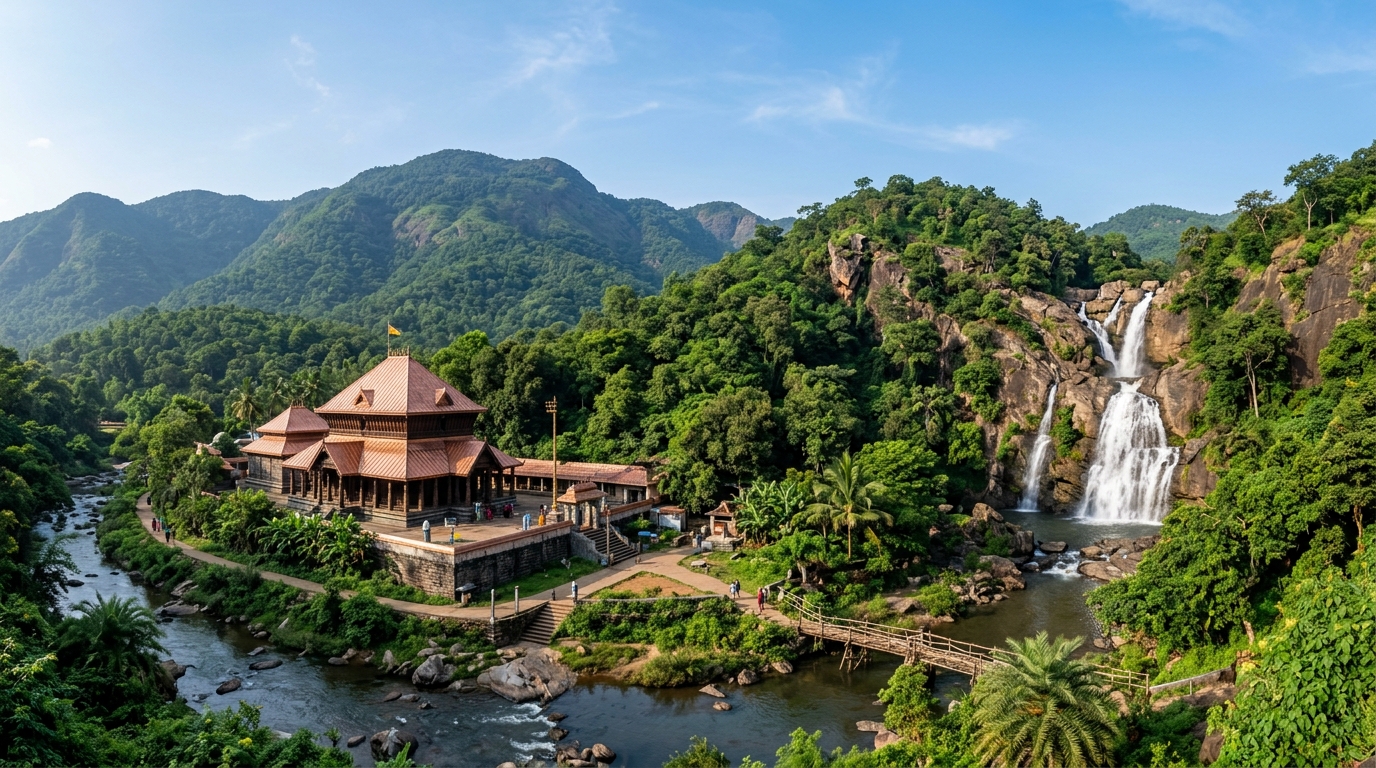
Courtallam Arulmigu Kutralanathar Temple and the nearby Chitra Sabha (Painted Hall) form a unique sanctuary of nature, spirituality, and classical art nestled at the foothills of the Podhigai Hills in Tenkasi district. Sanctified as the Chitra Sabha among Shiva's five cosmic dance halls, Courtallam is renowned for the divine legend of Sage Agastya balancing the Earth and transforming a Vishnu idol into a Shiva Lingam.

The destination is famous worldwide for the Chitra Sabha, an exquisite wooden chariot-shaped hall whose walls are painted with 17th-century herbal and mineral frescoes depicting the Tripura Samhara dance and 64 Thiruvilaiyadals. Situated adjacent to the famous Courtallam waterfalls (Peraruvi), where water cascades over thousands of medicinal herbs, the temple destination offers a rare synthesis of healing nature and sacred heritage.

Sthala Puranam & Authentic Legends

The divine origin of Courtallam is tied to the cosmic wedding of Lord Shiva and Goddess Parvati at Mount Kailash. To witness this supreme event, all gods, rishis, nagas, and celestial beings assembled in the Northern Himalayas. The unprecedented concentration of weight caused the northern hemisphere of Earth to sink downwards, tilting the entire planet and threatening global cataclysm.

Lord Shiva commanded Sage Agastya to travel south to the Podhigai Hills in the Western Ghats, reassuring him that his singular spiritual weight would rebalance the Earth. Agastya expressed deep sorrow that he would be deprived of witnessing the divine wedding. Lord Shiva granted him a boon: "Go to Courtallam. By converting the existing shrine there into a Shaivite temple, you will behold My divine marriage vision (Kalyana Darshan) whenever you pray."

Transformation of Vishnu Idol into Shiva Lingam

When Sage Agastya reached Courtallam, the temple was dedicated to Lord Vishnu (Chakraperumal) and guarded strictly by Vaishnavite priests. Seeing Agastya wearing rudraksha beads and holy ash (Vibhuti), the priests barred his entry. Using his yogic powers, Agastya transformed himself into a Vaishnavite devotee with Thiruman marks, entered the inner sanctum, and approached the main idol. Placing his hands upon the head of the Vishnu idol, Agastya chanted sacred Shaivite mantras and pressed the idol downwards. Miraculously, the idol shrank and transformed into a self-manifested Shiva Lingam (Kutralanathar). The physical impressions of Sage Agastya's fingers remain permanently embedded on the top of the Kutralanathar Lingam to this day.

Chitra Sabha (The Hall of Frescoes & Tripura Samhara Dance)

Located 500 meters from the main temple complex, the Chitra Sabha (Painted Hall) represents the cosmic elemental element of Painting/Art (Chitra) among Shiva's five dance halls. Constructed as a wooden hall shaped like a sacred temple chariot, its interior walls are decorated with stunning 17th-century herbal and mineral frescoes.

Lord Shiva performed His Tripura Samhara Tandava (Cosmic Dance of Destroying the Three Demon Cities) here. Uniquely, the Chitra Sabha does not contain a stone or bronze idol of Nataraja; instead, worship is offered directly to the magnificent wall fresco painting of Lord Nataraja and Sivakamasundari.

Classical Literary Canon & Sacred Hymns

Saint Thirugnanasambandar and Saint Thirunavukkarasar (Appar) composed soulful Tevaram hymns praising Lord Kutralanathar.

Saint Thirukoodarasappa Kavirayar composed the famous Tamil literary classic Kutrala Kuravanji, celebrating the natural beauty, waterfalls, and divine legends of Courtallam.

Epigraphical & Historical Events

Madurai Nayaka inscriptions document the commissioning of the 17th-century herbal wall frescoes inside the wooden Chitra Sabha.

Epigraphical records of Pandya King Parakrama Pandya record land grants for the daily maintenance of the Kutralanathar Temple and the waterfall bathing ghats.

Archaeo-Engineering & Scientific Marvels

Ancient metallurgical marvels, Siddha alchemical sciences, archaeo-engineering, and GI-tagged heritage:

  • 17th-Century Herbal Wall Frescoes: Intricate mural paintings created using natural vegetable dyes and mineral pigments depicting 64 Thiruvilaiyadals, Ramayana, and Mahabharata scenes.
  • Conch-Shaped Temple Layout: The main Kutralanathar Temple precinct is architecturally designed in the shape of a sacred Conch (Sankhu).
  • Medicinal Waterfalls: The temple is located next to Courtallam Main Falls, where water flows over thousands of medicinal herbs in the Podhigai Hills.

Signature Rituals, Anomalies & Special Sevas

Authentic daily pooja timelines, spatika-lingam darshan hours, special sevas, and sacred temple anomalies:

  • Thiruvaathirai Margazhi Festival: Grand ritual worship conducted inside the wooden Chitra Sabha.
  • Chitra Sabha Herbal Abhishekam: Special ritual paste applied to the wall murals during major festivals to preserve the ancient pigments.

What to See in the Temple (Visual Highlights)

🛕

Chitra Sabha Pavilion

Wooden chariot-shaped hall adorned with 17th-century mural art.

🛕

Kutralanathar Sanctum

Lingam bearing Sage Agastya's finger impressions.

🛕

Courtallam Main Falls (Peraruvi)

Majestic waterfall adjacent to the temple premises.

🛕

Shenbaga Devi Temple

Upstream forest shrine surrounded by wild champak flowers.

Practical Visitor Logistics & Dress Code

Temple Opening Timings & Daily Hours

Morning: 6:00 AM – 12:00 PM; Evening: 4:30 PM – 8:30 PM

Darshan & Special Entry Tickets

Free Darshan; Chitra Sabha Entry: ₹10 / ₹20

Dress Code & Special Rules

Traditional attire; No wet clothes allowed inside sanctum

Accessibility & Senior Citizens

Basic ramp access available

Car Parking & Footwear Cloakroom

Large parking lot near Main Falls & Chitra Sabha Road

Best Time to Visit & Festival Calendar

Seasonal weather guide, peaceful darshan timings, and annual Brahmotsavam festival dates:

  • Best Months: June to September (Waterfall Season) & October to March
  • Major Festivals: Margazhi Thiruvaathirai (December–January), Saral Vizha Waterfall Festival (July–August)

Transit, Accommodations & Prasadam Dining

How to Reach & Connectivity

• Nearest Railway Station: Tenkasi Junction (TSI) - 6 km • Nearest Airport: Tuticorin Airport (TCR) - 85 km / Trivandrum International Airport (TRV) - 100 km • Last-Mile Local Transport: Frequent town buses, auto-rickshaws, and private taxis available from Tenkasi Junction

Free Annadhanam & Local Veg Dining

  • Temple Prasadam: Puliyodarai, Sundal
  • Regional Specialties: Border Rahmath Parotta Shop (Tenkasi), local herbal tea stalls

Accommodations & Lodging Hubs

  • TTDC Hotel Tamil Nadu Courtallam, Mount Zion Resort, local lodges near Main Falls

Nearby Heritage Spots (5–30 km Radius)

Combine your yatra with surrounding UNESCO heritage sites, Paadal Petra Sthalams & Divya Desams:

Tenkasi Kasi Viswanathar Temple

6 km
Majestic 180

ft Rajagopuram temple built by Parakrama Pandya

Five Falls (Aintharuvi)

4 km
Famous 5

branch waterfall spot

Thirumalai Kovil Murugan Temple

15 km
Sacred & Heritage Spot

Hilltop shrine of Lord Murugan in Panpoli

Verified References & Source Bibliography

  • Kutrala Kuravanji by Thirukoodarasappa Kavirayar
  • ASI South India Circle - Frescoes of Chitra Sabha Courtallam
  • HR&CE Courtallam Devasthanam Archives

Community Photo Gallery (1)

Pilgrim Reflections (0)

No reflections logged for this destination yet.