
Arulmigu Dhandayuthapani Swamy Temple in Palani is the 3rd Sacred Abode (Tritiya Arupadai Veedu) of Lord Murugan, perched atop the 483ft monolithic granite Sivagiri Hill. Lord Murugan assumed the form of an ascetic youth (Dhandayuthapani) clad in a loincloth holding a wooden staff (Dhandam), renouncing worldly riches after His brother Ganesha received the divine Fruit of Wisdom (Gnana Pazham). The presiding deity is crafted from sacred Navapashanam (9 lethal mineral poisons alchemized into a medicinal matrix) by Siddhar Bogar and is renowned worldwide for divine healing.
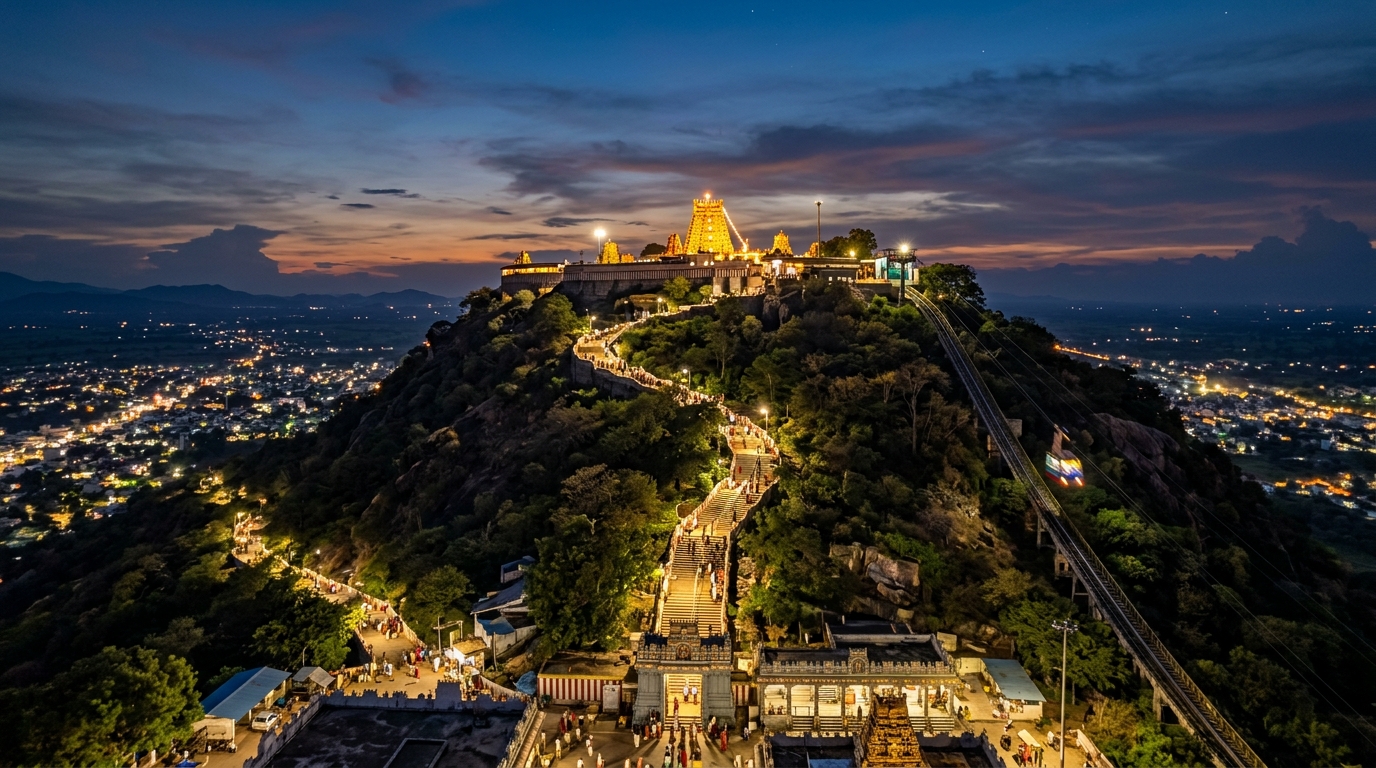
Arupadai Veedu
Arulmigu Dhandayuthapani Swamy Temple, Palani
அருள்மிகு தண்டாயுதபாணி சுவாமி திருக்கோயில்
Lord Dhandayuthapani Swamy (Lord Murugan / Kartikeya in his ascetical, renunciate form as an Andi / Yogi holding a wooden staff) • Dindigul District, Palani Hills, Kongu Nadu
About the Sacred Destination
Presiding Deity
Lord Dhandayuthapani Swamy (Lord Murugan / Kartikeya in his ascetical, renunciate form as an Andi / Yogi holding a wooden staff)
Consort & Sub-Shrines
None inside main hill Garbhagriha (Worshipped as a celibate renunciate wearing a loincloth / Kaupinam; Goddess Valli and Goddess Deivanai are enshrined in separate sub-shrines within the complex and at the foothill Thiru Avinankudi temple)
Foothill Shrines (Keezh Koil)
Keezh Koil: Thiru Avinankudi Temple (Lord Murugan as Child Velayuthaswamy with Goddesses Valli and Deivanai), Periya Nayaki Amman Temple (Town Temple / Kailasanathar), and Idumban Malai Shrine
Era & Dynasty
Early Chola & Chera foundations (traditionally attributed to King Cheraman Perumal, c. 8th Century CE); substantially expanded under the Pandya Dynasty (notably King Sadayavarman Parakrama Pandya and King Jatavarman Sundara Pandya, 13th–14th Century CE); outer mandapams and gopurams expanded by the Nayaks of Madurai (notably King Thirumalai Nayak, 17th Century CE).
Sacred Status & Classification
Arupadai Veedu #3 (Third Sacred Abode of Lord Murugan / Tritiya Arupadai Veedu) | Sangam Literature Site (Referred to as Pothini / Thiru Avinankudi in Tirumurugatrupadai) | Administered Special Grade Temple under the HR&CE Department, Government of Tamil Nadu
Sthala Puranam & Authentic Legends
• The Legend of Kavadi & Asura Idumban: Sage Agastya instructed his disciple, the demon Idumban, to transport two sacred hills—Sivagiri and Sakthigiri—from the Himalayas to the South. Idumban attached the hills to the ends of a wooden pole (Kavadi) using serpent ropes and carried them on his shoulders. Upon reaching Palani, Idumban placed the hills down to rest. When he attempted to lift them again, Sivagiri would not budge because child Murugan stood atop the hill posing as a traveler. A duel ensued until Idumban recognized Murugan's divinity and surrendered. Murugan decreed that anyone carrying a Kavadi to Palani in humility would receive divine blessings.
• The Legend of Pazham-Nee ('Thou Art the Fruit'): When Parvati and Shiva consoled the infuriated young Murugan at Sivagiri hill, they told him: "Pazham Nee" ("Thou art thyself the Fruit of Wisdom"). The divine words merged to form the name 'Palani'.
Classical Literary Canon & Sacred Hymns
• Sangam Literature (Tirumurugatrupadai): Nakkirar's Sangam poem celebrating Thiru Avinankudi / Pothini. • Thiruppugazh: 95+ ecstatic decads by Arunagirinathar dedicated to Palani Dhandayuthapani. • Bogar 7000 (Saptha Kaandam): Siddha medical treatise by Master Bogar describing Navapashanam alchemy. • Palani Pillai Tamil & Kandha Puranam.
Epigraphical & Historical Events
Divine Origin Legend (Sthala Puranam)
The Legend of Gnana Pazham (The Fruit of Wisdom): Sage Narada brought a divine golden mango (Gnana Pazham) to Mount Kailash and offered it to Lord Shiva and Goddess Parvati. Narada stipulated that the fruit could not be cut and must be consumed whole by the most deserving son. Lord Shiva announced a contest: whoever circumambulated the universe first would win the fruit. Lord Murugan immediately mounted his celestial Peacock vehicle and sped across the cosmos. Lord Ganesha, possessing supreme wisdom, circumambulated his divine parents Shiva and Parvati, declaring that his parents constituted the entire cosmos, and received the fruit. Returning from his cosmic journey and realizing he had lost the fruit, young Murugan was infuriated. Renouncing all celestial ornaments, garments, and worldly possessions, he clad himself in a simple loincloth (Kaupinam), took up a wooden staff (Dhandam), and descended to the hill of Palani (Sivagiri) to meditate as an ascetic hermit (Andi).
Siddhar Bogar & Navapashanam Idol Creation Master Siddhar Bogar (Bhoganathar), one of the 18 premier Siddhars of Tamil Siddha medicine, crafted the sacred idol of Lord Dhandayuthapani atop Sivagiri hill over 5,000 years ago. Utilizing the advanced science of Rasavatham (Siddha alchemy), Bogar isolated 9 deadly mineral and heavy metal poisons (Navapashanam) and subjected them to 84 herbal extractions (Mooligai Saaru) and calcination cycles (Putam), forming an insoluble, non-reactive bio-ceramic matrix. Bogar subsequently established his subterranean Jeeva Samadhi cave beneath the inner precinct of the temple.
Literary & Historical Associations • Sangam Literature (Tirumurugatrupadai): Sangam poet Nakkirar praises the foothill shrine Thiru Avinankudi (Pothini) as the 3rd abode of Murugan. • Devotional Hymns (Thiruppugazh): Saint Arunagirinathar composed over 95 rhythmic Thiruppugazh decads celebrating Palani Murugan's healing grace. • Royal Dynasties: Patronized by Cheraman Perumal (8th CE), Parakrama Pandya (14th CE), and Thirumalai Nayak of Madurai (17th CE).
Archaeo-Engineering & Scientific Marvels
Ancient metallurgical marvels, Siddha alchemical sciences, archaeo-engineering, and GI-tagged heritage:
Siddhar Bogar's Navapashanam Alchemical Matrix & GI-Tagged Panchamirtham (GI Tag #354)
🌿
9 Poisons (Navapashanam)
Veeram, Pooram, Quicksilver, Cinnabar
➔
Veeram, Pooram, Quicksilver, Cinnabar
🧪
84 Botanical Juices
Rasavatham & Calcination
➔
Rasavatham & Calcination
🛡️
Bio-Ceramic Icon
5,000-Yr Impervious Matrix
➔
5,000-Yr Impervious Matrix
🏺
GI Panchamirtham
Virupakshi Banana & Honey
Virupakshi Banana & Honey
The Alchemy of Navapashanam Chemistry & Bogar's Medicine • 9-Poison Bio-Ceramic Matrix: Presiding icon crafted by Siddhar Bogar using 9 lethal poisons (Veeram, Pooram, Rasam, Jathilingam, Kandhakam, Gauri Pasanam, Vellai Pasanam, Mriddharsingh, Silasat) processed through 84 botanical juices into an insoluble nano-composite ceramic that resists chemical corrosion and water erosion. • Pharmacological Abhishekam Cure: Sandalwood paste (Rakkala Sandhanam) applied overnight acts as an ion exchanger. Morning milk abhishekam absorbs non-toxic colloidal trace minerals that prevent curdling and exhibit antimicrobial, immunomodulatory properties. • Forensic Verification (2004 Consecration Probe): IIT Madras metallurgical analysis verified that modern 2004 Panchaloha replacement idol corroded within months, while Bogar's 5,000-year-old Navapashanam icon remains impervious. • Funicular Winch & Rope Car Engineering: Palani features India's premier funicular rail winch system (installed 1966) and high-capacity mono-cable Ropeway transporting 15,000+ pilgrims daily to the 483ft summit. • GI-Tagged Palani Panchamirtham (GI Tag #354): First South Indian temple prasadam granted Geographical Indication status in 2019.
Signature Rituals, Anomalies & Special Sevas
Authentic daily pooja timelines, spatika-lingam darshan hours, special sevas, and sacred temple anomalies:
• Viswaroopa Darshan (5:40 AM): First morning opening & Rakkala Sandhanam distribution. • Vila Pooja (6:50 AM) & Sirukalasanthi (8:00 AM) • Kalasandhi (9:00 AM): Morning main worship and milk abhishekam. • Uchikalam (12:00 PM): Noon grand pooja and sandalwood alangaram. • Sayaratchai (5:30 PM): Evening royal attire worship. • Rakkalam / Palliyarai (8:00 PM): Final night pooja, Chandana Kaappu application, and divine procession.
• Navapashanam Rakkala Sandhanam Prasadam: Sacred nocturnal sandalwood paste scraped during 5:40 AM Viswaroopa Darshan. • Thanga Ratham (Golden Chariot Procession): Daily evening procession around the hilltop circuit (Ticket ₹2,000). • Head Tonsuring (Mottai): Millions of devotees surrender their hair at foothill tonsuring halls as an act of ego-relinquishment. • Kavadi Offering: Walking hundreds of kilometers carrying decorated arches (Alangara Kavadi, Paal Kavadi, Macha Kavadi).
What to See in the Temple (Visual Highlights)
🛕
Sanctum & Navapashanam Idol (Garbhagriha)
Main Deity: Lord Dhandayuthapani Swamy. Height & Material: Monolithic 5,000-year-old icon crafted by Siddhar Bogar from Navapashanam (9 lethal mineral poisons alchemized into a vitrified bio-ceramic matrix). Depicted as a celibate renunciate youth wearing a loincloth (Kaupinam) holding a wooden staff (Dhandam) in his right hand. The sanctum faces West.
🧘
Subterranean Bogar Samadhi Cave
Located in the southwestern inner circumambulatory corridor (Praharam) of the hilltop temple. Houses an emerald lingam (Maragatha Lingam) and Sri Chakra Yantra personally consecrated by Siddhar Bogar, with an ancient tunnel connecting to the main pedestal.
👑
Gold-Plated Vimanam Roof
The elevated central garbharagriha tower is crowned by a magnificent solid gold-plated Vimanam roof visible across the Palani valley.
🏛️
Thiru Avinankudi Foothill Temple
The ancient Sangam foothill shrine (Pothini) where Lord Murugan is worshipped as Velayuthaswamy accompanied by Goddesses Valli and Deivanai.
🚠
Funicular Winch & Cable Ropeway Systems
3 Funicular Winch rail lines (operating since 1966) and 2 mono-cable Ropeway systems transporting over 15,000 pilgrims daily to the 483ft Sivagiri summit.
Practical Visitor Logistics & Dress Code
Temple Opening Timings & Daily Hours
Morning Session Hours: 5:40 AM – 12:00 PM | Evening Session Hours: 4:00 PM – 8:30 PM | Key Pooja / Aarti Timings: 5:40 AM (Vishvarupa Darshan), 6:50 AM (Vila Pooja), 8:00 AM (Sirukalasanthi), 9:00 AM (Kalasandhi), 12:00 PM (Uchikalam), 5:30 PM (Sayaratchai), 8:00 PM (Rakkalam / Palliyarai).
Darshan & Special Entry Tickets
• Free Darshan Line: Standard entry queue (Wait time: 1–4 hours depending on crowd).
• Express Entry Ticket: ₹10 / ₹100 / ₹200 express queue tickets.
• Funicular Winch Ticket: ₹10 (General) / ₹50 (Express Way).
• Rope Car Ticket: ₹15 (General) / ₹50 (Express Way).
• Thanga Ratham (Golden Chariot): ₹2,000 per family/party.
Dress Code & Special Rules
• Mandatory Attire: Men must wear Dhoti (Vesti) with shirt or upper cloth, or formal trousers. Women must wear Saree, Half-saree, or Churidar/Salwar Kameez with Dupatta.
• Prohibited Attire: Jeans, shorts, bermudas, lungis, sleeveless tops, and tight western wear are strictly prohibited.
• Non-Hindu Visitors: Allowed up to inner praharam; main garbharagriha entry governed by customary HR&CE Agama norms.
• Cameras: Strictly prohibited inside hill sanctum.
Accessibility & Senior Citizens
• Funicular Winch & Ropeway: 3 Funicular Winch tracks and 2 Mono-cable Ropeway systems provide step-free transit for elderly and disabled pilgrims to the 483ft hilltop.
• Step Access: 693 well-lit carved granite steps with shaded pavilions and water stations.
• Wheelchairs: Available at winch base station and hilltop administrative office.
Car Parking & Footwear Cloakroom
Multi-acre vehicle parking lots located near Giri Veedhi entry checkpoints and Palani Central Bus Stand (Capacity: 800+ cars & buses). Vehicles are strictly restricted inside inner Giri Veedhi street during peak festival hours.
Best Time to Visit & Festival Calendar
Seasonal weather guide, peaceful darshan timings, and annual Brahmotsavam festival dates:
• Thaipusam (Jan–Feb): 10-day world-famous mega festival drawing over 3 million pilgrims walking barefoot (Pada Yatra) from across South India carrying Kavadis. • Panguni Uthiram (Mar–Apr): 10-day spring festival celebrating divine celestial weddings and chariot processions (Therotam). • Vaikasi Visakam (May–Jun) & Kandha Sashti (Oct–Nov): Depicting Soorasamharam victory over demon Soorapadman. • Agni Nakshatram (May) & Monthly Karthigai Star Days.
Transit, Accommodations & Prasadam Dining
How to Reach & Connectivity
• Nearest Railway Station: Palani Railway Station (PLNI) — ~2 km from the foothill winch/ropeway station (direct trains to Madurai, Coimbatore, Chennai, and Pollachi). • Nearest Airport: Coimbatore International Airport (CJB) — ~100 km (~2.5 hours drive) | Madurai Airport (IXM) — ~115 km (~2.5 hours drive). • Local Transit: Town buses run continuously between Palani Bus Stand and Giri Veedhi foothill. Auto-rickshaws and taxis operate 24/7.
Free Annadhanam & Local Veg Dining
• Temple Prasadam & Free Annadhanam: GI-Tagged Palani Panchamirtham stalls near Winch station and hilltop. • Free Annadhanam: Daily free lunch served to 1,000+ devotees under TN HR&CE Annadhanam scheme in the foothill hall at 12:15 PM.
Accommodations & Lodging Hubs
• Palani Devasthanam Pilgrim Cottages: HR&CE manages hundreds of affordable guest rooms and chaultries at the foothill and Giri Veedhi (Bookable online via hrce.tn.gov.in or temple office). • TTDC Hotel Tamil Nadu Palani: State tourism hotel located ~1 km from hill base with A/C rooms and parking. • Private Family Hotels: Hotel Ganpat (0.5 km from Winch), Hotel Eden Park (0.8 km), Hotel Subam, and V.V. Grand.
Nearby Heritage Spots (5–30 km Radius)
Combine your yatra with surrounding UNESCO heritage sites, Paadal Petra Sthalams & Divya Desams:
Thiru Avinankudi Temple (Arulmigu Kulandhai Velayuthaswamy Temple)
~1 km (Foothill, Giri Veedhi)Ancient Cave/Hillfoot Temple (Part of 3rd Arupadai Veedu)
The original Thiru Avinankudi shrine celebrated in Sangam literature (Tirumurugatrupadai). Presided over by Lord Murugan as a divine child (Kulandhai Velayuthaswamy) seated on a peacock, flanked by Lakshmi, Saraswati, Bhumi Devi, Agni, and Indra.
Periya Nayaki Amman Temple (Kothaimangalam / Town Temple)
~2 km (Palani Town center)Historic Dravidian Temple Complex (Chola/Nayaka Era)
Known locally as the Oor-Kovil (Town Temple), dedicated to Goddess Periya Nayaki (Parvati) and Lord Kailasanathar. Houses massive multi-tiered gopurams and serves as the primary site for temple flag-hoisting (Dhwajarohanam) and car festivals (Rathotsavam).
Idumban Hill & Temple (Idumban Malai)
~2 km East of Palani HillSacred Hillock & Sub-Shrine
The physical hillock carried by Asura Idumban according to the Sthala Puranam. Features a summit shrine dedicated to Idumban and Kadamba Subrahmanyar where pilgrims offer prayers before carrying their Kavadi.
Periya Avudaiyar Temple (Arulmigu Periya Avudaiyar Kovil)
~5 km from PalaniAncient Riverside Heritage Temple (Chola/Pandya Era)
Situated on the banks of the Shanmuga Nathi, dedicated to Lord Shiva as Periya Avudaiyar (Brihadeeswarar). Celebrated for its 13th-century stone reliefs, quiet natural setting, and architectural layout.
Varathamanathi Dam & Forest Reserve
~7 km from PalaniScenic Water Reservoir & Eco-Tourism Spot
A dam constructed across the Varathamanathi River at the foothills of the Western Ghats (Palani Hills range), surrounded by reserve forests and nature trails.
Verified References & Source Bibliography
Official / Government Sources: • HR&CE Official Portal: hrce.tn.gov.in • Archaeological Survey of India (ASI) - Southern Circle Documentation: asi.nic.in • Geographical Indications Registry, Govt of India (GI Tag #354 - Palani Panchamirtham): ipindia.gov.in
Literature & Epigraphical Records: • Tirumurugatrupadai by Nakkirar (Sangam Literature decad on Thiru Avinankudi / Pothini) • Thiruppugazh by Arunagirinathar (95+ decads on Palani Dhandayuthapani) • Bogar 7000 (Saptha Kaandam by Siddhar Bogar) • South Indian Inscriptions (SII), Archaeological Survey of India
Web References & Research Papers: • IIT Madras Metallurgical Analysis Report (2004 Consecration Probe on Navapashanam vs Panchaloha) • Nilakanta Sastri, K.A., The Pandyan Kingdom, Swathi Publications
Featured Research Articles & Reports

Sathish Kumar A L
2026-09-22 • Article
Palani Murugan Temple & Thiruchandur
While travelling to **Palani and Thiruchendur Murugan Temple**, I was blessed to witness a beautiful sight — **peacocks flying freely** along the way. 🦚✨
Their graceful flight and the **wonderful, melodious sound of the peacocks** made the journey even more special. It felt li...
Read Full Article in Community
Dr. Arumuga Sthapathi (Siddha Alchemy & Temple Heritage)
2026-08-19 • Article
The Alchemy of Immortality: The Science, Chemistry & Mystery of Bogar’s 9-Poison (Navapashanam) Deity at Palani
Perched 483 feet high upon the monolithic granite summit of Sivagiri hill in Palani stands an icon that defies the foundational laws of both modern metallurgy and toxicology: the sacred Bala Dhandayuthapani Swamy.
While conventional Hindu temple deities are sculpted from hard g...
Read Full Article in Community
Community Photo Gallery (0)
No community photos uploaded yet.
Pilgrim Reflections (0)
No reflections logged for this destination yet.