
- Spiritual & Architectural Overview: Arulmigu Jambukeswarar Temple is a magnificent 18-acre temple complex located on Srirangam Island between the Kaveri and Coleroon rivers. As the Water Element (Appu Sthalam) among the Pancha Bhoota Sthalams, the primary Swayambhu Lingam is located in a low subterranean Garbhagriha where a natural underground spring continuously bubbles up around the Lingam. The temple features five monumental concentric walls (Prakarams), seven towering Gopurams, and the famous 7-foot tall Vibhooti Prakaram wall built by Lord Shiva himself in the guise of a stone mason.
- Sacred Geography & Setting: Nestled in the lush river island of Thiruvanaikaval (Thiruvanaikoil), just 2 km east of the Srirangam Ranganathaswamy Temple.
- Core Spiritual Identity: The sacred site where Goddess Akhilandeshwari performed penance under a Jambu (Jamun) tree by fashioning a Lingam out of Kaveri river water. Every day during the noon Uchikalam Pooja, the head priest dresses in a saree representing Goddess Akhilandeshwari and performs Abhishekam to Lord Jambukeswarar.
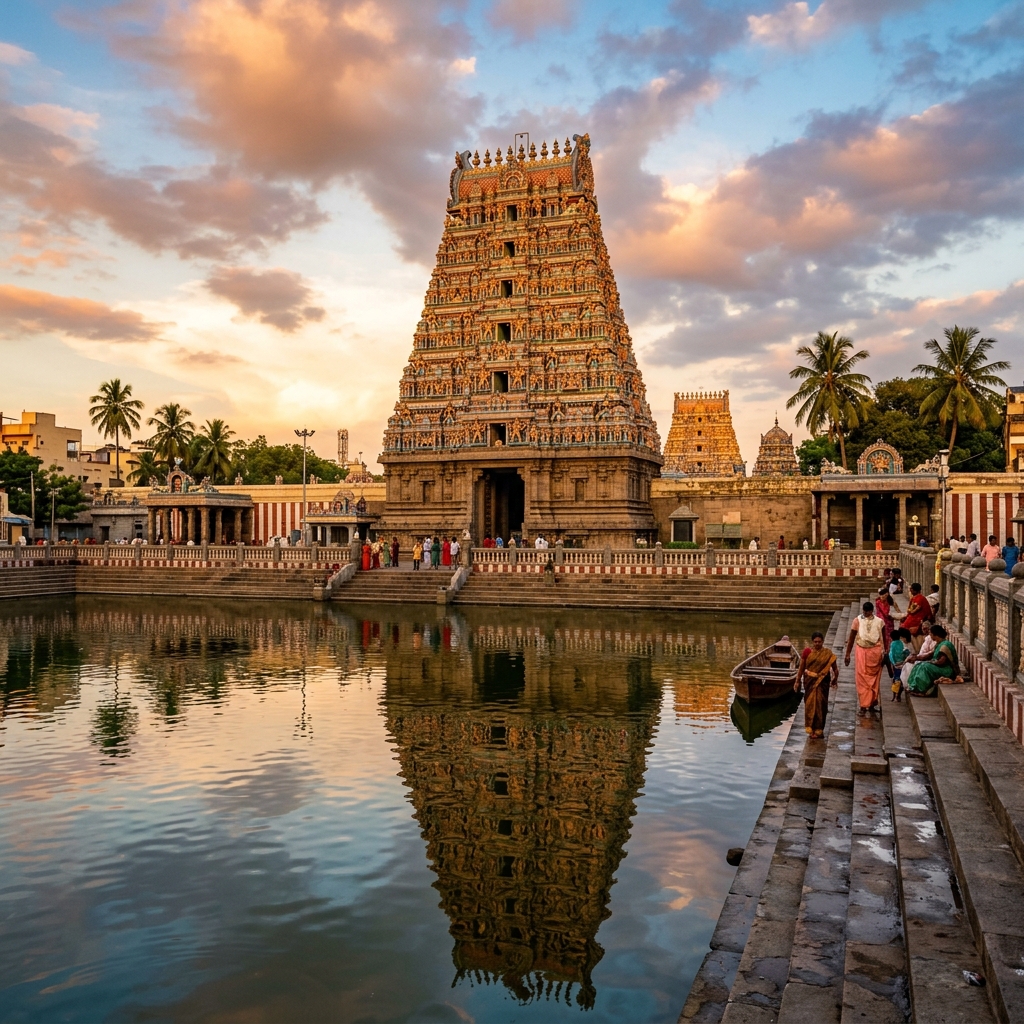
Pancha Bhoota Sthalams
Jambukeswarar Temple, Thiruvanaikaval (Appu Sthalam)
Lord Jambukeswarar (Swayambhu Appu Lingam submerged in a subterranean water spring) • Tiruchirappalli, Chola Nadu
About the Sacred Destination
Presiding Deity
Lord Jambukeswarar (Swayambhu Appu Lingam submerged in a subterranean water spring)
Consort & Sub-Shrines
Lord Jambukeswarar (Swayambhu Appu Lingam submerged in a subterranean water spring) & Goddess Akhilandeshwari ("Ruler of the Universe")
Era & Dynasty
Early Chola foundations by King Kochenganan (3rd Century BCE / 2nd Century CE); monumental expansion by Rajaraja Chola I, Rajendra Chola I, and Sundara Pandya (13th Century CE).
Sacred Status & Classification
Appu Sthalam (Water Element) among the 5 Sacred Pancha Bhoota Sthalams; Paadal Petra Sthalam (Chola Nadu Vadakarai Shrine #60); Sacred Srirangam Island Shrine.
Sthala Puranam & Authentic Legends
Divine Manifestation & Primary Origin Narrative (Sthala Puranam):
Legend narrates that Sage Jambu performed intense penance to Lord Shiva, presenting a Jamun (Jambu) fruit. Lord Shiva ate the fruit and spat out the seed, which sprouted into a sacred Jambu tree (Sthala Vriksham). Under this tree, an underground spring welled forth, and a water Lingam (Appu Lingam) manifested naturally.
Simultaneously, an Elephant (Aanai) and a Spider (Santhirasoodan) worshipped the Lingam daily. The spider meticulously wove webs over the Lingam to prevent dry leaves from falling onto it. The elephant brought fresh water from the Kaveri River in its trunk to perform Abhishekam, washing away the spider's web in the process. Thinking the elephant was desecrating its offering, the enraged spider crawled inside the elephant's trunk and bit it severely. The elephant crashed its trunk against the stone ground in agony, killing both itself and the spider.
Pleased by their intense devotion, Lord Shiva granted liberation to both. The spider was blessed to be reborn in its next life as the Chola King Kochenganan ("Red-Eyed Chola"). Remembering his past life conflict with the elephant, King Kochenganan constructed 70 Chola temples (Maadakoils) with elevated sanctums and narrow staircase entrances designed specifically so elephants could never enter the Garbhagriha.
Adi Shankara & Thadanga Pratishtha:
Goddess Akhilandeshwari originally manifested with extreme Ugra (fierce) energy. Sages and pilgrims feared approaching her shrine. Great philosopher Adi Shankara pacified her energy by installing two massive gold Sri Chakra ear ornaments (Thadanga) on the Goddess and consecrating a shrine for Lord Ganesha (Vigneswara) directly facing her.
Classical Literary Canon & Sacred Hymns
- Tevaram Hymns (7th–8th Century CE): Praised in 22 sacred Tevaram hymns by Saint Thirugnanasambandar, Saint Appar, and Saint Sundarar.
- Periya Puranam: Sekkizhar details the story of King Kochenganan Chola and the spider's devotion at Thiruvanaikaval.
Epigraphical & Historical Events
- Chola Inscriptions (10th–12th Century CE): More than 150 stone inscriptions document royal grants of fertile Kaveri delta paddy fields, lamp endowments, and gold donations by Parantaka Chola I, Rajaraja Chola I, and Kulothunga Chola I.
- Pandya Inscriptions (13th Century CE): Jatavarman Sundara Pandya I crowned himself at Thiruvanaikaval and built the massive outer walls (Vibhooti Prakaram).
Archaeo-Engineering & Scientific Marvels
Ancient metallurgical marvels, Siddha alchemical sciences, archaeo-engineering, and GI-tagged heritage:
- Hydro-Geological Anomaly: The inner Garbhagriha rests below the water table level of the surrounding Kaveri River delta; water continuously seeps into the sanctum pit even during severe droughts.
- 7-Foot Vibhooti Wall: The 3rd outer wall (Vibhooti Prakaram) measures 1 mile in circumference and 25 feet high. Inscriptions state workers were paid in sacred ash (Vibhooti) which turned into gold coins at sunset.
Signature Rituals, Anomalies & Special Sevas
Authentic daily pooja timelines, spatika-lingam darshan hours, special sevas, and sacred temple anomalies:
Signature Daily Rituals:
- Uchikalam Saree Pooja (12:00 PM): The chief Archaka dresses in traditional female saree attire, wearing gold ornaments representing Goddess Akhilandeshwari, and conducts the noon Abhishekam to Lord Jambukeswarar.
- Cow Worship (Go Pooja): Performed every morning in front of Goddess Akhilandeshwari's sanctum.
- Special Sevas: Thadanga Pooja, Navarathri Chandi Homa, and Aadi Pooram Utsavam.
What to See in the Temple (Visual Highlights)
🛕
Water Garbhagriha
Subterranean sanctum housing the Appu Lingam under the Jambu tree root structure.
🛕
Akhilandeshwari Shrine
Magnificent Shakthi sanctum featuring the Sri Chakra Thadanga ear studs.
🛕
Vibhooti Prakaram
Monumental 1-mile long outer stone wall.
🛕
Monolithic Pillar Halls
Carved stone pillars depicting King Kochenganan, Chola warriors, and Yali motifs.
Practical Visitor Logistics & Dress Code
Temple Opening Timings & Daily Hours
Open daily from 6:00 AM to 1:00 PM & 4:00 PM to 9:30 PM.
Darshan & Special Entry Tickets
Free General Line; Quick Darshan pass ₹50 per pilgrim.
Dress Code & Special Rules
Traditional Indian attire mandatory (Dhoti/Veshti for Men; Saree/Salwar Kameez for Women). Jeans and shorts barred.
Accessibility & Senior Citizens
Wheelchair ramps installed at East gate; short walking distance to sanctum.
Car Parking & Footwear Cloakroom
Dedicated Devasthanam parking lot at the East Rajagopuram entrance gate.
Best Time to Visit & Festival Calendar
Seasonal weather guide, peaceful darshan timings, and annual Brahmotsavam festival dates:
- Best Months / Season to Visit: October to March (pleasant climate, 22°C–30°C).
- Best Hours for Peaceful Darshan: 6:00 AM to 7:30 AM and 4:00 PM to 5:30 PM.
Major Festivals & Peak Days:
- Panguni Mandala Brahmotsavam (March/April): 48-day annual festival featuring the Gaja Samhara and Chariot procession.
- Aadi Pooram (July/August): Grand festival celebrating Goddess Akhilandeshwari.
Transit, Accommodations & Prasadam Dining
How to Reach & Connectivity
- Nearest Railway Station: Tiruchirappalli Town Station (1.5 km) / Tiruchirappalli Junction (TPJ - 8 km).
- Nearest Airport: Tiruchirappalli International Airport (TRZ - 14 km).
- Last-Mile Local Transport: Frequent local city buses (Route 1, 1A, 1B, 11) connecting Trichy Junction, Central Bus Stand, and Srirangam to Thiruvanaikaval.
Free Annadhanam & Local Veg Dining
- Temple Prasadam: Thiruvanaikaval Kovil Puliyodarai, Sarkarai Pongal, and Paal Payasam.
- Local Veg Dining: Sri Sangeethas Veg Restaurant (Thiruvanaikoil branch - 500m), Saravana Bhavan Srirangam, Vasantha Bhavan.
Accommodations & Lodging Hubs
- State Tourism Stays: Hotel Tamil Nadu (TTDC Trichy - 7 km).
- Private Hotels: Hotel Sangam Trichy (8 km), Breeze Residency (7.5 km), SRM Hotel Trichy (12 km), Femina Hotel (7 km).
Nearby Heritage Spots (5–30 km Radius)
Combine your yatra with surrounding UNESCO heritage sites, Paadal Petra Sthalams & Divya Desams:
Srirangam Ranganathaswamy Temple
156 acresSacred & Heritage Spot
2 km, Divya Desam #1, Largest functioning Hindu temple complex in the world with 21 Gopurams.
Rockfort Ucchi Pillayar Temple
5 km, 7th
century Pallava/Nayaka rock-cut cave temple atop a 273-foot ancient quartz rock.
Samayapuram Mariamman Temple
12 kmSacred & Heritage Spot
, Famous Sakthi shrine known for Poomichadithal flower festival.
Verified References & Source Bibliography
- South Indian Inscriptions, Vol. XXIV, Archaeological Survey of India (ASI).
- The Colas by K.A. Nilakanta Sastri, University of Madras.
- HR&CE Devasthanam Archives, Thiruvanaikaval Temple Official Registry.
Featured Research Articles & Reports
Venkatesh "Venkat" Iyer (THADAM Yatra Lab)
2026-08-29 • Article
The Unquenchable Spring of Thiruvanaikaval: The Subterranean Hydrology of the Appu Lingam, Sangam King Kochengannan's Elephant-Proof Mada Koils & Adi Shankara's Sri Chakra Earring Consecration
Step through the towering 7-tier eastern Rajagopuram of Thiruvanaikaval into the subterranean shadows of the innermost Garbhagriha, and the first sensation that strikes you is not the scent of camphor or the ring of temple bells—it is the primal sound and chill of subterranean wa...
Read Full Article in Community
Community Photo Gallery (0)
No community photos uploaded yet.
Pilgrim Reflections (0)
No reflections logged for this destination yet.