Explore Calendar Community THADAM+ My Thadam
Kanchipuram Arulmigu Kachi Neri Karaikadu Sathyanatheswarar Temple
Paadal Petra Sthalams

Kanchipuram Arulmigu Kachi Neri Karaikadu Sathyanatheswarar Temple

Kanchipuram-Kachi Neri Karaikadu - Sathyanatheswarar Shiva Temple

Sri Sathyanatheswarar / Karaithirunaatteeswarar (Swayambhu Lingam) • Kanchipuram, Thondai Nadu

Open in Maps My Thadam Check in

About the Sacred Destination

Presiding Deity
Sri Sathyanatheswarar / Karaithirunaatteeswarar (Swayambhu Lingam)
Consort & Sub-Shrines
Goddess Pramhavithambigai / Sathya Bhashini Ambal
Era & Dynasty
Pallava Dynasty (7th-8th C) & Chola Dynasty (Kulothunga I, 11th-12th C)
Sacred Status & Classification
Paadal Petra Sthalam (Thondai Nadu #5 / #268 of 276)

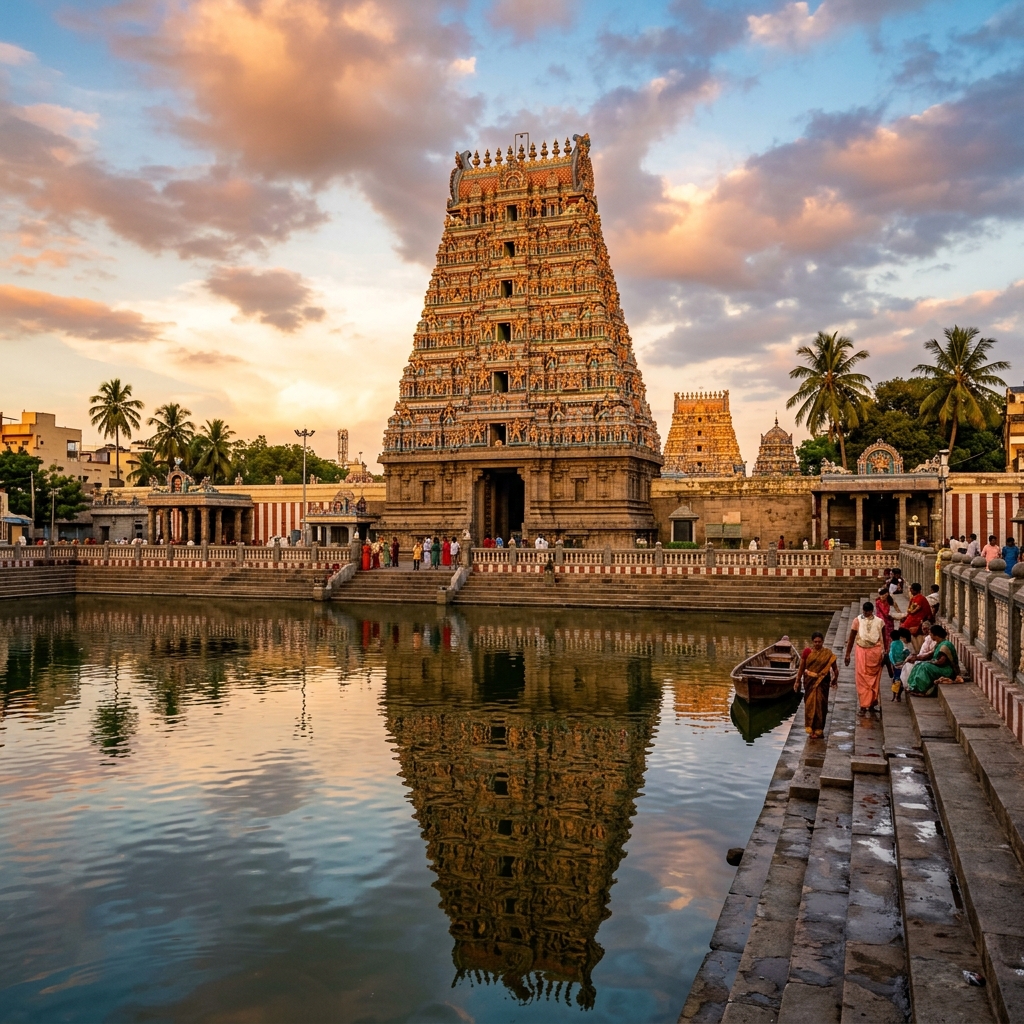
Kanchipuram Arulmigu Kachi Neri Karaikadu Sathyanatheswarar Temple is an ancient Paadal Petra Sthalam (Thondai Nadu Shrine #5) glorified in the 7th-century Tevaram hymns of Saint Thirugnanasambandar. Situated in Karaipettai near Orikkai on the southern side of Kanchipuram, the temple is surrounded by peaceful coconut groves and ancient Karai plants.

The temple complex features a 3-tiered gopuram, a spacious outer prakaram housing the sacred Indra Theertham (Sathya Theertham), a 16-pillared assembly hall, and an inner sanctum housing a self-manifested (Swayambhu) Shiva Lingam. The shrine is celebrated for Indra performing penance here to regain his truthfulness (Sathyam) and celestial kingdom, as well as Saint Sambandar's Tevaram decad extolling Lord Shiva as the supreme embodiment of Truth.

Sthala Puranam & Authentic Legends

Indra's Penance & Sathyanatheswarar Origin Legend

According to the Kanchi Puranam, Indra, the King of the Devas, once committed a spiritual lapse by acting deceptively, causing him to lose his celestial glory, peace of mind, and divine kingdom. Plagued by remorse, Indra sought counsel from Sage Vasishta, who advised him to travel to Kanchipuram and seek refuge under Lord Shiva in the dense Karai plant grove (Karai Kadu).

Indra arrived at Kanchipuram, dug a holy bathing tank—known today as Indra Theertham—and established a Shiva Lingam amidst the Karai bushes. He performed intense penance, offering bilva leaves and chanting the sacred Panchakshara Mantra. Lord Shiva appeared before Indra, cleansed him of all karmic blemishes, restored his truthfulness (Sathyam), and re-established him as the King of Swarga. Since Lord Shiva restored truth to Indra, He earned the divine name Sri Sathyanatheswarar ("The Lord of Truth") and Karaithirunaatteeswarar, and the Goddess was named Pramhavithambigai (Goddess of Truthful Wisdom) or Sathya Bhashini (Goddess of Truthful Speech).

Saint Thirugnanasambandar's Tevaram Miracle

During Saint Thirugnanasambandar's pilgrimage through Thondai Nadu in the 7th Century CE, he visited Kachi Neri Karaikadu and composed a 10-verse Tamil Tevaram decad starting with "Ezhaiyiddai" (ஏழையிடை).

Sambandar praised Lord Shiva as the eternal master who resides with Goddess Parvati in the Karai grove of Kanchipuram, destroying the ignorance and false speech of mortals.

Blessing of Truthful Speech & Legal Deliverance

According to local priest tradition, devotees who suffer from stammering, speech delays, or false accusations in legal disputes offer honey and bilva garlands to Goddess Sathya Bhashini and Lord Sathyanatheswarar. It is believed that praying at this shrine bestows clear, truthful, and victorious speech.

Classical Literary Canon & Sacred Hymns

Kachi Neri Karaikadu is enshrined in the 3rd Thirumurai of the Shaivite Tevaram canon composed by Saint Thirugnanasambandar.

> Tevaram Verse (Sambandar - 3rd Thirumurai, Decad 112, Verse 1): > "ஏழையிடை மடவாள் உடனாய் இசைந்து > வாழும் எழில் கச்சி நெறிக்காரைக் காடே > நாளும் அடியார் தொழுது ஏத்த அருள்செய்யும் > ஆளும் பசுபதியைத் தொழுவார்க்கு அஞ்சலன்றே."

Translation: "Oh Lord who resides gracefully with Goddess Parvati in Kachi Neri Karaikadu! Those who daily bow before Lord Pasupathi Sathyanatheswarar shall have all fear erased by His divine protection."

The temple's history is also documented in Sekkizhar's 12th-century Periya Puranam.

Epigraphical & Historical Events

  • Pallava & Chola Inscriptions (8th–12th Century CE): Stone inscriptions carved into the inner sanctum walls document royal endowments by Chola Kings Kulothunga Chola I (1070–1120 CE) and Rajaraja Chola III (1216–1246 CE).
  • Endowments: Charters record land grants in Karaipettai village for maintaining perpetual ghee lamps (Nanda Deepam) and funding the morning milk abhishekam.

Archaeo-Engineering & Scientific Marvels

Ancient metallurgical marvels, Siddha alchemical sciences, archaeo-engineering, and GI-tagged heritage:

  • Botanical Preservation of Karai Vriksham: The temple courtyard preserves specimens of the rare ancient Karai Maram (Canthium coromandelicum), known for its medicinal and air-purifying properties.
  • Indra Theertham Hydro-Geometry: A square stone step-well fed by natural underground aquifers linked to the Vegavathi river basin.

Signature Rituals, Anomalies & Special Sevas

Authentic daily pooja timelines, spatika-lingam darshan hours, special sevas, and sacred temple anomalies:

  • Sathya Bhashini Honey Archana: Special honey offering and lamp lighting performed on Tuesdays and Fridays to Goddess Sathya Bhashini for children with speech delays.
  • Pradosham Pooja: Holy milk, curd, honey, and sandalwood Abhishekam performed to Lord Sathyanatheswarar during Pradosham.

What to See in the Temple (Visual Highlights)

🛕

Main Sanctum (Sri Sathyanatheswarar)

Housing the self-manifested (Swayambhu) Lingam facing East.

🛕

Goddess Pramhavithambigai Shrine

Dedicated sanctum showcasing graceful Chola-style stone sculptures of Ambal.

🛕

Indra Theertham

Sacred temple water tank in front of the main Gopuram.

🛕

Karai Tree (Sthala Vriksham)

Sacred tree situated in the outer prakaram.

Practical Visitor Logistics & Dress Code

Temple Opening Timings & Daily Hours

Morning: 06:30 AM – 11:30 AM; Evening: 04:30 PM – 08:00 PM

Darshan & Special Entry Tickets

Free General Queue; Special Entry Ticket: ₹10

Dress Code & Special Rules

Traditional Indian attire required (Dhoti/Veshti for men; Saree/Salwar for women). Male upper cloth removal required in inner sanctum line.

Accessibility & Senior Citizens

Entire temple complex is at ground level with flat stone flooring, fully wheelchair accessible.

Car Parking & Footwear Cloakroom

Vehicle parking space available near the temple gate in Karaipettai. Footwear counter located near entrance.

Best Time to Visit & Festival Calendar

Seasonal weather guide, peaceful darshan timings, and annual Brahmotsavam festival dates:

  • Best Months: October to March (pleasant weather for Kanchipuram temple exploration).
  • Major Festivals:
  • Maha Shivaratri (February–March)
  • Margazhi Arudra Darshan (December–January)
  • Navarathri for Goddess Pramhavithambigai (September–October)

Transit, Accommodations & Prasadam Dining

How to Reach & Connectivity

  • Nearest Railway Station: Kanchipuram Railway Station (CJ/RDNG) (4 km)
  • Nearest Airport: Chennai International Airport (MAA) (65 km via NH48)
  • Last-Mile Local Transport: Auto-rickshaws and local town buses from Kanchipuram New Bus Stand (3 km) running to Karaipettai / Orikkai stop.

Free Annadhanam & Local Veg Dining

  • Temple Prasadam: Sakkarai Pongal, Puliyodarai & Honey Prasadam.
  • Nearby Dining: Sri Rama Cafe (3 km), Saravana Bhavan Kanchipuram (3 km).

Accommodations & Lodging Hubs

  • Hotel Tamil Nadu (TTDC Kanchipuram) - 3 km from temple.
  • GRT Regency Kanchipuram (4 km)
  • Hotel MM Legacy (4.5 km)

Nearby Heritage Spots (5–30 km Radius)

Combine your yatra with surrounding UNESCO heritage sites, Paadal Petra Sthalams & Divya Desams:

Kanchipuram Varadharaja Perumal Temple

2.5 km
Famous 23

acre Divya Desam temple.

Kanchipuram Ekambareswarar Temple

3.5 km
Sacred & Heritage Spot

Prithvi Sthalam / Paadal Petra Sthalam #1.

Kanchi Kamakshi Amman Temple

3 km
Sacred & Heritage Spot

Primary Shakti Peetham shrine of Kanchipuram.

Verified References & Source Bibliography

  • Tevaram 3rd Thirumurai by Saint Thirugnanasambandar.
  • Periya Puranam by Sekkizhar (Thirugnanasambanda Nayanar Puranam).
  • South Indian Inscriptions, Vol. III, Archaeological Survey of India (ASI).

Community Photo Gallery (0)

No community photos uploaded yet.

Pilgrim Reflections (0)

No reflections logged for this destination yet.