Explore Calendar Community THADAM+ My Thadam
Kapaleeshwarar Temple, Mylapore

Kapaleeshwarar Temple, Mylapore

Kapaleeshwarar (Shiva, Swayambhu Lingam facing West) & Karpagambal (Parvati, standing facing East) • Chennai, Thondai Nadu

Open in Maps My Thadam Check in

About the Sacred Destination

Presiding Deity
Kapaleeshwarar (Shiva, Swayambhu Lingam facing West) & Karpagambal (Parvati, standing facing East)

Arulmigu Kapaleeshwarar Temple (அருள்மிகு கபாலீஸ்வரர் திருக்கோயில்) is an ancient, highly revered Saivite temple located in Mylapore, Chennai, Tamil Nadu. It is celebrated as the 24th shrine in the Tondaimandalam cluster of the 274 sacred Shiva shrines canonicalized in the 7th-century Tevaram hymns (Paadal Petra Sthalam).

Lord Shiva is worshipped here as Kapaleeshwarar (manifested as a Swayambhu Lingam facing West), and his divine consort Goddess Parvati is worshipped as Karpagambal ("Goddess of the Wish-Yielding Tree", facing East).

Originally constructed directly on the Coromandel seashore during the 7th-century Pallava era, the temple underwent a historical coastal relocation in the 16th century CE under Vijayanagara and Nayaka patronage following colonial destruction by the Portuguese. Today, it stands as an enduring architectural monument of South Indian Dravidian heritage, renowned for its 135-foot East Rajagopuram, 5-acre temple tank (Kulam), and the world-famous Arupathumoovar festival.

THADAM YouTube Video Documentary

Subscribe on YouTube

Sthala Puranam & Authentic Legends

1. The Peacock Penance of Goddess Parvati (Mayil Penance): While Lord Shiva was imparting the supreme esoteric wisdom of the Panchakshara Mantra and Brahmavidya to Goddess Parvati, her attention was fleetingly captivated by a flock of dancing peacocks. Displeased by her lapse of focus, Shiva cursed her to be born on Earth as a peahen (Mayil). Parvati descended to the Punnai forest (Punnai Vanam) at Mylapore, installed a Shivalingam under a Punnai tree, and performed intense penance. Lord Shiva appeared, released her from the curse, and united with her. The settlement was named Mayilappur ('Town of Peacocks', Mylapore) and Goddess Parvati became Karpagambal ('Wish-Yielding Mother').

2. The Decapitation of Brahma's Fifth Head (Kapaleeshwarar): Creator Lord Brahma possessed five heads, mirroring Lord Shiva, which inflated his cosmic ego (Ahamkara). To sever Brahma's pride, Lord Shiva plucked off Brahma's fifth head with his fingernail. Brahma performed rigorous penance at Mylapore to expiate his pride. Lord Shiva pardoned him, restored his creator powers, and manifested here as Kapaleeshwarar ('Lord of the Skull / Kapalam').

3. The Miracle of Angam Poompavai (7th Century CE): Sivanesan Chettiar, a wealthy merchant of Mylapore, dedicated his daughter Poompavai to Saivite saint Thirugnanasambandar. Before the marriage could occur, Poompavai died of a cobra bite. Sivanesan cremated her body and preserved her ashes in an earthen urn (Kudam). When Sambandar arrived, he placed the urn outside Kapaleeshwarar Temple and sang the 11-stanza Poompavai Padikam ('Madditta Punnaiyang Kanal Madaye...'), asking how Poompavai could depart without witnessing Kapaleeshwarar's grand monthly festivals (Panguni Uthiram, Karthigai Deepam, Margaazhi Thiruvathirai). With each stanza, her body reconstituted, and on the 11th verse, Poompavai emerged alive from the urn in full maidenhood.

4. Vayilar Nayanar's Heart Temple (Manasika Puja): Mylapore is the birthplace of Vayilar Nayanar, one of the 63 Nayanmars. Lacking wealth to build a stone temple, Vayilar constructed an imperishable, luminous temple inside his heart with mindfulness as the sanctum, love as the lamp, and contemplation as the Abhishekam. Lord Kapaleeshwarar granted him divine liberation (Moksha).

Classical Literary Canon & Sacred Hymns

• Tevaram Canon (7th Century CE): Praised by Thirugnanasambandar (Poompavai Padikam: 'Mattitta Punnaiyan Kanal Madaye...') and Thirunavukkarasar (Appar) in 1st & 6th Thirumurai. Paadal Petra Sthalam #24 in Tondaimandalam. • Thiruppugazh (15th Century CE): Saint Arunagirinathar composed soul-stirring hymns for Lord Singaravelar (Murugan) enshrined within the temple. • Classical Sangam & Greco-Roman Literature: Mentioned in Sangam works (Ahananuru, Purananuru) and 2nd-century CE Ptolemy's Geography as 'Maliarpha'.

Epigraphical & Historical Events

Archaeo-historical research by eminent historians (including S.R. Balasubrahmanyam and K.A. Nilakanta Sastri) alongside Archaeological Survey of India (ASI) documentation confirms that the original 7th-century Pallava-era Kapaleeshwarar Temple was situated directly on the seashore near present-day San Thome Beach.

In the 16th century (c. 1522–1560 CE), Portuguese colonial forces demolished the coastal temple complex to construct the San Thome Fort and Cathedral Basilica. Inscriptions from the reign of Rajendra Chola I (11th century CE) and ancient Pallava carved pillars were discovered embedded in the foundations, paving stones, and surrounding walls of the San Thome Basilica during 19th and 20th-century excavations. Following the destruction, local chieftains and Vijayanagara feudatories salvaged key sacred icons and reconstructed the present temple ~300 meters inland at its current location, meticulously maintaining agamic spatial proportions.

Subsequent major renovations and stone embellishments were carried out by local merchant chieftains, including the Nattukottai Chettiars and Mudaliars, during the 19th and 20th centuries. Today, the temple is administered by the HR&CE Department of Tamil Nadu.

What to See in the Temple (Visual Highlights)

🛕

Lord Kapaleeshwarar Sanctum (Garbhagriha)

Houses a cylindrical, self-manifested granite Lingam (Swayambhu Lingam) mounted upon a circular Yoni Pitha. The sanctum faces West—a rare orientation in Saivite temples associated with the Anugraha (liberation-bestowing) aspect of Shiva.

🪜

Goddess Karpagambal Shrine

Dedicated south-facing shrine with an East-facing 1.5-meter black granite idol standing in serene Samabhanga posture. Her right hand displays Abhaya Mudra, her left holds Varada Mudra, and she is adorned with a golden coin necklace (Kasu Malai).

🐘

East Rajagopuram (135ft / 40m)

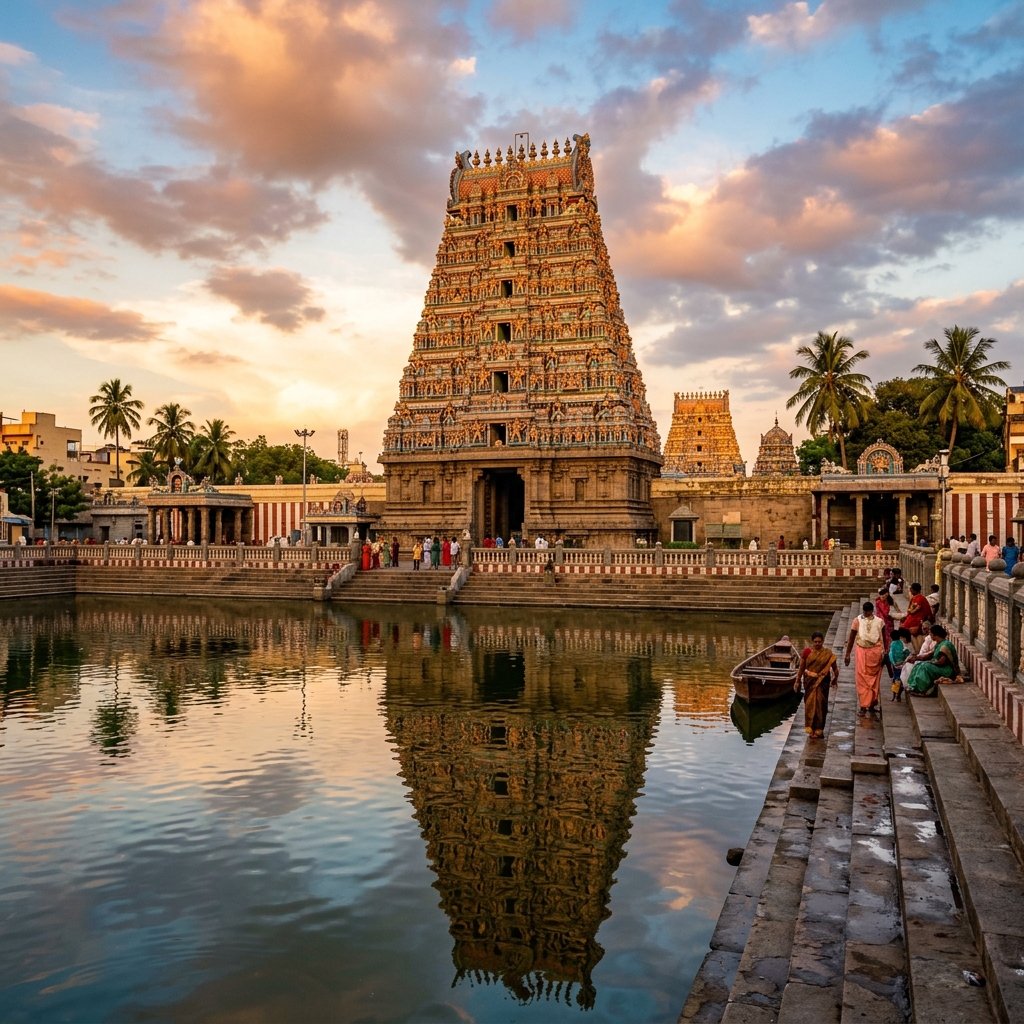
7-tiered Vijayanagara-Nayaka Dravidian tower dominating the Mylapore skyline. Adorned with hundreds of painted mortar sculptures (Sudhai) illustrating puranic episodes and the 63 Nayanmar miracles.

🏛️

West Gopuram

5-tiered gateway tower facing the 5-acre temple tank (Kulam), serving as the primary entrance for devotees arriving from the tank side.

👑

Navaratri & Kalyana Mandapams

Open pillar halls featuring stone pillars carved with high-relief figures of Yalis (mythical leonine beasts), rearing equestrian warriors, and intricate monolithic lotus ceiling medallions.

🌳

Bronze Gallery of 63 Nayanmar Saints

Dedicated outer Prakaram gallery housing a complete set of precision-cast bronze idols of all 63 Saivite Nayanmar saints alongside Saint Sundarar and Vayilar Nayanar.

✨

Lord Singaravelar Sub-Shrine

Revered Murugan shrine holding a bow, arrow, and Vel, seated on his peacock mount (Mayil), flanked by his consorts Valli and Deivayanai. Saint Arunagirinathar composed Thiruppugazh here.

✨

Kapaleeshwarar Teertham (Mylapore Kulam)

Spanning over 5 acres on the western perimeter, this stone-lined rectangular tank features flight steps on all four sides and a central 16-pillared Neerazhi Mandapam for the Float Festival.

✨

Sthala Vriksham (Sacred Punnai Tree)

Sacred Alexandrian Laurel tree (Calophyllum inophyllum) in the outer courtyard with an open-air stone sculpture at its base depicting Goddess Parvati as a peahen worshipping a Shivalingam.

✨

Monolithic Granite Kodungai Cornices

Outer eaves of inner mandapams feature double-curved stone cornices (Kodungai) carved from single granite blocks with drip-stones engineered to divert rainwater away from masonry.

Practical Visitor Logistics & Dress Code

Temple Opening Timings & Daily Hours

• Morning Session: 5:30 AM – 12:30 PM • Evening Session: 4:00 PM – 9:00 PM Key Daily Pooja & Aarti Schedule: • Ushathkala Puja: ~6:00 AM • Kala Santhi Puja: ~8:00 AM • Uchikala Puja: ~12:00 PM • Sayaratchai Puja: ~5:00 PM – 6:00 PM (High spiritual fervor & peak crowds) • Arthajama Puja: ~8:45 PM

Darshan & Special Entry Tickets

Free Darshan line available; Special Darshan tickets at counters.

Dress Code & Special Rules

Traditional Indian attire required (Dhoti/Shirt for Men, Saree/Salwar for Women). Male upper cloth removal rules apply where posted.

Car Parking & Footwear Cloakroom

• Direct Temple Parking: Extremely limited due to historic, narrow Mada Streets (North, South, East, and West Mada Streets). • Four-Wheeler Parking: Recommended paid parking lot at Luz MLCP (Multi-Level Car Parking) or Luz Church Road (approx. 400m walk). • Two-Wheeler Parking: Designated street parking stalls along East Mada Street and South Mada Street.

Best Time to Visit & Festival Calendar

Seasonal weather guide, peaceful darshan timings, and annual Brahmotsavam festival dates:

• Panguni Peruvizha (March–April): 9-day annual festival featuring the world-famous Arupathumoovar Procession, where all 63 bronze idols of the Nayanmar saints are carried on individual palanquins around the Mada streets alongside the grand wooden chariot (Ther). • Thai Teppotsavam (January–February): 3-day Float Festival conducted at night on the 5-acre temple tank (Kapaleeshwarar Kulam). • Margaazhi Thiruvathirai (December–January): Arudhra Darisanam celebration of Lord Nataraja. • Karthigai Deepam (November–December): Grand lighting of giant oil lamps across gopurams and temple tank. • Navaratri & Vasanthotsavam: 9-day spring and autumn cultural festivals at Kalyana Mandapam.

Transit, Accommodations & Prasadam Dining

How to Reach & Connectivity

Located in central Mylapore, Chennai. 300m from Thirumayilai MRTS Railway Station, 4 km from Chennai Central Railway Station, 16 km from Chennai International Airport (MAA). Accessible by local MTC city buses, taxis, and auto rickshaws.

Free Annadhanam & Local Veg Dining

• Temple Annadhanam Hall (Serving sacred free mid-day meals to pilgrims) • Rayar's Mess (Legendary Mylapore mess famous for hot idlis, vadas, & piping hot filter coffee) • Karpagambal Mess (Heritage South Indian tiffin center operating for over 70 years) • Jannal Kadai (Famous window takeaway shop known for authentic molaga bajji & tiffin) • Mami Tiffin Stall & Hotel Saravana Bhavan (Pure vegetarian South Indian dining)

Accommodations & Lodging Hubs

• Kapaleeshwarar Temple Devasthanam Guest House (Mylapore) • Heritage Pilgrim Lodges & Chourtries around Mada Streets • Mid-Range & Luxury Hotels in Mylapore, Alwarpet, & R.A. Puram (1 to 3 km radius)

Nearby Heritage Spots (5–30 km Radius)

Combine your yatra with surrounding UNESCO heritage sites, Paadal Petra Sthalams & Divya Desams:

San Thome Cathedral Basilica — Built over the tomb of St. Thomas the Apostle; historical site where 11th

1.5 km East
Sacred & Heritage Spot

century Chola inscriptions of the original coastal Kapaleeshwarar temple were recovered.

Sri Ramakrishna Math, Mylapore — First center of the Ramakrishna Order in South India (est. 1897); features a serene Universal Temple with fusion Dravidian, Rajput, & Greco

1.0 km West
Sacred & Heritage Spot

Roman architecture.

Arulmigu Sri Parthasarathy Perumal Temple, Triplicane — Ancient 8th

3.5 km North
Sacred & Heritage Spot

century Pallava Divya Desam (#61) praised by Alvars; famous for housing Lord Krishna as a charioteer with a mustache.

Luz Anjaneyar Temple — Over 300

1.2 km NW
year

old shrine dedicated to Lord Hanuman, deeply revered in local Mylapore tradition.

Government Museum & Art Gallery, Egmore — Houses one of the world's finest collections of ancient South Indian Chola Bronzes, Pallava epigraphy, and Buddhist sculptures.

6.5 km NW
Sacred & Heritage Spot

Government Museum & Art Gallery, Egmore — Houses one of the world's finest collections of ancient South Indian Chola Bronzes, Pallava epigraphy, and Buddhist sculptures.

Featured Research Articles & Reports

Gopal (THADAM Research Wing)
2026-09-19 • Article

The Peacock Penance, Portuguese Coastal Shift & The Miracle of Poompavai: Deep Archaeo-Historical Guide to Kapaleeshwarar Temple, Mylapore

The sacred Arulmigu Kapaleeshwarar Temple in Mylapore stands as one of the most culturally vital landmarks in South India. ### 1. The Peacock Penance & Sacred Etymology According to the *Mylai Sthala Puranam*, Goddess Parvati was momentarily distracted by a peacock while Lord S...
Read Full Article in Community
Mylapore Kapaleeshwarar Archaka Sangam
2026-08-18 • Happening

Live Happening: Yesterday's Sacred Pradosham Nandi Abhishekam & Twilight Sandhya Deeparadhana

Yesterday (September 8, 2026), thousands of Shiva devotees gathered at shrines across Tamil Nadu during the twilight Pradosham window (4:30 PM to 6:00 PM) to observe the sacred Pradosha Vratam and Nandi Abhishekam! At Mylapore Kapaleeshwarar Temple, Thiruvarur Thyagarajar Temple...
Read Full Article in Community
THADAM Sacred Newsroom
2026-08-03 • News

Maha Samprokshanam & Holy Consecration Announced for Chidambaram Nataraja Temple

The Temple Deekshithar Trust has officially announced the upcoming Maha Samprokshanam consecration rituals for the ancient Chidambaram Thillai Nataraja Temple. Comprehensive gopuram restoration and sacred tank (Sivaganga) desilting works are nearing completion. Special Yagasala p...
Read Full Article in Community

Community Photo Gallery (1)

Pilgrim Reflections (1)

Shiva Bhakta

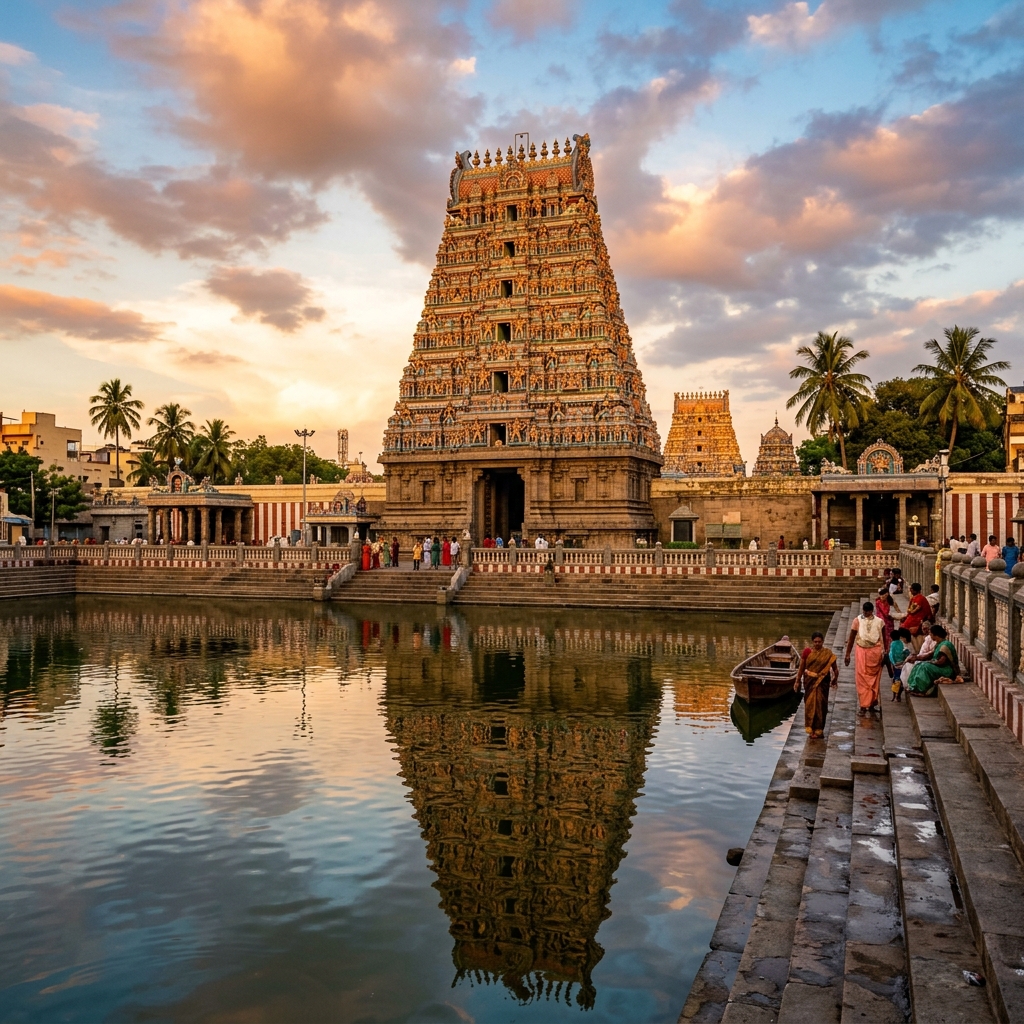
The atmosphere at Kapaleeshwarar tank during twilight is divine.

2026-09-03 16:35