Explore Calendar Community THADAM+ My Thadam
Makaral Arulmigu Makaraleswarar Temple
Paadal Petra Sthalams

Makaral Arulmigu Makaraleswarar Temple

Makaral-Thiru Makaraleswarar Temple

Sri Makaraleswarar / Agasthiyeeswarar (Swayambhu Lingam) • Kanchipuram, Thondai Nadu

Open in Maps My Thadam Check in

About the Sacred Destination

Presiding Deity
Sri Makaraleswarar / Agasthiyeeswarar (Swayambhu Lingam)
Consort & Sub-Shrines
Goddess Tribhuvana Nayaki / Thirubhuvana Sundari Ambal
Era & Dynasty
Chola Dynasty (Rajendra Chola I, 11th C)
Sacred Status & Classification
Paadal Petra Sthalam (Thondai Nadu #7 / #270 of 276)

Makaral Arulmigu Makaraleswarar Temple is a historic Paadal Petra Sthalam (Thondai Nadu Shrine #7) glorified in the 7th-century Tevaram hymns of Saint Thirugnanasambandar. Located in Magaral village on the Kanchipuram-Uttiramerur highway along the banks of the Cheyyaru River, the temple is celebrated for its unique iguana-tail-shaped Swayambhu Lingam and divine healing attributes.

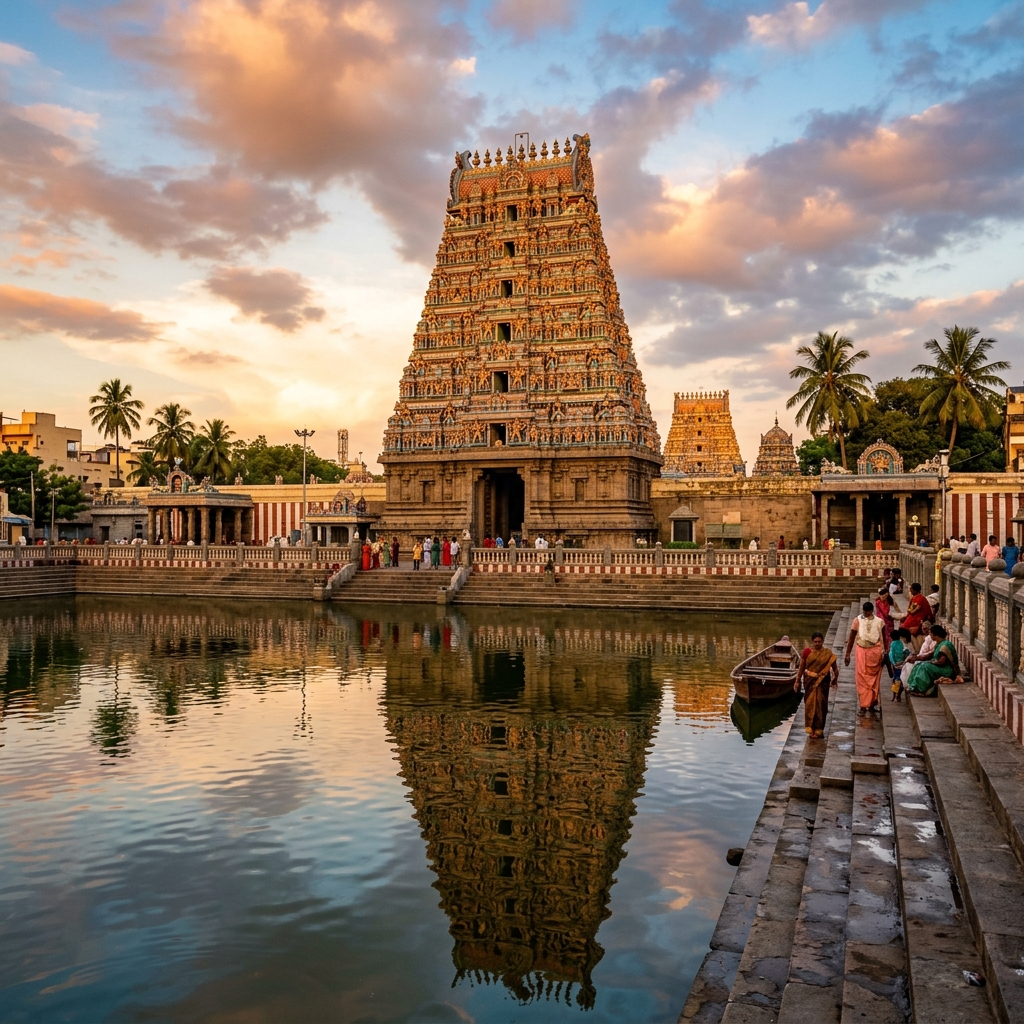
Spanning across a spacious granite enclosure with a 3-tiered Gopuram, the temple houses the sacred Agastya Theertham, a 16-pillared Mukha Mandapam, and a separate sanctum for Goddess Tribhuvana Nayaki. The shrine is famous for the Chola legend of a golden monitor lizard (Makaral / Udumbu) leading the king to a self-manifested Shiva Lingam, as well as Sage Agastya worshipping here to cure severe joint and leg afflictions.

Sthala Puranam & Authentic Legends

Golden Monitor Lizard (Makaral / Udumbu) Legend

According to the Thondaimandala Puranam, an early Chola monarch (identified in inscriptions with Rajendra Chola I) was hunting in the dense jackfruit forests along the Cheyyaru River. The king spotted a radiant golden monitor lizard (Udumbu / Makaral) and gave chase. The creature darted into a thicket of jackfruit trees and disappeared into a large anthill.

When the king commanded his hunters to dig open the anthill with iron crowbars, the iron tip struck a hard stone object, and blood began to flow from the earth. Terrified, the king cleared the soil with his own hands and discovered a self-born Shiva Lingam shaped like the tail of a monitor lizard, bearing a fresh scar on its crown. Lord Shiva manifested before the king, accepted his repentance, and healed the wound. The king constructed a magnificent granite temple over the site and named the sthalam Thirumakaral (Makaral = Monitor Lizard / Iguana), and the deity Sri Makaraleswarar. The Lingam's crown still retains the unique tail-shaped curve.

Sage Agastya's Leg Healing Legend

Sage Agastya suffered from severe joint pains and leg paralysis after traveling south from Mount Kailash. On divine guidance, Sage Agastya arrived at Thirumakaral, bathed in the Cheyyaru River (Agastya Theertham), and worshipped Lord Makaraleswarar with fresh jackfruit leaves and bilva.

Lord Shiva appeared, touched Agastya's legs, and restored complete mobility and strength. Devotees suffering from arthritis, rheumatism, joint disorders, and leg injuries offer oil lamps and oil abhishekam to Lord Makaraleswarar, believing that worshipping here cures all physical limb ailments.

Saint Thirugnanasambandar's Tevaram Miracle

Saint Thirugnanasambandar visited Thirumakaral in the 7th Century CE and composed a 10-verse Tamil Tevaram decad starting with "Neeru Vangupul" (நீறு வாங்குபுல்). Sambandar proclaimed that anyone who sings these 10 hymns with devotion shall be completely cured of leg pains, joint diseases, and karmic rebirths.
Classical Literary Canon & Sacred Hymns

Thirumakaral is enshrined in the 1st Thirumurai of the Shaivite Tevaram canon composed by Saint Thirugnanasambandar.

> Tevaram Verse (Sambandar - 1st Thirumurai, Decad 82, Verse 1): > "நீறு வாங்குபுல் லேறதொன் றேறியே > ஆறு சூடிய ஆதிமன் திருமாகறல் > கூறு மாமறை ஓதிமுன் தொழுவார்கள் > வேறு தான்வரு நோயெலாம் வீடுமே."

Translation: "Oh Lord of Thirumakaral who rides the sacred bull and holds the holy river Ganga upon His head! Those who worship Him while chanting the sacred Vedic verses shall have all bodily diseases and future afflictions completely destroyed."

The temple's origin is also documented in Sekkizhar's 12th-century Periya Puranam.

Epigraphical & Historical Events

  • Chola Stone Inscriptions (11th Century CE): Inscriptions carved on the sanctum granite plinth date to Chola Emperors Rajendra Chola I (1012–1044 CE) and Kulothunga Chola I (1070–1120 CE), recording land grants in Magaral village for conducting the Ushathkalam milk pooja and maintaining 12 perpetual ghee lamps (Nanda Deepam).
  • Vijayanagara Royal Grants: 15th-century epigraphs record endowments by Vijayanagara governors for renovating the 16-pillared Mukha Mandapam and constructing the temple tank steps.

Archaeo-Engineering & Scientific Marvels

Ancient metallurgical marvels, Siddha alchemical sciences, archaeo-engineering, and GI-tagged heritage:

  • Unique Udumbu-Tail Lingam Iconography: The central Swayambhu Lingam displays a distinct natural curved asymmetry resembling an iguana tail, verifying the ancient sthala puranam.
  • Cheyyaru Aquifer Connection: The temple's Agastya Theertham tank receives subterranean spring water linked directly to the Cheyyaru River basin.

Signature Rituals, Anomalies & Special Sevas

Authentic daily pooja timelines, spatika-lingam darshan hours, special sevas, and sacred temple anomalies:

  • Joint-Healing Oil Abhishekam: Special sesame oil and gingelly oil abhishekam performed on Sundays to Lord Makaraleswarar for devotees seeking relief from arthritis, joint pains, and leg ailments.
  • Panguni Uthiram Utsavam: Annual 10-day festival celebrating the celestial marriage of Lord Makaraleswarar and Goddess Tribhuvana Nayaki.

What to See in the Temple (Visual Highlights)

🛕

Main Sanctum (Sri Makaraleswarar)

Housing the sacred iguana-tail-shaped Swayambhu Lingam adorned with vilva garlands.

🛕

Goddess Tribhuvana Nayaki Shrine

Dedicated sub-shrine showcasing elegant Chola-style stone sculptures of Ambal.

🛕

Agastya Theertham

Sacred temple tank in front of the main Gopuram.

🛕

Sthala Vriksham (Jackfruit Tree)

Sacred tree situated in the outer prakaram courtyard.

Practical Visitor Logistics & Dress Code

Temple Opening Timings & Daily Hours

Morning: 06:30 AM – 11:30 AM; Evening: 04:30 PM – 08:00 PM

Darshan & Special Entry Tickets

Free General Queue; Special Entry Ticket: ₹10

Dress Code & Special Rules

Traditional Indian attire required (Dhoti/Veshti for men; Saree/Salwar for women). Male upper cloth removal required in inner sanctum line.

Accessibility & Senior Citizens

Entire temple complex is at ground level with flat stone flooring, fully wheelchair accessible.

Car Parking & Footwear Cloakroom

Open vehicle parking available near the temple gate in Magaral village. Footwear counter near entrance.

Best Time to Visit & Festival Calendar

Seasonal weather guide, peaceful darshan timings, and annual Brahmotsavam festival dates:

  • Best Months: October to March (pleasant weather for Kanchipuram temple exploration).
  • Major Festivals:
  • Maha Shivaratri (February–March)
  • Panguni Uthiram (March–April)
  • Margazhi Arudra Darshan (December–January)

Transit, Accommodations & Prasadam Dining

How to Reach & Connectivity

  • Nearest Railway Station: Kanchipuram Railway Station (CJ/RDNG) (16 km) / Chengalpattu Junction (22 km)
  • Nearest Airport: Chennai International Airport (MAA) (65 km via NH48)
  • Last-Mile Local Transport: Local buses (Kanchipuram-Uttiramerur route via Magaral) running frequently from Kanchipuram New Bus Stand (16 km); auto-rickshaws available from Kanchipuram or Magaral bus stop.

Free Annadhanam & Local Veg Dining

  • Temple Prasadam: Sakkarai Pongal, Puliyodarai & Jackfruit Prasadam.
  • Nearby Dining: Sri Rama Cafe (Kanchipuram - 16 km), Saravana Bhavan Kanchipuram (16 km).

Accommodations & Lodging Hubs

  • Hotel Tamil Nadu (TTDC Kanchipuram) - 16 km from temple.
  • GRT Regency Kanchipuram (17 km)
  • Hotel MM Legacy (17.5 km)

Nearby Heritage Spots (5–30 km Radius)

Combine your yatra with surrounding UNESCO heritage sites, Paadal Petra Sthalams & Divya Desams:

Uttiramerur Arulmigu Sundara Varadaraja Perumal Temple

14 km
World famous for 10th

century Chola village self-governance (Kudavolai) inscriptions.

Kanchipuram Ekambareswarar Temple

16 km
Sacred & Heritage Spot

Prithvi Sthalam / Paadal Petra Sthalam #1.

Kuranganilmuttam Valeeswarar Temple

8 km
Sacred & Heritage Spot

Paadal Petra Sthalam #6.

Verified References & Source Bibliography

  • Tevaram 1st Thirumurai by Saint Thirugnanasambandar.
  • Periya Puranam by Sekkizhar (Thirugnanasambanda Nayanar Puranam).
  • South Indian Inscriptions, Vol. III, Archaeological Survey of India (ASI).

Community Photo Gallery (0)

No community photos uploaded yet.

Pilgrim Reflections (0)

No reflections logged for this destination yet.