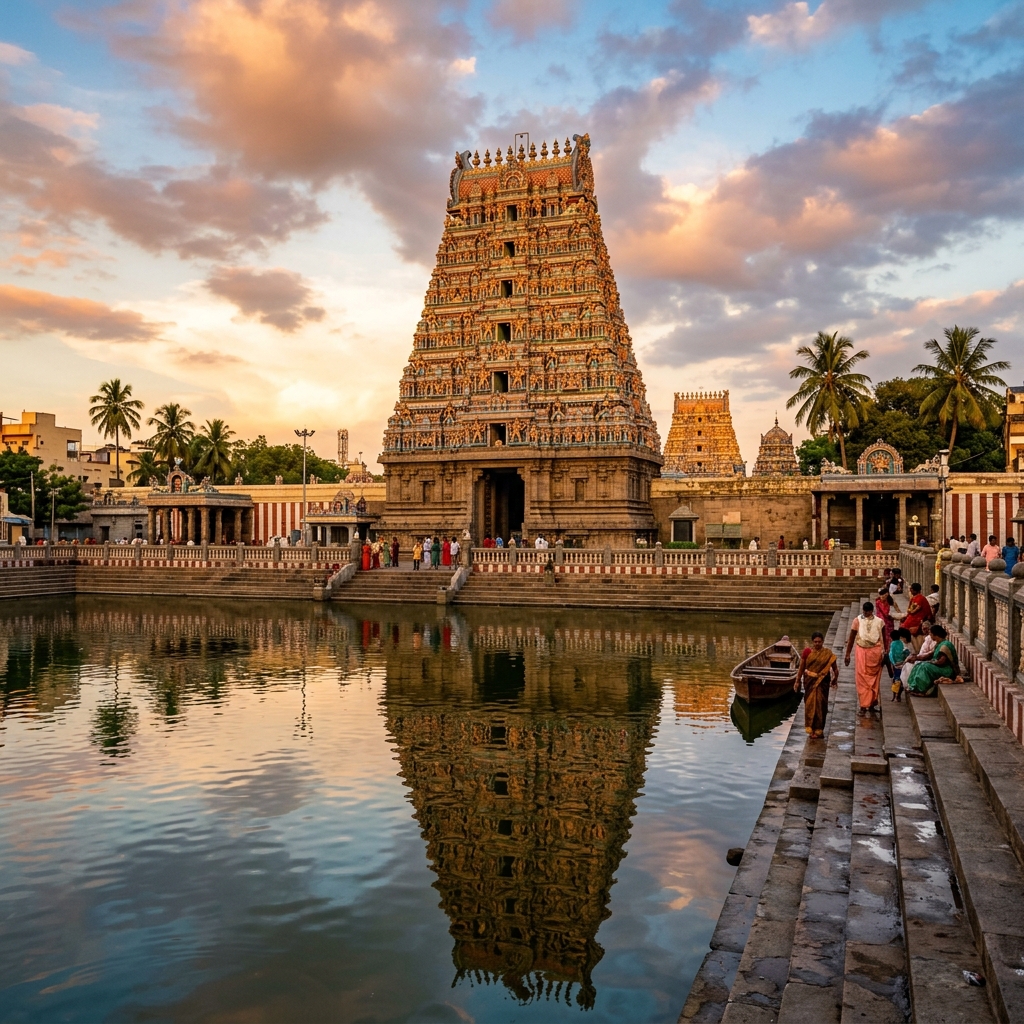
Goddess Parvati's Peacock Penance & Name Origin (Mylapore)
According to sacred Purana tradition, Goddess Parvati was distracted by the dance of a wild peacock while Lord Shiva was imparting the sacred Panchakshara mantra at Mount Kailash. Lord Shiva instructed Her to take the form of a peahen (Mayil) on Earth to regain absolute concentration. Goddess Parvati descended to the Punnai tree grove near the Mylapore seashore, established a Swayambhu Lingam, and performed intense penance in peahen form. Pleased by Her devotion, Lord Shiva manifested before Her, restored Her divine form, and declared the holy city as Mayilapur ("The City of Peacocks"). A dedicated shrine depicting Goddess Karpagambal worshipping Lord Kapaleeswarar in peahen form stands beneath the ancient Punnai tree inside the temple prakaram.
Saint Sambandar's Miracle of Resurrecting Poompavai
The most celebrated miracle in Shaivite literature took place at Mylapore. A wealthy merchant named Sivanesan Chettiar had pledged his daughter Poompavai to Saint Thirugnanasambandar. When Poompavai died tragically from a snakebite, Sivanesan preserved her ashes and bones in a clay pot (Kudam). When Saint Sambandar visited Mylapore Kapaleeswarar Temple, he stood before the temple gopuram with the pot of ashes and sang his famous 10-verse Tevaram decad beginning with "Mattitta Punnaiam Kanal Madamayilai". As Sambandar sang each verse describing the temple festivals of Mylapore, the ashes reconstituted into blood, bones, flesh, and life! By the 10th verse, Poompavai emerged alive in full beauty from the pot. This divine event is commemorated annually during the Poompavai Vizha during the 10-day Panguni festival.
Severing of Lord Brahma's Head (Kapaleeswarar)
Lord Shiva severed Brahma's fifth head out of cosmic pride, holding the skull (Kapalam) in His hand. Brahma performed penance at Mylapore to seek forgiveness, leading to the divine name Kapaleeswarar ("The Lord of the Skull").