
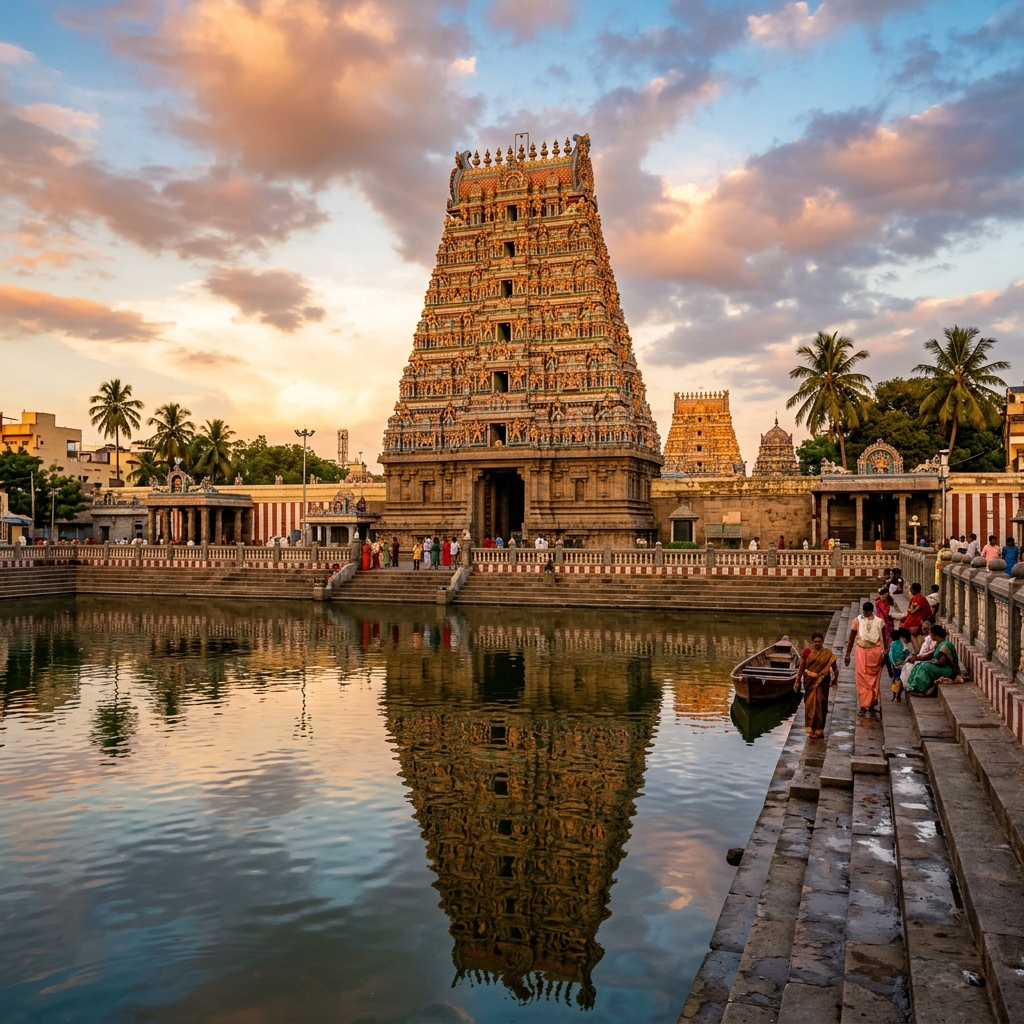
- Spiritual & Architectural Overview: Situated on the sacred conch-shaped island of Rameswaram in the Gulf of Mannar, Arulmigu Ramanathaswamy Temple is a crowning jewel of Dravidian temple architecture and one of Hinduism's most sacred pilgrimage sites. The temple features the world's longest temple corridor (Praharam)—a 1,219-meter long outer corridor consisting of 1,212 sculptured granite pillars displaying breathtaking symmetry and painted ceiling rosettes. The temple complex encloses 22 holy water wells (Theerthams), each possessing unique mineral properties and spiritual powers.
- Sacred Geography & Setting: Located at the eastern tip of Pamban Island facing the Palk Strait, where the Bay of Bengal meets the Indian Ocean (Agni Theertham beach).
- Core Spiritual Identity: The sacred site where Lord Rama established and worshipped Lord Shiva to absolve the Brahma Hatya sin of slaying Ravana in the Lanka war.
Jyotirlingas
Ramanathaswamy Temple, Rameswaram (Ekadasa Jyotirlinga)
Lord Ramanathaswamy (Ramalingam made of sand by Goddess Sita & Viswalingam brought by Hanuman) • Ramanathapuram, Pandya Nadu
About the Sacred Destination
Presiding Deity
Lord Ramanathaswamy (Ramalingam made of sand by Goddess Sita & Viswalingam brought by Hanuman)
Consort & Sub-Shrines
Lord Ramanathaswamy (Ramalingam made of sand by Goddess Sita & Viswalingam brought by Hanuman) & Goddess Parvathavardhini (Parvati)
Era & Dynasty
Ancient Ramayana origins; monumental Dravidian granite expansion by Pandya Dynasty (12th Century CE) and Sethupathi Kings of Ramnad (15th–18th Century CE).
Sacred Status & Classification
Ekadasa (11th) Jyotirlinga among the 12 Sacred Jyotirlingas; Paadal Petra Sthalam (Pandya Nadu Shrine #8); Bada Char Dham node (Southern cardinal point).
Sthala Puranam & Authentic Legends
Divine Manifestation & Primary Origin Narrative (Sthala Puranam):
According to the Valmiki Ramayana (Yuddha Kanda) and the Skanda Purana (Brahma Khanda), after defeating Ravana and rescuing Goddess Sita from Lanka, Lord Rama returned to the shores of Rameswaram accompanied by Lakshmana, Sugriva, and Hanuman. Great sages including Agastya advised Rama that although Ravana was a tyrannical demon, he was also a learned Brahmin and son of Sage Vishrava. Therefore, slaying him incurred the grave sin of Brahma Hatya Dosha.
To absolve this sin, Lord Rama resolved to perform intense Panchamrutha Abhishekam to Lord Shiva at Rameswaram. Rama dispatched Hanuman to Mount Kailash to fetch a divine Shiva Lingam. However, as the auspicious astrological hour (Mahurtham) for the ritual approached and Hanuman had not yet returned from Kailash, Goddess Sita crafted a sacred Lingam out of beach sand with her own hands. Lord Rama consecrated this sand Lingam, naming it Ramalingam (Ramanathaswamy - "The Lord of Rama").
When Hanuman returned carrying two Lingams (Viswalingam & Hanumadlingam) from Kailash, he was grieved to find the Ramalingam already consecrated. To console Hanuman, Lord Rama attempted to move the sand Lingam with his hands, but it remained unmovable. Hanuman wrapped his powerful tail around the Ramalingam and tried to pull it out with all his strength, but the Lingam stood firm while Hanuman fell exhausted, leaving tail marks on the stone. Lord Rama decreed that henceforth, Hanuman's Viswalingam must be worshipped first before worshipping the Ramalingam—a tradition strictly maintained to this day.
Secondary & Sub-Shrine Legends:
The 22 holy wells (22 Theerthams) inside the temple compound were created by Lord Rama firing arrows into the ground to draw pure waters from different sacred rivers of India to bathe and purify his army.
Classical Literary Canon & Sacred Hymns
- Tevaram Hymns: Celebrated in 7th-century Tevaram hymns by Saivite Nayanars Thirugnanasambandar and Appar (Shrine #8 in Pandya Nadu).
Thirugnanasambandar Tevaram:
திரையார்புனல் சூழ்ந்த இராமேச்சுரத்து... (Tevaram 3.109)
- Translation: "Lord Ramanatha who abides in Rameswaram surrounded by roaring ocean waves, who bestows liberation upon all who surrender."
- Ramcharitmanas: Goswami Tulsidas writes in Ramcharitmanas (Lanka Kanda): "Sri Raghunath placed the Lingam at Rameswaram, declaring that none is dearer to me than Shiva, and none is dearer to Shiva than me."
Epigraphical & Historical Events
- Sethupathi Royal Inscriptions: The Sethupathi Kings of Ramnad were the hereditary guardians (Kaval) and principal builders of Rameswaram temple from the 15th to 18th century CE. King Muthuramalinga Sethupathi constructed the famous Third Corridor (Mundram Praharam) between 1763 and 1795 CE.
- Sri Lankan Royal Donations: Epigraphical grants from King Parakramabahu I of Sri Lanka (12th Century CE) record royal donations of gold, jewels, and stone masons to construct the inner sanctum walls of Ramanathaswamy temple.
Archaeo-Engineering & Scientific Marvels
Ancient metallurgical marvels, Siddha alchemical sciences, archaeo-engineering, and GI-tagged heritage:
- The World's Longest Temple Corridor: The third corridor measures 1,219 meters (4,000 feet) in total perimeter length, supported by 1,212 massive monolithic granite pillars carved with intricate yali motifs, engineered to withstand saline ocean wind erosion.
- Hydro-Geological Miracle of 22 Theerthams: Although Rameswaram is a small island surrounded entirely by salt ocean water, each of the 22 internal temple wells yields freshwater with completely different mineral compositions, temperatures, and tastes.
Signature Rituals, Anomalies & Special Sevas
Authentic daily pooja timelines, spatika-lingam darshan hours, special sevas, and sacred temple anomalies:
Signature Daily Rituals:
- Spatika Lingam Darshan: 5:00 AM to 6:00 AM pre-dawn ritual where the sacred crystal Lingam (Spatika Lingam) installed by Adi Shankara is worshipped with milk and holy water.
- 22 Theertham Holy Bathing: Pilgrims bathe in sequence at the sea (Agni Theertham) followed by all 22 internal temple wells poured by temple attendants.
- Palliyarai Seva: 8:45 PM night procession where the Utsava Murti of Lord Ramanathaswamy is carried in a golden palanquin to the bedchamber (Palliyarai).
- Special Sevas: Viswalingam First Worship, 108 Kalasa Abhishekam, and Thirukalyanam.
What to See in the Temple (Visual Highlights)
🛕
Ramalingam & Viswalingam Sanctums
The twin sanctums housing the sand Lingam crafted by Sita and the Kailash Lingam brought by Hanuman.
🛕
Third Outer Corridor (Mundram Praharam)
World-famous 1,219m long granite corridor with 1,212 carved pillars.
🛕
Agni Theertham & 22 Temple Wells
Sacred ocean sea bath and internal mineral wells (Mahalakshmi, Savitri, Gayatri, Saraswati, Koti, Amrita wells).
🛕
Goddess Parvathavardhini Shrine
Separate shrine housing the standing idol of Goddess Parvati facing East.
🛕
Gandhamadhana Parvatham (Ramjharokha)
2 km away, highest hill on the island housing Lord Rama's footprints (Rama Padam).
Practical Visitor Logistics & Dress Code
Temple Opening Timings & Daily Hours
Open daily from 5:00 AM to 1:00 PM & 3:00 PM to 9:00 PM. Spatika Lingam Darshan: 5:00 AM–6:00 AM; 22 Theertham Bathing: 5:30 AM to 12:00 PM & 3:30 PM to 7:00 PM.
Darshan & Special Entry Tickets
Free General Line. Quick Darshan pass ₹50; Special Spatika Lingam Darshan ticket ₹50; 22 Theertham Bathing ticket ₹25 per pilgrim. Online booking available at HR&CE official portal (`rameshwaramtemple.hrce.tn.gov.in`).
Dress Code & Special Rules
Wet clothes from 22 Theertham bathing must be changed in designated changing rooms before entering main sanctum. Traditional modest dress mandatory: Men in Dhoti/Vesti or formal trousers; Women in Saree/Salwar.
Accessibility & Senior Citizens
Wheelchairs and battery cars available at East Gopuram entrance. Dedicated senior citizen queue line for Spatika Lingam darshan.
Car Parking & Footwear Cloakroom
Dedicated parking plazas at East Car Street and Agni Theertham (₹50/car). Free footwear counters at North, East, and West Gopuram gates. Electronic items, mobile phones, and cameras banned inside main sanctum.
Best Time to Visit & Festival Calendar
Seasonal weather guide, peaceful darshan timings, and annual Brahmotsavam festival dates:
- Best Months / Season to Visit: October to March (Pleasant coastal island climate, 20°C–30°C).
- Best Hours for Peaceful Darshan: 5:00 AM to 6:30 AM (Spatika Lingam slot) and 3:30 PM to 5:00 PM.
Major Festivals & Peak Days:
- Maha Shivaratri (Feb/March): 10-day Brahmotsavam with silver chariot procession (Rathotsavam).
- Thirukalyanam Festival (July/August): 17-day celestial wedding festival of Lord Ramanathaswamy and Goddess Parvathavardhini.
- Ram Navami (March/April): Special celebrations honoring Lord Rama's consecration of the temple.
Transit, Accommodations & Prasadam Dining
How to Reach & Connectivity
- Nearest Railway Station: Rameswaram Railway Station (RMM) - 1.5 km from temple (Direct express trains over the famous Pamban Sea Bridge connecting to Chennai, Madurai, Coimbatore, and Kanyakumari).
- Nearest Airport: Madurai International Airport (IXM) - 175 km (approx. 3.5 hours drive via Madurai-Rameswaram Highway NH87).
- Last-Mile Local Transport: Town buses (Route #1 to Agni Theertham), auto-rickshaws (₹50–₹100), and electric rickshaws around Mada Streets.
Free Annadhanam & Local Veg Dining
- Temple Prasadam & Free Annadhanam: Official Devasthanam Prasadam counter selling famous Rameswaram Puliyodarai, Chakkarai Pongal, and Laddoo Prasadam. Free Annadhanam served daily at Devasthanam Annadhana Hall from 11:30 AM to 2:00 PM.
- Nearby Pure-Vegetarian Dining Options: TTDC Hotel Tamil Nadu Restaurant, Ram Nivas Mess, Gujarat Bhavan Mess, Hotel Aryaas, Hotel Saravana Bhavan Rameswaram.
Accommodations & Lodging Hubs
- HR&CE Devasthanam Pilgrim Guest Houses: Ramanathaswamy Temple Devasthanam Guest House, Ullar Cottages, Sethupathi Pilgrim Rest House.
- State Tourism Hotel: Hotel Tamil Nadu Rameswaram (TTDC / Tamil Nadu Tourism) - Located near Agni Theertham.
- Private Hotels: Daiwik Hotels Rameswaram (1.5 km), Hotel Royal Park, Hyatt Place Rameswaram.
Nearby Heritage Spots (5–30 km Radius)
Combine your yatra with surrounding UNESCO heritage sites, Paadal Petra Sthalams & Divya Desams:
Agni Theertham
200m EastHoly Ocean Bathing Ghat
Sacred sea beach where Lord Rama bathed to cleanse his sins before establishing the Lingam.
Dhanushkodi & Arichal Munai
20 km SoutheastGhost Town & Ocean Confluence
Abandoned historic town and tip of India where Bay of Bengal meets Indian Ocean, starting point of Ram Setu (Adam's Bridge).
Dr. A.P.J. Abdul Kalam National Memorial
4 km WestMemorial Park
Monumental memorial dedicated to India's 11th President Dr. A.P.J. Abdul Kalam.
Verified References & Source Bibliography
- Official / Government Sources: HR&CE Department Official Portal (`rameshwaramtemple.hrce.tn.gov.in`), ASI Chennai Circle Reports.
- Scholarly & Historical Books: The Sethupathis of Ramnad by Dr. S. Kadhirvel; South Indian Shrines by P.V. Jagadisa Ayyar; Tevaram Hymns (Pandya Nadu).
- Classical Literature: Valmiki Ramayana (Yuddha Kanda), Skanda Purana (Brahma Khanda), Ramcharitmanas.
Featured Research Articles & Reports
Rameswaram Theertha Sangam
2026-08-09 • Happening
The Mystical 22 Sacred Wells of Rameswaram: Distinct Mineral Compositions Surrounding the Ocean
A unique phenomenon awaits every yatri at Rameswaram Ramanathaswamy Temple! Inside the temple complex lie 22 sacred water wells (Theerthams), each named after divine deities (Mahalakshmi, Savitri, Gayatri, Saraswati, Chakra, Amrita, Nala, Neela, etc.).
What stuns modern hydrolog...
Read Full Article in Community
Community Photo Gallery (0)
No community photos uploaded yet.
Pilgrim Reflections (0)
No reflections logged for this destination yet.