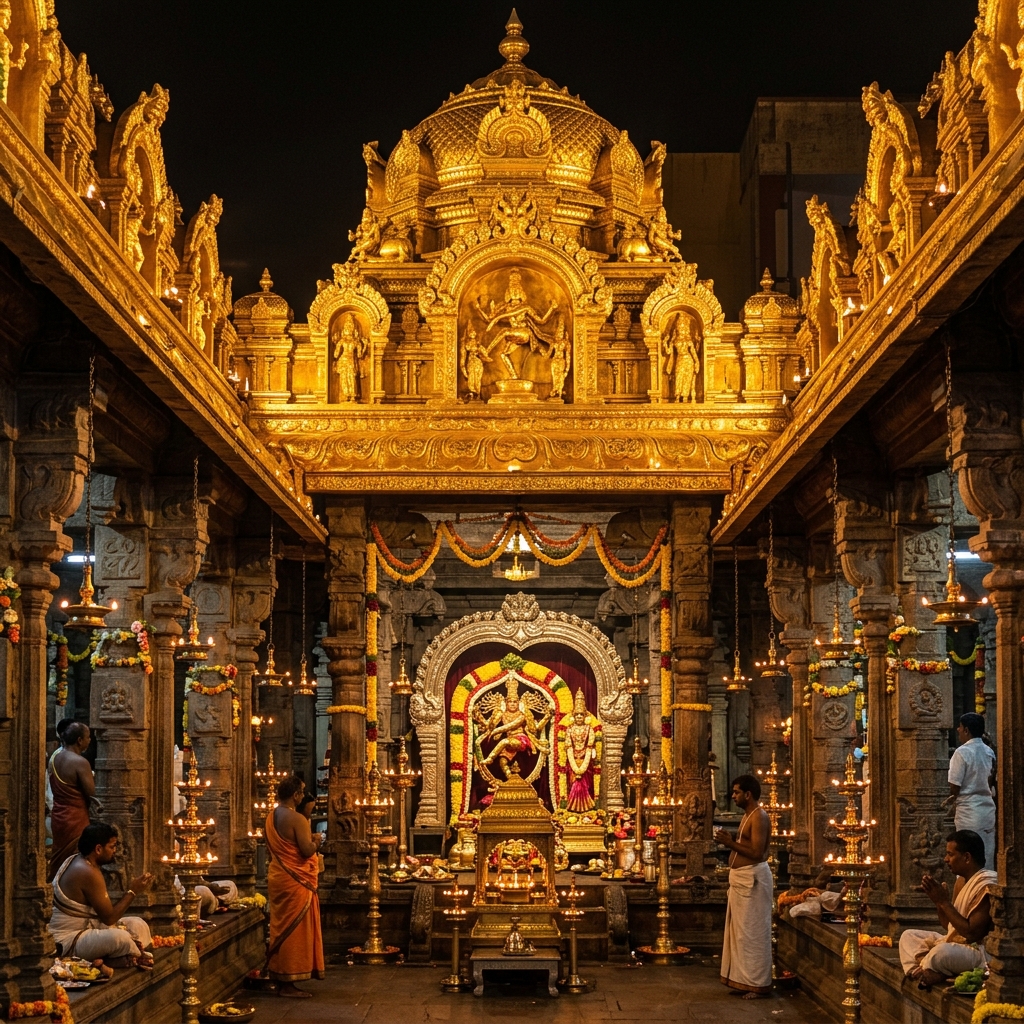
About the Sacred Destination
Presiding Deity
Subramanya Swamy (Sri Thanikachalapathy holding Vajra Vel), Valli & Deivayanai
Consort & Sub-Shrines
Goddess Valli (Valli Ammai) & Goddess Deivayanai (Devasena)
Era & Dynasty
Early Pallava (c. 9th Century CE), Late Chola & Vijayanagara Era Expansion
Sacred Status & Classification
Panchama Arupadai Veedu #5, HR&CE Protected Temple
Arulmigu Subramanyaswamy Temple, Tiruttani (அருள்மிகு சுப்பிரமணியசுவாமி திருக்கோயில், திருத்தணி) is the revered 5th abode (Panchama Arupadai Veedu) of Lord Murugan, situated atop the 700-foot Tanigaimalai hill in Tiruvallur District, Tamil Nadu.
After vanquishing the demon Surapadman at Thiruchendur, Lord Murugan retired to this peaceful hill to cool His divine anger ('Tanigai' = soothing/calming) and wedded Goddess Valli. Celebrated in 3rd-century Sangam literature (Tirumurugarrupadai by Nakkeerar) and 15th-century Thiruppugazh by Saint Arunagirinathar, Tiruttani is also famous as the sacred sanctuary where Carnatic Trinity composer Muthuswami Dikshitar received divine grace to begin his musical composition journey.
Sthala Puranam & Authentic Legends
1. Calming of Divine Anger (Tanigai / Tiruttani): After defeating the demon Surapadman at Thiruchendur, Lord Murugan's cosmic anger and inner heat remained intense. He sought a peaceful hill sanctuary to cool his temperament ('Tanigai' = calming/soothing). Upon reaching Tanigaimalai (Tiruttani), His wrath subsided and divine peace was restored.
2. Celestial Wedding with Goddess Valli (Valli Kalyanam): Goddess Valli was born to a deer in Vallimalai and raised by tribal hunter chief Nambi Rajan. Lord Murugan fell in love with her and took various disguises—a hunter, an old man, and a wild elephant created by Lord Ganesha—to win her heart. When Valli embraced the old man in fear of the charging elephant, Murugan revealed His divine six-faced form and wedded her atop Tiruttani hill.
3. Restoration of Lord Indra's Celestial Wealth: Lord Indra offered his daughter Deivayanai in marriage to Murugan and presented his white elephant Airavatam as a wedding gift. When Airavatam faced East towards Indra's realm, Indra's depleted wealth began restoring. Hence, the elephant mount in Tiruttani faces East instead of facing the deity.
4. Muthuswami Dikshitar's Musical Awakening: Carnatic Trinity composer Muthuswami Dikshitar sat in deep meditation on Tiruttani hill. Lord Murugan appeared as an elderly sage, placed sugar candy in Dikshitar's mouth, and vanished. Instantly, Dikshitar was blessed with divine musical inspiration and composed his first kriti 'Srinathadi Guruguho' adopting the mudra 'Guruguha'.
Epigraphical & Historical Events
Historical and epigraphical research by Archaeological Survey of India (ASI) experts and temple historians (S.R. Balasubrahmanyam and K.A. Nilakanta Sastri) confirms early Pallava origins for the Tiruttani hill shrine during the 9th century CE (reign of King Aparajita Varman).
Inscriptions carved upon the temple stone walls record royal patronages, gold coin endowments for perpetual oil lamps (Nanda Deepam), and land grants bestowed by Late Chola monarchs (Kulothunga Chola I, Vikrama Chola) and Vijayanagara Emperor Krishnadevaraya. The temple complex was systematically expanded across centuries with multi-tiered Rajagopurams, granite pillar halls (Valli Kalyana Mandapam), and stone-lined water tanks (Nandi Theertham). Today, the temple is administered by the HR&CE Department of Tamil Nadu.
Archaeo-Engineering & Scientific Marvels
Ancient metallurgical marvels, Siddha alchemical sciences, archaeo-engineering, and GI-tagged heritage:
365 stone steps representing 365 days of solar year; Vajra Vel with physical chest battle scar; East-facing Airavatam elephant mount.
Signature Rituals, Anomalies & Special Sevas
Authentic daily pooja timelines, spatika-lingam darshan hours, special sevas, and sacred temple anomalies:
Viswaroopa (5:45 AM), Kala Santhi (8:00 AM), Uchikalam (12:00 PM), Sayaratchai (5:30 PM), Arthajama (8:45 PM)
Santhanabhisheka sandal paste consumed as curative prasadam; Flower Kavadi (Poomalai Kavadi) tradition.
Best Time to Visit & Festival Calendar
Seasonal weather guide, peaceful darshan timings, and annual Brahmotsavam festival dates:
• Aadi Krithigai (July–August): 3-day grand annual festival attracting over 500,000 pilgrims carrying elaborate Flower Kavadis (Poomalai Kavadi). • Padi Thiruvizha (December 31st / January 1st): New Year Step Festival where thousands chant devotional songs on each of the 365 steps. • Masi Brahmotsavam (February–March): 10-day annual Brahmotsavam featuring the grand wooden chariot procession (Rathotsavam) and Valli Kalyanam. • Monthly Krithigai & Sashti Days: Special monthly peak days with elaborate Santhana Abhishekam and night golden chariot processions.