
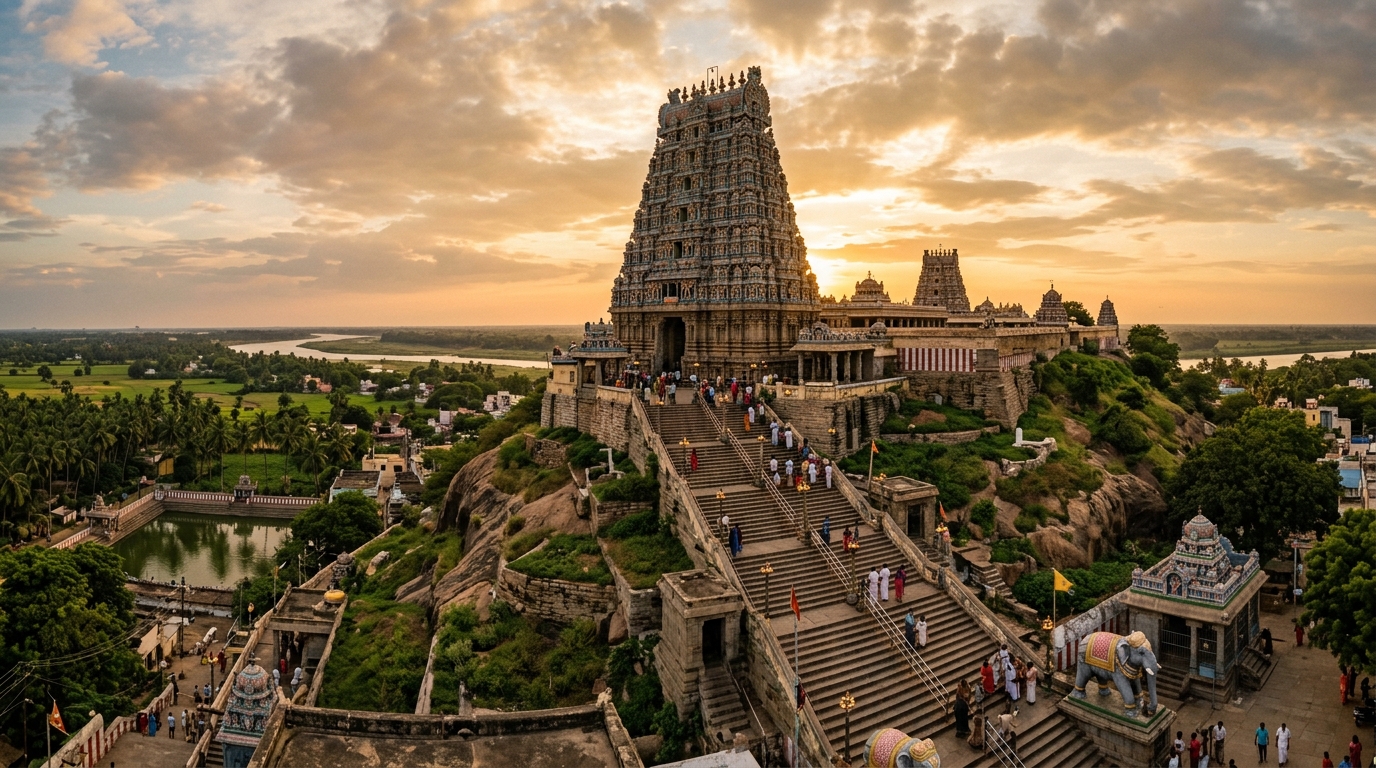
Arulmigu Swaminatha Swamy Temple in Swamimalai is the 4th Sacred Abode (Arupadai Veedu #4) of Lord Murugan. Situated ~5 km from Kumbakonam on the banks of the Kaveri / Arasalar rivers, this holy hillock shrine is where young Lord Murugan expounded the supreme spiritual secret of the Omkara (Pranava Mantra 'OM') to his father, Lord Shiva, assuming the role of Guru Bhagavan (Thagappan Swami).
Arupadai Veedu
Arulmigu Swaminatha Swamy Temple, Swamimalai
அருள்மிகு சுவாமிநாதசுவாமி திருக்கோயில்
Lord Swaminatha Swamy (Lord Murugan / Kartikeya as Guru Bhagavan / Thagappan Swami — the Divine Teacher who expounded the secret meaning of the Pranava Mantra 'OM' to his father, Lord Shiva) • Thanjavur District, Swamimalai, Kumbakonam Taluk
About the Sacred Destination
Presiding Deity
Lord Swaminatha Swamy (Lord Murugan / Kartikeya as Guru Bhagavan / Thagappan Swami — the Divine Teacher who expounded the secret meaning of the Pranava Mantra 'OM' to his father, Lord Shiva)
Consort & Sub-Shrines
None inside main hilltop Garbhagriha (Worshipped as a supreme child-guru / celestial bachelor; Goddess Valli and Goddess Deivanai are enshrined in separate sub-shrines within the complex)
Foothill Shrines (Keezh Koil)
Keezh Koil: Lord Shiva as Sundareswarar and Goddess Parvati as Meenakshi Amman
Era & Dynasty
Early Chola foundations (traditionally attributed to King Parantaka Chola I, 10th Century CE); substantially expanded under medieval Cholas (Kulottunga Chola I and Vikrama Chola, 12th Century CE), the Vijayanagara Empire, and the Nayaka Dynasty of Thanjavur (16th–17th Century CE).
Sacred Status & Classification
Arupadai Veedu #4 (Fourth Sacred Abode of Lord Murugan out of the Six Abodes) | Sangam Literature Site (Referred to as Eragaram / Swamimalai in Tirumurugatrupadai) | Administered Special Grade Temple under the HR&CE (Hindu Religious and Charitable Endowments) Department, Government of Tamil Nadu
Sthala Puranam & Authentic Legends
• The Legend of the 60 Tamil Years (60 Granite Steps): The flight of 60 granite steps leading to the hilltop sanctum (Mel Koil) represents the 60-year cycle of the traditional Hindu / Tamil calendar (Sixty Samvatsaras, from Prabhava to Akshaya). Each step is personified as a deity of time (Kala Devata). Devotees worshipping while climbing these steps pray for longevity, spiritual progression, and liberation from time-bound karmic cycles.
• The Legend of Airavata (White Elephant Vehicle): Indra, the King of the Devas, presented his divine white elephant Airavata to Lord Murugan after Murugan vanquished the demon Padmasura. In eternal gratitude, Indra requested that Airavata be allowed to face Murugan's sanctum forever. Uniquely, at Swamimalai, the divine white elephant Airavata stands facing the inner sanctum instead of the traditional Peacock vehicle (Mayil).
Classical Literary Canon & Sacred Hymns
• Sangam Literature (Tirumurugatrupadai): Sangam poet Nakkirar (c. 1st–3rd Century CE) praises Swamimalai under its ancient Sangam name Eragaram in Tirumurugatrupadai. • Devotional Hymns (Thiruppugazh): The 15th-century saint-poet Arunagirinathar composed 38 rhythmic hymns (Thiruppugazh) dedicated specifically to Lord Swaminatha Swamy extolling Omkara Upadesam and the Kaveri banks. • Kandha Puranam: Detailed accounts by Kachiyappa Sivachariyar.
Epigraphical & Historical Events
Divine Origin Legend (Sthala Puranam)
The Legend of Omkara Upadesam (Expounding the Pranava Mantra): According to the Sthala Puranam, Lord Brahma, the creator deity, visited Mount Kailash and passed young Lord Murugan without offering due reverence. Murugan intercepted Brahma and questioned him on his competence to create the cosmos. When Brahma cited his knowledge of the Vedas, Murugan challenged him to explain the esoteric meaning of the sacred primordial sound 'OM' (the Pranava Mantra). Brahma was unable to explain its ultimate spiritual essence. Murugan imprisoned Brahma for his ignorance and assumed the role of cosmic creator. Lord Shiva intervened and requested Murugan to release Brahma and explain the true meaning of OM. Murugan politely submitted that the supreme spiritual secret could only be imparted to a seeker demonstrating true humility as a disciple (Sishya). Accepting Murugan as his Guru, Shiva seated himself at a lower elevation while Murugan stood atop an elevated hillock (Kattu Malai) and whispered the inner meaning of OM directly into Shiva's right ear. Thus, Lord Murugan earned the epithet Swaminathan ("The Master of the Supreme Lord") and Thagappan Swami ("The Father's Teacher").
Literary & Historical Associations • Sangam Literature (Tirumurugatrupadai): Sangam poet Nakkirar (c. 1st–3rd Century CE) praises Swamimalai under its ancient Sangam name Eragaram in Tirumurugatrupadai, highlighting it as an essential sanctuary of Lord Murugan. • Devotional Hymns (Thiruppugazh): The 15th-century saint-poet Arunagirinathar composed 38 rhythmic hymns (Thiruppugazh) dedicated specifically to Lord Swaminatha Swamy. His verses extol the Omkara Upadesam, the sacred banks of the Kaveri River (Kaveri-Karai), and the spiritual power of the hillock shrine. • Kandha Puranam: Detailed accounts of Murugan's divine manifestation as Swaminatha Swamy are documented in the Kandha Puranam authored by Kachiyappa Sivachariyar.
Historical & Epigraphical Events • Chola Inscriptions: Epigraphical stone inscriptions recorded on the enclosure walls log royal patronage during the reign of Parantaka Chola I (10th Century CE) and Vikrama Chola (12th Century CE), detailing endowments of land, gold coins (Kasu), and flower garden trusts (Poo-Kattalai). • Carnatic Wars Military Post (18th Century CE): During the Anglo-French conflicts in South India (1750s), the elevated hillock structure of Swamimalai was briefly occupied as a strategic military post by Franco-British troops, suffering minor structural damage before being re-consecrated and restored by Thanjavur and Maratha chieftains.
Archaeo-Engineering & Scientific Marvels
Ancient metallurgical marvels, Siddha alchemical sciences, archaeo-engineering, and GI-tagged heritage:
Swamimalai Lost-Wax Bronze Casting Process (GI Tag #132)
🏞️
Kaveri Clay
Alluvial Vandal Mann
➔
Alluvial Vandal Mann
🐝
Beeswax Model
Cire Perdue Lost-Wax
➔
Cire Perdue Lost-Wax
🔥
Panchaloha Melt
5-Metal Alloy Pour
➔
5-Metal Alloy Pour
🏆
GI-Tagged Bronze
Shilpa Shastra Masterpiece
Shilpa Shastra Masterpiece
Mathematical & Architectural Curiosities • 60-Step Architectural Calendar: The precise integration of 60 granite steps corresponding to the 60 Samvatsaras (solar/Jupiter Tamil years), with the name of each year engraved on the vertical riser of each step. • Hierarchical Elevation Geometry: The structural layout places Lord Shiva (Sundareswarar) and Goddess Parvati (Meenakshi) at ground level (Keezh Koil), while Lord Murugan is elevated 60 feet higher on an artificial hillock (Kattu Malai / Mel Koil), physically symbolizing the Guru-Sishya posture where the teacher sits higher than the student.
Archaeo-Engineering & Metallurgical Marvels • Swamimalai Lost-Wax Bronze Casting (GI Tagged): Swamimalai is India's premier center for traditional bronze icon casting using the ancient Cire Perdue (Lost-Wax) technique. Hereditary Sthapathis (master sculptors) trace their unbroken lineage back to Raja Raja Chola I's master sculptors. The process utilizes fine alluvial clay from the nearby Kaveri riverbed (Kaveri Vandal Mannoru) mixed with organic binders to create heat-resistant molds, into which molten Panchaloha (a 5-metal alloy: gold, silver, copper, zinc, lead/tin) is poured, strictly governed by the canonical proportions of the Shilpa Shastra (Manasara). The craft was officially granted a Geographical Indication (GI) Tag in 2008–2009. • Kattu Malai Artificial Mound Engineering: The 60-foot artificial hillock was constructed using interlocking granite blocks and compacted earthen core technology in the Chola era to elevate the sanctum above the flood line of the adjacent Kaveri and Arasalar rivers.
Astronomical Alignments • Solar Illumination: During specific solar transition days in the Tamil month of Chithirai (April–May), sunlight aligns directly through the gopuram entrance to illuminate the main sanctum deity in the early morning hours.
Famous News, Documentary Features & Media • Featured in National Geographic, BBC Documentary Series on Chola Bronzes, and UNESCO Cultural Heritage Surveys documenting Swamimalai as the living heritage heartland of Indian lost-wax bronze metal casting.
Signature Rituals, Anomalies & Special Sevas
Authentic daily pooja timelines, spatika-lingam darshan hours, special sevas, and sacred temple anomalies:
• Usha Kalam (6:00 AM): Morning waking ceremony and first visual darshan. • Kalasandhi (9:00 AM): Morning primary worship and Abhishekam. • Uchikala Pooja (12:00 PM): Midday elaborate ritual bath with milk, curd, honey, panchamirtham, and sandalwood. • Sayaratchai (5:30 PM): Evening lighting ritual where the deity is adorned in royal attire (Rajalankaram). • Rendam Kalam (8:00 PM): Night worship service. • Ardhajama Pooja (10:00 PM): Final night ritual followed by the Palliyarai procession.
• Netra Abhishekam (Eye Cosmetic Ritual): A unique ritual offering where special eye-salve/collyrium and silver eyes (Netram) are offered to Lord Swaminatha Swamy. • Vibhuti & Santhana Alankaram: Sacred ash (Vibhuti) and sandalwood paste coating applied over the 6-foot main granite deity. • Airavata Vahana Procession: Procession using the white elephant vehicle during monthly festival days. • Padi Pooja (Worship of the 60 Steps): Devotees perform elaborate poojas and light brass oil lamps on all 60 steps on Tamil New Year's Day (Chithirai 1) and personal milestone anniversaries. • Sahasranama Archana & Abhishekam Seva: Special private ritual ablutions booked via HR&CE. • Golden Chariot (Thanga Ther) Procession: Daily evening procession around the hilltop circuit.
What to See in the Temple (Visual Highlights)
🛕
Sanctum & Main Deity (Garbhagriha)
Main Deity: Lord Swaminatha Swamy. Height & Material: Monolithic granite icon standing 6 feet tall on an elevated pedestal. Features & Posture: Depicted as a supreme teacher holding a wooden staff (Dhandam) in his right hand, his left hand resting on his thigh (Uru Hastam), wearing the sacred thread (Yajnopavita) and simple ascetic attire. The sanctum faces East.
🏛️
Foothill Base Shrines (Keezh Koil)
Shrines dedicated to Lord Shiva as Sundareswarar and Goddess Parvati as Meenakshi Amman, situated at ground level before ascending the hillock steps.
👑
Mandapams & Structural Features
60 Granite Steps: Flight of 60 steps with the names of the 60 Tamil years inscribed on the vertical risers. Rajagopuram: 5-tiered entrance tower adorned with detailed stucco figures illustrating the Omkara Upadesam legend. Airavata Sanctum: Shrine/image of the white elephant Airavata standing directly in front of the main sanctum. Kalyana Mandapam & Sabha Mandapam: Pillared halls showcasing Nayaka and Vijayanagara architectural carving styles.
🔱
Sub-Shrines (Parivara Devatas)
Shrines dedicated to Lord Vinayakar (Siddhi Vinayakar), Goddess Valli, Goddess Deivanai, Lord Sabhapathi (Nataraja), and Chandikeshwarar.
🌳
Temple Tank (Theertham) & Sacred Tree (Sthala Vriksham)
Sthala Vriksham: Nelli Tree (Indian Gooseberry, Phyllanthus emblica). Sacred Theerthams: Netra Pushkarini (Sacred tank associated with legend of blind devotee regaining sight), Vajra Theertham, Saravana Theertham, Kumaratturai (adjacent sacred Kaveri River bank).
Practical Visitor Logistics & Dress Code
Temple Opening Timings & Daily Hours
Morning Session Hours: 5:00 AM – 12:00 PM | Evening Session Hours: 4:00 PM – 10:00 PM | Key Pooja / Aarti Timings: 6:00 AM (Ushakalam), 9:00 AM (Kalasandhi), 12:00 PM (Uchikalam), 5:30 PM (Sayaratchai), 8:00 PM (Rendam Kalam), 10:00 PM (Ardhajama).
Darshan & Special Entry Tickets
• Free Darshan Line: Available to all pilgrims without entry fee (Wait time: ~30 minutes to 2 hours).
• Special Entry Ticket: ₹50 per person for priority express queue.
• Abhishekam / Special Pooja Tickets: ₹1,500 – ₹3,000 (Bookable via HR&CE portal or temple office).
Dress Code & Special Rules
• Dress Code & Special Rules: Men: Dhoti (Vesti) or Pyjama with shirt/upper cloth, or formal trousers with shirt. Shorts, lungis, sleeveless tops, and athletic wear are strictly prohibited.
Women: Saree, Half-saree, or Churidar/Salwar Kameez with Dupatta. Western attire (shorts, skirts, sleeveless tops) is strictly prohibited.
• Non-Hindu Entry: Respectful non-Hindu visitors are permitted within the outer precincts; inner sanctum access is regulated per HR&CE customary rules.
• Photography: Strictly prohibited inside the main sanctum.
Accessibility & Senior Citizens
• Accessibility & Senior Citizens: Elevator / Lift Facility: An elevator/lift facility has been installed on the side of the artificial hillock to provide step-free access to the hilltop sanctum for elderly and differently-abled pilgrims (Subject to operational availability; inquire at temple office upon arrival).
• Wheelchairs: Available at the base office upon request.
Car Parking & Footwear Cloakroom
Limited parking space available near the temple main entrance and peripheral streets. Paid parking lots located along Swamimalai-Kumbakonam main road.
Best Time to Visit & Festival Calendar
Seasonal weather guide, peaceful darshan timings, and annual Brahmotsavam festival dates:
• Vaikasi Visakam (May–Jun): Grand annual festival celebrating Lord Murugan's birth star. • Chithirai Thiruvizha (Apr–May): 10-day annual festival featuring the Therotam (Car Festival). • Kandha Sashti / Soorasamharam (Oct–Nov): 6-day festival depicting the victory of Murugan over demon Soorapadman. • Padi Pooja (Jan 1 & Chithirai 1): Special illumination and worship of the 60 steps on New Year's Day. • Thaipusam (Jan–Feb) & Panguni Uthiram (Mar–Apr) • Peak Crowd Days: Tuesdays, monthly Karthigai star days, Amavasya, Pournami, and Sashti days.
Transit, Accommodations & Prasadam Dining
How to Reach & Connectivity
• Nearest Railway Station: Kumbakonam Railway Station (KMU) — ~5 km from Swamimalai (well-connected to Chennai, Trichy, Tanjore, and Madurai). Swamimalai Railway Station (SML) is a local passenger stop ~2 km away. • Nearest Airport: Tiruchirappalli International Airport (TRZ) — ~85 km from Swamimalai. • Last-Mile Local Transport: Frequent TNSTC town buses (Route #4, #12, #6) run every 10 minutes between Kumbakonam Central Bus Stand and Swamimalai. Auto-rickshaws and taxis are readily available 24/7 at Kumbakonam Railway Station (~15-minute drive).
Free Annadhanam & Local Veg Dining
• Temple Prasadam & Free Annadhanam: Prasadam: Sacred Vibhuti, Panchamirtham, Rava Kesari, Puliyodarai, and Laddu available at official HR&CE counters inside the temple. • Free Annadhanam: Daily free vegetarian meals served under the TN HR&CE Annadhanam scheme in the temple dining hall at 12:15 PM.
Accommodations & Lodging Hubs
• Temple / Devasthanam Cottages: Swamimalai Devasthanam manages basic pilgrim guest houses and chaultries near the temple (Inquire/book at temple administration office, Swamimalai). • State Tourism Hotels: Hotel Tamil Nadu (TTDC Kumbakonam) — ~5 km away in Kumbakonam, providing A/C rooms, restaurant, and parking. • Private Hotels & Nearby Lodging Hubs: Kumbakonam Town (~5 km away) serves as the primary lodging hub with budget hotels, 3-star family hotels, and heritage resorts (e.g., INDeco Swamimalai Heritage Resort located right in Swamimalai, Quality Inn, Raya's Grand).
Nearby Heritage Spots (5–30 km Radius)
Combine your yatra with surrounding UNESCO heritage sites, Paadal Petra Sthalams & Divya Desams:
Airavatesvara Temple, Darasuram
~3 kmUNESCO World Heritage Site (12th Century Chola Architecture)
Built by Rajaraja Chola II, renowned for its chariot-shaped mandapam, musical steps, and stone reliefs.
Adi Kumbeswarar Temple, Kumbakonam
~5 kmAncient Chola Shiva Temple
The central shrine of Kumbakonam town and the focal point of the 12-year Mahamaham festival.
Sarangapani Temple, Kumbakonam
~5 kmDivya Desam Vishnu Temple
Major Vaishnava shrine featuring a 147-foot Rajagopuram and a stone chariot-shaped sanctum.
Dhenupureeswarar Temple, Patteeswaram
~6 kmHistoric Chola Shiva Temple
Renowned for its shaded Durga shrine, intricate stone ceiling beams, and Chola sculpture work.
Uppiliappan Temple, Thirunageswaram
~11 kmDivya Desam Vishnu Temple
Famous Vishnu shrine celebrated for its saltless food offerings (Uppiliappan) and divine legend.
Verified References & Source Bibliography
Official / Government Sources: • HR&CE Official Portal: hrce.tn.gov.in • Archaeological Survey of India (ASI) - Southern Circle Documentation: asi.nic.in • Geographical Indications Registry, Govt of India (GI Tag #132 - Swamimalai Bronze Icons): ipindia.gov.in
Literature & Epigraphical Records: • Tirumurugatrupadai by Nakkirar (Sangam Literature decad on Eragaram / Swamimalai) • Thiruppugazh by Arunagirinathar (Decads on Swamimalai Swaminathan) • Kandha Puranam by Kachiyappa Sivachariyar • South Indian Inscriptions (SII), Vol. XXIII & XXVI, Archaeological Survey of India
Web References & Research Papers: • Balasubrahmanyam, S.R., Early Chola Temples & Later Chola Temples, Mudgala Trust • Nilakanta Sastri, K.A., The Colas, University of Madras • UNESCO Cultural Heritage Report on Traditional Bronze Casting of Swamimalai
Community Photo Gallery (0)
No community photos uploaded yet.
Pilgrim Reflections (0)
No reflections logged for this destination yet.