
Explore Calendar Community THADAM+ My Thadam
Thiruchopuram - Mangalapureeswarar Temple
Paadal Petra Sthalams

Thiruchopuram - Mangalapureeswarar Temple

Thiruchopuram - Mangalapureeswarar Temple

Chopuranathar, Mangalapureeswarar and the Ambal Chopuranayaki, Satyayadakshi • Tamil Nadu, Nadu Naadu

Open in Maps My Thadam Check in

About the Sacred Destination

Presiding Deity
Chopuranathar, Mangalapureeswarar and the Ambal Chopuranayaki, Satyayadakshi
Consort & Sub-Shrines
Lord Mangalapureeswarar (Chopuranathar - Swayambhu Lingam) & Goddess Satyayadakshi (Chopuranayaki / Velarkanni)
Era & Dynasty
Ancient Chola stone construction (11th Century CE - Kulothunga Chola I); Renamed *Tyagavalli* after Chola Queen Tyagavalli; Later Pandya additions.
Sacred Status & Classification
Paadal Petra Sthalam (#6 in Nadu Naadu / 276 Shaivite Shrines); Glorified in Tevaram by Thirugnanasambandar.

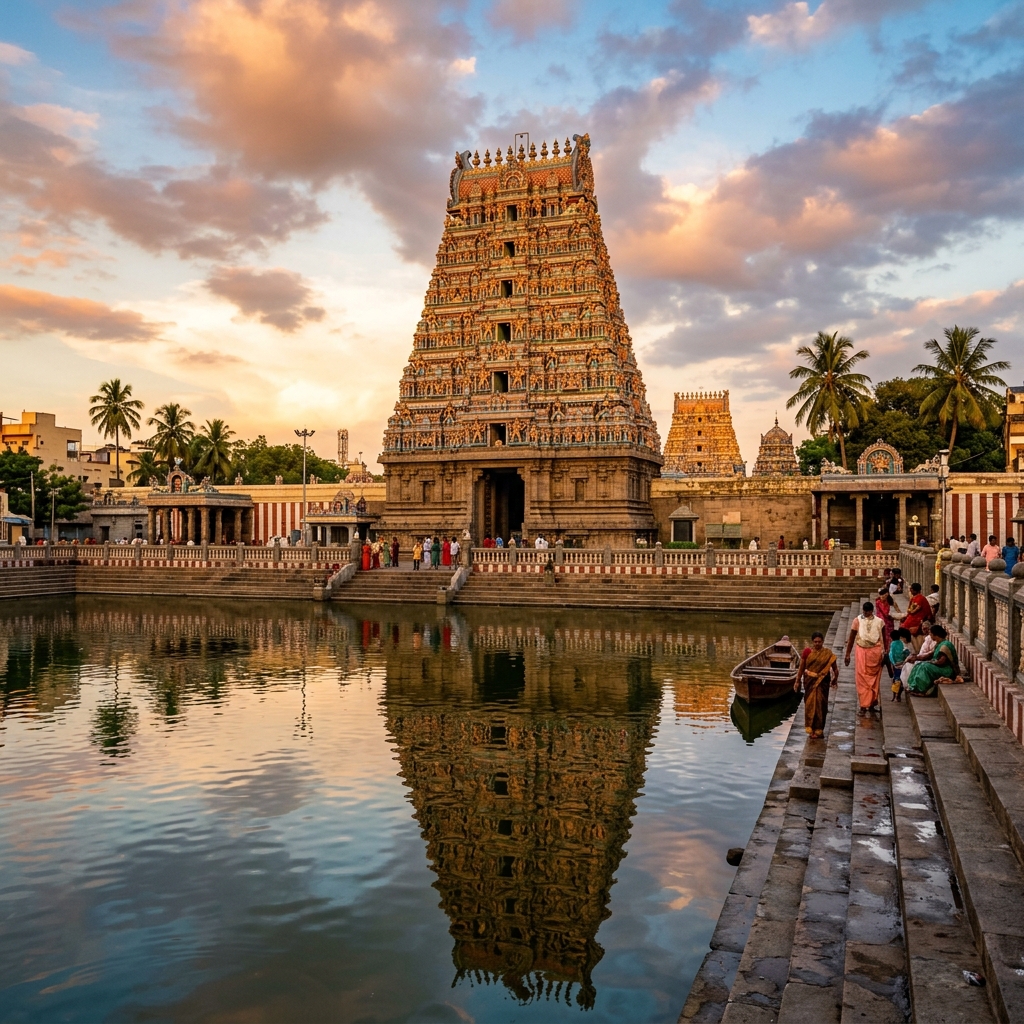
Thiruchopuram Arulmigu Mangalapureeswarar Temple (historically known as Thiru Chopuram / Tyagavalli) is an ancient 11th-century coastal Chola sanctuary and the 6th holy Paadal Petra Sthalam in the historic Nadu Naadu region of Tamil Nadu. Located along the scenic East Coast Road (ECR) just 15 km south of Cuddalore and 500 meters from the Bay of Bengal, this sacred temple derives its divine name Chopuram (Red Mountain / Golden Shore) from Lord Shiva's manifestation as a luminous mountain of golden-red light before Sage Agastya and Lord Brahma.

Enshrined in the 7th-century Tamil Tevaram hymns composed by child-saint Thirugnanasambandar, the temple is famous for its Surya Theertham—a miraculous freshwater well located right on the ocean shore whose water remains sweet as nectar despite being surrounded by salty sea water. The temple complex features a three-tiered Rajagopuram, an inner sanctum housing the Swayambhu Lingam of Mangalapureeswarar, a dedicated shrine for Goddess Satyayadakshi, the sacred Kolinji bush (Sthala Vriksham), and the serene coastal well. Pilgrims travel to Thiruchopuram to seek marriage boons (Mangala Dosha Nivarthi), auspiciousness, wealth, and freedom from astrological hurdles.

Sthala Puranam & Authentic Legends

The Manifestation of Chopuranathar (The Golden-Red Flame)

According to the Sthala Puranam, during ancient times, Sage Agastya and Lord Brahma performed intense penance at this coastal site to behold Lord Shiva's divine radiance. Pleased with their devotion, Lord Shiva manifested before them in the form of a magnificent, luminous mountain of reddish-golden light (Chopuram in Sanskrit, meaning Golden Red Spire). Lord Shiva promised that whoever worshipped Him at this spot would be blessed with all auspiciousness (Mangalam). Hence, the deity was hailed as Chopuranathar and Mangalapureeswarar, and the town was named Thiruchopuram.

The Miracle of the Sweet Coastal Well (Surya Theertham)

While performing daily abhishekam to Lord Chopuranathar, Sage Agastya found it difficult to fetch fresh water since the ocean was nearby and all local groundwater was salty. Agastya prayed to Lord Shiva for a source of pure water. Lord Shiva instructed Agastya to dig a small well near the eastern prakaram wall.

Miraculously, when water sprang forth from the well right next to the salty Bay of Bengal, it tasted completely sweet and pure! Named Surya Theertham (because Lord Surya worshipped here to regain his lost brilliance), this ancient well continues to yield sweet drinking water to this day, standing as a natural marvel and divine miracle.

Queen Tyagavalli & Chola History

During the 11th century CE, the devout Queen Tyagavalli, beloved consort of Chola Emperor Kulothunga Chola I, visited Thiruchopuram. Deeply moved by the beauty of the shrine, she gifted vast tracts of coconut groves and fertile lands to the temple. In honor of her patronage, the surrounding township was named Tyagavalli.

Classical Literary Canon & Sacred Hymns

  • Tevaram (1st Thirumurai): Glorified by Thirugnanasambandar in 11 verses beginning with "Karisai eerum kadeedhu solli... " (கரிசை ஈரும் கடீது சொல்லி).
  • Periya Puranam: Sekkizhar commemorates Sambandar's coastal pilgrimage through Thiru Chopuram in the 12th-century Shaivite chronicle.

Epigraphical & Historical Events

  • Kulothunga Chola I Inscriptions (1070–1120 CE): Stone inscriptions carved into the inner granite walls of the sanctum document royal grants of land by Queen Tyagavalli for maintaining daily morning and evening poojas and feeding ascetics.
  • Sundara Pandya Inscriptions: 13th-century epigraphs record repairs to the outer mandapam corridors and temple wall boundaries.

Archaeo-Engineering & Scientific Marvels

Ancient metallurgical marvels, Siddha alchemical sciences, archaeo-engineering, and GI-tagged heritage:

  • Hydrological Anomaly of Surya Theertham: Geological studies of the temple well observe that despite its location less than 500 meters from the saline ocean shore, the groundwater aquifer is fed by a natural fresh lens, yielding potable water with low total dissolved solids (TDS).
  • Chola Coastal Architecture: Built from solid granite blocks to withstand coastal humidity and salt-air erosion over a millennium.

Signature Rituals, Anomalies & Special Sevas

Authentic daily pooja timelines, spatika-lingam darshan hours, special sevas, and sacred temple anomalies:

  • Mangala Dosha & Marriage Boon Pooja: Special abhishekam performed for Goddess Satyayadakshi and Lord Mangalapureeswarar on Tuesdays and Fridays to overcome marriage delays and marital disharmony.
  • Four Daily Kala Poojas: Morning Kalasanthi, Midday Uchikalam, Evening Sayarakshai, and Night Ardha Jamam.
  • Surya Pushkarini Theertham Snanam: Devotees sprinkle water from the sweet coastal well on Sundays to seek energy and cure eye ailments.

What to See in the Temple (Visual Highlights)

🛕

Main Sanctum (Garbhagriha)

Housing the sacred Swayambhu Lingam of Lord Mangalapureeswarar (Chopuranathar).

🛕

Goddess Satyayadakshi Shrine

Dedicated south-facing shrine for Goddess Parvati as Chopuranayaki.

🛕

Surya Theertham (Sweet Coastal Well)

Ancient freshwater well located near the eastern temple wall.

🛕

Sthala Vriksham (Kolinji Bush)

Sacred Kolinji plant inside the temple courtyard.

🛕

Chola Koshta Reliefs

Fine 11th-century stone reliefs of Lord Dakshinamurthy, Lingodbhavar, Brahma, and Durga adorning the outer sanctum walls.

Practical Visitor Logistics & Dress Code

Temple Opening Timings & Daily Hours

Morning: 6:00 AM – 12:00 PM; Evening: 4:30 PM – 8:00 PM.

Darshan & Special Entry Tickets

Free general queue available; Special Darshan: ₹20.

Dress Code & Special Rules

Traditional Indian attire (Men: Dhoti / Pants; Women: Saree / Salwar Kameez).

Accessibility & Senior Citizens

Single ground-level layout with easy step-free access.

Car Parking & Footwear Cloakroom

Parking available in front of the temple entrance along Tyagavalli ECR road; footwear counter at entrance gate.

Best Time to Visit & Festival Calendar

Seasonal weather guide, peaceful darshan timings, and annual Brahmotsavam festival dates:

  • Best Months: October to March (pleasant coastal climate).
  • Major Festivals: Maha Shivaratri (Feb–March), Margazhi Arudra Darshan (Dec–Jan), Panguni Uthiram (March–April), Monthly Pradosham.

Transit, Accommodations & Prasadam Dining

How to Reach & Connectivity

  • Nearest Railway Station: Cuddalore Port Junction (CUPJ) - 15 km; Chidambaram Railway Station (CDM) - 28 km.
  • Nearest Airport: Puducherry Airport (PNY) - 35 km; Tiruchirappalli International Airport (TRZ) - 135 km.
  • Last-Mile Local Transport: TNSTC buses running along ECR between Cuddalore and Chidambaram stop at Tyagavalli / Thiruchopuram bus stop. Auto-rickshaws available from Cuddalore.

Free Annadhanam & Local Veg Dining

  • Temple Prasadam: Puliyodarai, Ven Pongal, Sundal, Vibhooti Prasadam.
  • Nearby Dining: Pure vegetarian dining available at Cuddalore town and along East Coast Road.

Accommodations & Lodging Hubs

  • Named Hotels: Hotels in Cuddalore town (15 km) such as Hotel Tamil Nadu Cuddalore, and beach resorts along Puducherry ECR road (30 km).

Nearby Heritage Spots (5–30 km Radius)

Combine your yatra with surrounding UNESCO heritage sites, Paadal Petra Sthalams & Divya Desams:

Theerthanagiri Sivakozhuntheeswarar Temple

8 km
Sacred & Heritage Spot

distance, historic Paadal Petra Sthalam with Saptha Theerthams.

Cuddalore Padaleeswarar Temple

15 km
Sacred & Heritage Spot

distance, major ancient Paadal Petra Sthalam in Cuddalore.

Pichavaram Mangrove Forest

25 km
Sacred & Heritage Spot

distance, world's second largest mangrove forest boat riding site.

Verified References & Source Bibliography

  • Tevaram Thirumurai Canon (1st Thirumurai, Thirugnanasambandar).
  • Periya Puranam by Sekkizhar (Sambandar Puranam).
  • ASI South Indian Inscriptions, Volume XIX (Inscriptions of Kulothunga Chola I).

Community Photo Gallery (0)

No community photos uploaded yet.

Pilgrim Reflections (0)

No reflections logged for this destination yet.