Explore Calendar Community THADAM+ My Thadam
Thirukkachur Sri Kachabeswarar & Sri Virundheeswarar Temple
Paadal Petra Sthalams

Thirukkachur Sri Kachabeswarar & Sri Virundheeswarar Temple

Thirukkachur- Kachabeswarar Temple

Sri Kachabeswarar (Swayambhu) & Sri Virundheeswarar • Chengalpattu, Thondai Nadu

Open in Maps My Thadam Check in

About the Sacred Destination

Presiding Deity
Sri Kachabeswarar (Swayambhu) & Sri Virundheeswarar
Consort & Sub-Shrines
Sri Kachabeswarar (Foothill Shrine) & Sri Virundheeswarar (Hilltop Shrine) & Goddess Anjanakshi Amman / Irulneekki Ambal
Era & Dynasty
Pallava origins (8th C CE) with major Chola granite expansions by Kulothunga Chola I (1070–1120 CE), Vikrama Chola, and Vijayanagara Kings
Sacred Status & Classification
Paadal Petra Sthalam (Thondai Nadu Shrine #27 / Shrine #264 of 276 Shaivite Shrines)

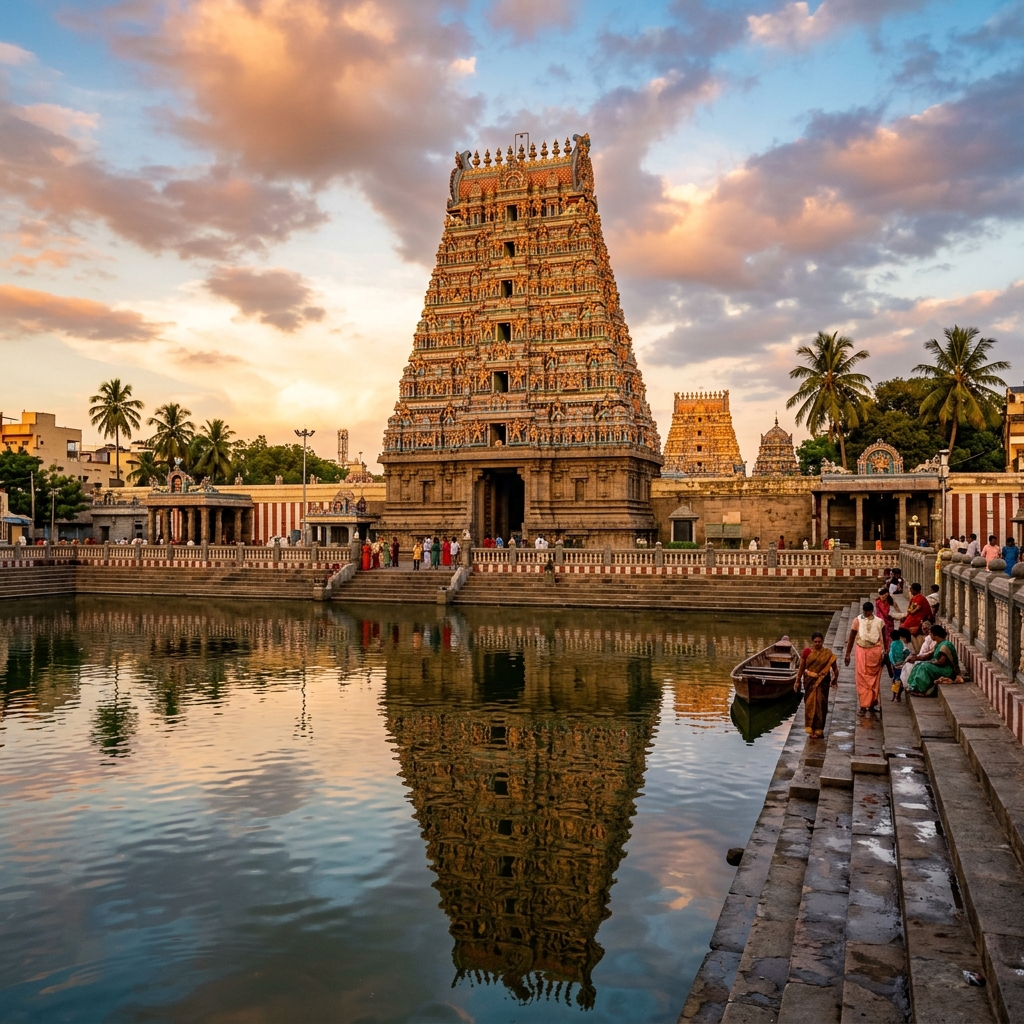
Thirukkachur Sri Kachabeswarar & Sri Virundheeswarar Temple is an ancient and profound Paadal Petra Sthalam immortalized in the 8th-century Tevaram hymns of Saint Sundaramurthy Nayanar. Nestled at the foot of a scenic hillock near Singaperumal Kovil in Chengalpattu district, Tamil Nadu, the temple encompasses a unique dual-shrine complex: the principal foothill sanctuary of Sri Kachabeswarar and the hilltop shrine of Sri Virundheeswarar (Malaikovil).

Spanning across a serene 5-acre granite complex, the foothill temple features a 5-tiered entrance Rajagopuram, a spacious 16-pillared assembly hall (Mukha Mandapam), the sacred Koorma Theertham water tank, and an inner sanctum housing a self-manifested Swayambhu Shiva Lingam. The temple is celebrated for two legendary divine miracles: Lord Vishnu taking the form of Kurma (turtle) to worship Lord Shiva after the cosmic churning of the Ocean of Milk, and Lord Shiva Himself walking the village streets disguised as a begging priest to collect food and serve a lavish feast (Virundhu) to an exhausted Saint Sundarar.

Sthala Puranam & Authentic Legends

Divine Manifestation & Kurma Avatar Legend (Kachabeswarar)

According to the ancient Thondaimandala Puranam, during the celestial event of Samudra Manthan (churning of the Ocean of Milk), the celestial Mandara Mountain began to sink into the deep waters. Lord Vishnu assumed the gigantic avatar of Kurma (the cosmic turtle) to support the mountain upon His shell. After the churning yielded the divine nectar (Amritham), Lord Vishnu felt immense physical heat, exhaustion, and pride from His colossal feat. To regain His divine tranquility and purify His form, Lord Vishnu descended to Thirukkachur, dug a sacred pool using His fins—known today as Koorma Theertham—and established a Shiva Lingam. Lord Vishnu performed rigorous penance (Tapas) worshipping Lord Shiva with bilva leaves and holy water. Pleased by Vishnu's devotion, Lord Shiva appeared, absorbed His fatigue, and granted Him cosmic peace. Since Lord Vishnu worshipped here in His Kachaba (turtle) form, the presiding Lord earned the divine name Sri Kachabeswarar (Kachabam = Turtle, Eswarar = Lord Shiva).

Sundarar's Feast Miracle & Virundheeswarar Legend

In the 8th Century CE, Saint Sundaramurthy Nayanar was traveling on foot from Thirukkazhukundram to Thirukkachur along with a large group of Nayanmar disciples. After walking under the intense afternoon sun, Sundarar reached Thirukkachur thoroughly exhausted, dehydrated, and famished. Unable to walk further, he sat under a shade-giving Banyan tree near the foot of the hill. Seeing the plight of His beloved devotee, Lord Shiva transformed Himself into an elderly Brahmin priest carrying a begging bowl (Bhiksha Patra). The Lord approached Sundarar and said, "Stay here and rest, my son; I shall bring you food." Lord Shiva then went door-to-door through every house in the village of Thirukkachur, begging for cooked rice, dhal, and curries. Collecting a vessel full of fresh, warm food, the Lord returned and lovingly served a royal feast (Virundhu) to Sundarar and his companions. When Sundarar completed his meal and turned around to express his gratitude, the old Brahmin vanished into the air. Realizing that it was Lord Shiva Himself who had begged for food to feed His devotee, Sundarar broke down in tears of ecstatic devotion and composed the famous Tevaram decad starting with "Mudhakkalazhundhi". Because the Lord served a feast (Virundhu) to His devotee, the hilltop deity is worshipped to this day as Sri Virundheeswarar.

Goddess Anjanakshi Amman & Irulneekki Ambal

The shrine of the Divine Mother at Thirukkachur is dedicated to Goddess Anjanakshi Amman. According to local priest traditions, the Goddess applies divine eye ointment (Anjana) to Her devotees, curing physical eye ailments, cataract, and spiritual blindness (Irul). Devotees who offer lotus flowers and ghee lamps to Goddess Anjanakshi are blessed with restored eyesight and inner clarity. She is also reverently called Irulneekki Ambal ("The Goddess who dispels darkness").
Classical Literary Canon & Sacred Hymns

This sacred shrine is enshrined in the 7th Thirumurai of the Tevaram by Saint Sundaramurthy Nayanar.

  • Tevaram Hymn by Saint Sundarar (7th Thirumurai, Decad 42):

> "முதுக கூனலைந்த மொய்ம்பிற் கோலமே மேவி > சதுக விஞ்சையர்கள் பாடி வாழ்த்தும் திருக்கச்சூர் > விதுகொள் சடையானை விருந்தீஸ்வரனைத் தொழுது > எதுகொள் தொண்டரெல்லாம் இன்புற்று வாழ்வாரே." > > Translation: "Oh Lord of Thirukkachur who wears the crescent moon upon Your matted locks, who assumed a humble form and begged for food to serve a feast to Your devotees! Those who bow before Virundheeswarar shall be liberated from all sorrows and live in eternal bliss."

The temple is also vividly documented in Sekkizhar's 12th-century masterpiece Periya Puranam.

Epigraphical & Historical Events

  • Chola Stone Inscriptions: The granite walls of the inner prakaram feature over 15 historical inscriptions dating back to the reign of Kulothunga Chola I (1070–1120 CE), Vikrama Chola (1118–1135 CE), and Rajaraja Chola III (1216–1246 CE).
  • Royal Endowments: Inscriptions record royal decrees granting agricultural lands in Kachur-nadu for maintaining the daily Sundarar Virundhu offering, burning 24 perpetual ghee lamps (Nanda Deepam), and funding the annual Sundarar Begging Festival.

Archaeo-Engineering & Scientific Marvels

Ancient metallurgical marvels, Siddha alchemical sciences, archaeo-engineering, and GI-tagged heritage:

  • Dual Structural Layout: A rare archaeo-architectural layout comprising two distinct temples—the Kachabeswarar Temple at the foothill (symbolizing Vishnu's Kurma worship) and the Virundheeswarar Malaikovil on the hilltop.
  • Koorma Theertham Hydro-Geometry: The temple tank's stone steps are carved in a square turtle-shell concentric pattern, designed anciently to maintain natural water filtration.

Signature Rituals, Anomalies & Special Sevas

Authentic daily pooja timelines, spatika-lingam darshan hours, special sevas, and sacred temple anomalies:

  • Sundarar Virundhu Festival (Chithirai Month): On the day of Chitra Pournami, the priest re-enacts Lord Shiva going with a begging bowl to village households, collecting cooked rice, and distributing it as sacred prasadam to all pilgrims.
  • Koorma Avathara Abhishekam: Special holy bathing with milk, honey, and lotus water performed on Saturdays to Lord Kachabeswarar for overcoming career hurdles.
  • Anjanakshi Netra Pooja: Special eye-healing pooja performed on Tuesdays and Fridays for devotees suffering from eye ailments.

What to See in the Temple (Visual Highlights)

🛕

Foothill Sanctum (Sri Kachabeswarar)

Houses the self-manifested (Swayambhu) Lingam facing East, worshipped by Lord Vishnu.

🛕

Goddess Anjanakshi Amman Shrine

Dedicated sanctum featuring the graceful standing idol of Ambal adorned with eye ointments.

🛕

Hilltop Malaikovil (Sri Virundheeswarar)

Reached via 100 wide stone steps, offering panoramic views of the surrounding hills and housing Lord Virundheeswarar.

🛕

Banyan Tree (Sthala Vriksham)

Sacred tree under which Lord Shiva served food to Saint Sundarar.

🛕

Koorma Theertham

Serene square temple tank where Lord Vishnu performed penance.

Practical Visitor Logistics & Dress Code

Temple Opening Timings & Daily Hours

Morning: 06:00 AM – 11:30 AM; Evening: 05:00 PM – 08:30 PM

Darshan & Special Entry Tickets

Free General Queue; Special Entry Darshan Ticket: ₹20

Dress Code & Special Rules

Traditional Indian attire mandatory (Dhoti/Shirt for men; Saree/Salwar for women). Men must remove upper shirt when entering the inner sanctum of Kachabeswarar

Accessibility & Senior Citizens

Foothill Kachabeswarar temple is fully flat and wheelchair accessible. Hilltop Virundheeswarar shrine requires climbing ~100 low stone steps

Car Parking & Footwear Cloakroom

Dedicated vehicle parking available near North Gopuram and Koorma Theertham. Footwear counter located at the main gate

Best Time to Visit & Festival Calendar

Seasonal weather guide, peaceful darshan timings, and annual Brahmotsavam festival dates:

  • Best Months: October to March (pleasant climate for temple exploration)
  • Major Festivals:
  • Chithirai Festival & Sundarar Virundhu (April–May): Reenactment of Lord Shiva's begging feast for Sundarar.
  • Maha Shivaratri (February–March): Four-kala night long abhishekam.
  • Navarathri for Anjanakshi Amman (September–October): 9-day grand festival.

Transit, Accommodations & Prasadam Dining

How to Reach & Connectivity

  • Nearest Railway Station: Singaperumal Kovil Railway Station (2.5 km) / Chengalpattu Junction (12 km)
  • Nearest Airport: Chennai International Airport (MAA) (35 km)
  • Last-Mile Local Transport: Shared auto-rickshaws, local taxis, and MTC Bus Route 70V / M70 running frequently from Singaperumal Kovil bus stop (GST Road / NH 45)

Free Annadhanam & Local Veg Dining

  • Temple Prasadam: Sundarar Virundhu Prasadam (Ven Pongal, Puliyodarai, Dhal Rice & Sundal). Free Annadhanam served daily at 12:15 PM
  • Nearby Dining: Hotel Sri Saravana Bhavan (Singaperumal Kovil - 2.5 km), Adyar Ananda Bhavan (GST Road - 3 km)

Accommodations & Lodging Hubs

  • Hotel MGR Residency (Singaperumal Kovil - 2.5 km)
  • SRM Hotel & Resort (Maraimalai Nagar - 6 km)
  • TTDC Hotel Tamil Nadu (Chengalpattu - 12 km)

Nearby Heritage Spots (5–30 km Radius)

Combine your yatra with surrounding UNESCO heritage sites, Paadal Petra Sthalams & Divya Desams:

Singaperumal Kovil Sri Pataladri Narasimha Swamy Temple

2.8 km
Ancient rock

cut cave temple dedicated to Lord Narasimha

Thirukkazhukundram Vedagiriswarar Hill Temple

22 km
Sacred & Heritage Spot

Famous Paadal Petra Sthalam hill temple known for eagle worship

Mahabalipuram UNESCO Shore Temple & Monuments

32 km
World famous 7th

century Pallava rock-cut architecture by the sea

Verified References & Source Bibliography

  • Tevaram 7th Thirumurai by Saint Sundaramurthy Nayanar (Decad 42)
  • Periya Puranam by Sekkizhar (Sundara Moorthy Nayanar Puranam)
  • Early Chola Temples by S.R. Balasubrahmanyam (1971, Orient Longman)
  • ASI South Indian Inscriptions, Vol. III (Inscriptions of Kulothunga Chola I)
  • HR&CE Devasthanam Archives, Arulmigu Kachabeswarar Temple, Thirukkachur

Community Photo Gallery (0)

No community photos uploaded yet.

Pilgrim Reflections (0)

No reflections logged for this destination yet.