
Explore Calendar Community THADAM+ My Thadam
Thirumalpur-Sri Manikanteswara Swamy Temple
Paadal Petra Sthalams

Thirumalpur-Sri Manikanteswara Swamy Temple

Thirumalpur-Sri Manikanteswara Swamy Temple

Maal Vanangia Eesar, Manikandeswarar and the Ambal Karunai Nayaki, Anjanakshi The sthala vriksham is Vilvam and the Theertham Vishnu Theertham Sambandar and Appar composed the Pathigam • Tamil Nadu, Thondai Naadu Temples

Open in Maps My Thadam Check in

About the Sacred Destination

Presiding Deity
Maal Vanangia Eesar, Manikandeswarar and the Ambal Karunai Nayaki, Anjanakshi The sthala vriksham is Vilvam and the Theertham Vishnu Theertham Sambandar and Appar composed the Pathigam
Consort & Sub-Shrines
Sri Manikanteswarar (Maal Vanangia Eesar) & Goddess Karunai Nayaki / Anjanakshi
Era & Dynasty
Early Chola origins (9th–10th C CE) with major extensions by Chola Kings Parantaka I, Rajaraja I, and Rajendra I
Sacred Status & Classification
Paadal Petra Sthalam (Thondai Nadu Shrine #11 / Shrine #274 of 276 Shaivite Shrines)

Thirumalpur Arulmigu Manikanteswarar Temple, historically known as Thirumalperu, is one of the celebrated 276 Paadal Petra Sthalams immortalized in the 7th-century Tevaram hymns composed by Saint Thirugnanasambandar and Saint Thirunavukkarasar (Appar). Situated strategically between the ancient silk city of Kanchipuram and Arakkonam in Tamil Nadu, this holy shrine is famous across South India as the sacred site where Lord Vishnu (Maal) worshipped Lord Shiva with 1,000 lotus flowers and offered His own lotus eye to receive the powerful Sudarshana Chakra.

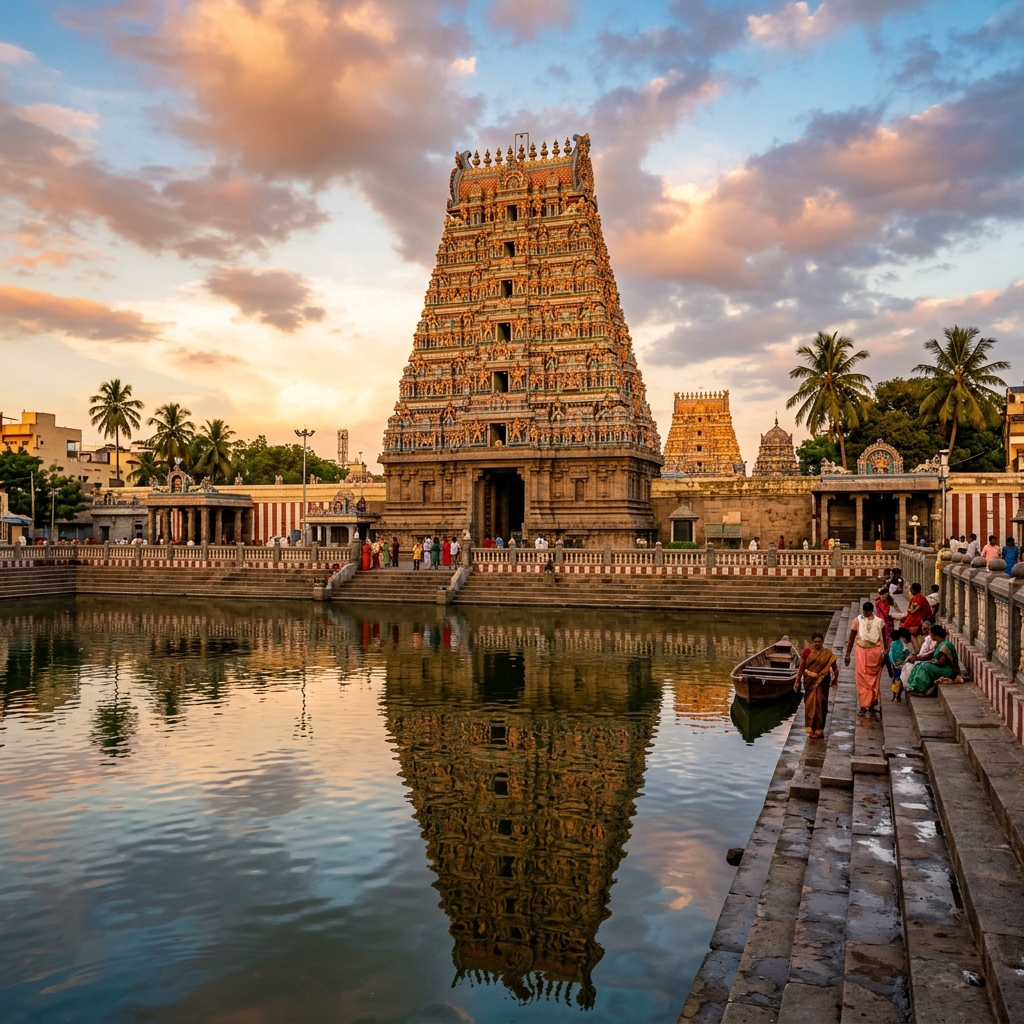
Spanning a serene granite complex housing a towering 5-tiered Rajagopuram, sculpted Chola granite walls, a sacred lotus tank (Vishnu Theertham), and an inner sanctum enshrining a self-manifested Swayambhu Lingam, Thirumalpur stands as a monumental symbol of Hari-Hara unity. Devotees visit this sacred sanctuary to pray for vision health, relief from eye ailments, and divine spiritual enlightenment.

Sthala Puranam & Authentic Legends

Lord Vishnu's Eye Offering & Sudarshana Chakra Boon

The principal sthala puranam of Thirumalpur is recorded in the Shiva Puranam and Tevaram canon. When the demon Jalandhara wreaked havoc across the three worlds, Lord Vishnu resolved to defeat him. To obtain the invincible cosmic weapon, the Sudarshana Chakra, from Lord Shiva, Vishnu undertook intense penance at Thirumalpur, promising to offer 1,000 fresh lotus flowers daily to the Swayambhu Lingam.

To test Vishnu's unyielding devotion, Lord Shiva secretly concealed one lotus flower on the final day. Upon counting His daily offering, Vishnu discovered He had only 999 flowers. Without a moment's hesitation, Lord Vishnu plucked out His own right lotus eye (Kamala-Nethram) with his fingernail and laid it upon the Shiva Lingam to complete the 1,000th lotus offering. Deeply moved by this supreme sacrifice, Lord Shiva immediately manifested before Vishnu, restored His eye, and granted Him the incandescent Sudarshana Chakra. In commemoration of this divine event, the deity assumed the title Maal Vanangia Eesar ("The Lord Worshipped by Vishnu") and Manikanteswarar.

Name Origin of Thirumalperu / Thirumalpur

Because Lord Vishnu (Thirumal) worshipped Shiva and gained His divine weapon at this holy sthalam, the village was consecrated as Thirumalperu (meaning "The Place where Thirumal Gained Grace"), which over centuries came to be pronounced as Thirumalpur.

Sage Agastya's Worship

Sage Agastya worshipped Lord Manikanteswarar at Thirumalpur during his southern journey to balance the earth. The Lord granted him divine visions of the celestial wedding of Shiva and Parvati (Kalyana Kolam) at this sanctum.

Classical Literary Canon & Sacred Hymns

This sacred shrine is enshrined in the 2nd Thirumurai of the Tevaram by Saint Thirugnanasambandar and the 6th Thirumurai by Saint Appar.

  • Tevaram Hymn by Saint Thirugnanasambandar:

> "மாதோர் கூறன மான்மறி ஏந்திய > ஆதியன் அமரும் திருமால்பேறு > ஏதியால் எதிர்ந்த இமையவர் போற்ற > நீதியால் நினைவார் வினைய நாசமே." > > Translation: "At Thirumalperu resides the Supreme Lord Shiva who holds the deer in His hand and shares His body with Goddess Parvati. Devotees who meditate upon Him according to righteous duty shall see all their past karmas completely destroyed."

The temple is also extolled in Sekkizhar's 12th-century epic Periya Puranam.

Epigraphical & Historical Events

  • Early Chola Inscriptions: Epigraphical surveys by the Archaeological Survey of India (ASI) record over 40 stone inscriptions carved into the Garbhagriha walls. Inscriptions of Parantaka I (907–955 CE) document land grants for feeding Vedic scholars.
  • Rajaraja I & Rajendra I Grants: Inscriptions of Rajaraja Chola I and his son Rajendra I detail gold gifts (Pon) for maintaining perpetual ghee lamps and celebrating the annual Brahmotsavam festival.

Archaeo-Engineering & Scientific Marvels

Ancient metallurgical marvels, Siddha alchemical sciences, archaeo-engineering, and GI-tagged heritage:

  • Iconographical Anomaly: A unique sculpted stone icon inside the inner prakaram depicts Lord Vishnu kneeling on one knee and presenting His lotus eye on a platter to Lord Shiva, illustrating the core sthala puranam.
  • Eye Healing Tradition: Devotees suffering from eye disorders, cataract issues, or failing vision perform special Nethra Pooja (eye worshipping ritual) at this temple, offering silver eye plates (Nethra Malai).

Signature Rituals, Anomalies & Special Sevas

Authentic daily pooja timelines, spatika-lingam darshan hours, special sevas, and sacred temple anomalies:

  • Four Daily Kala Poojas: Conducted as per Shaiva Agama rites: Kalasanthi (8:00 AM), Uchikalam (12:00 PM), Sayarakshai (5:30 PM), and Ardha Jamam (8:00 PM).
  • Nethra Abhishekam & Eye Offering: Special weekly ritual on Mondays where devotees offer lotus flowers and silver eye tokens to Sri Manikanteswarar seeking healing for eye ailments.
  • Vishnu-Shiva Joint Festival: Special festival on Vaikunta Ekadashi and Maha Shivaratri celebrating the divine bond between Lord Vishnu and Lord Shiva.

What to See in the Temple (Visual Highlights)

🛕

Main Sanctum (Garbhagriha)

Enshrines the self-manifested Swayambhu Lingam of Sri Manikanteswarar.

🛕

Lord Vishnu Offering Eye Sculpted Shrine

Rare stone sculpture depicting Lord Vishnu plucking out His eye for Shiva.

🛕

Goddess Karunai Nayaki Shrine

South-facing shrine housing the compassionate 4-foot standing image of Goddess Anjanakshi.

🛕

Vishnu Theertham

Sacred temple tank where Lord Vishnu bathed before His penance.

🛕

Rajagopuram

Towering 5-tiered granite and mortar entrance gopuram.

Practical Visitor Logistics & Dress Code

Temple Opening Timings & Daily Hours

Morning: 6:00 AM – 12:00 PM; Evening: 4:30 PM – 8:30 PM

Darshan & Special Entry Tickets

Free general entry queue; Special Darshan Ticket: ₹20

Dress Code & Special Rules

Traditional Indian attire mandatory. Men: Dhoti, Shirt, or Kurta; Women: Saree, Salwar Kameez

Accessibility & Senior Citizens

Ground-level access throughout outer prakaram; assistance ramps provided at inner step entrances

Car Parking & Footwear Cloakroom

Parking area available in front of the East Rajagopuram entrance; footwear counter near gopuram gate

Best Time to Visit & Festival Calendar

Seasonal weather guide, peaceful darshan timings, and annual Brahmotsavam festival dates:

  • Best Months: October to March (cooler winter climate ideal for pilgrimage)
  • Major Festivals:
  • Maha Shivaratri (Feb–March): Night-long four-kala poojas and lotus flower offerings.
  • Thai Brahmotsavam (Jan–Feb): 10-day festival featuring grand float procession (Theppotsavam) in Vishnu Theertham.
  • Margazhi Arudra Darshan (Dec–Jan): Abhishekam for Nataraja.

Transit, Accommodations & Prasadam Dining

How to Reach & Connectivity

  • Nearest Railway Station: Thirumalpur Railway Station (TML) - 2.5 km; Kanchipuram Railway Station (CJ) - 15 km; Arakkonam Junction (AJJ) - 14 km
  • Nearest Airport: Chennai International Airport (MAA) - 75 km
  • Last-Mile Local Transport: Direct Tamil Nadu State Transport (TNSTC) buses run every 20 minutes from Kanchipuram Bus Stand (15 km) and Arakkonam Bus Stand (14 km) via Thirumalpur. Local auto-rickshaws available at Thirumalpur Railway Station (2.5 km from temple)

Free Annadhanam & Local Veg Dining

  • Temple Prasadam: Kovil Puliyodarai, Sakkarai Pongal, Sundal, and Lotus Flower Vibhooti Prasadam available at temple counter. Free daily Annadhanam served at 12:15 PM
  • Specific Pure-Veg Restaurants: Hotel Sri Saravana Bhavan (Kanchipuram Bus Stand Road - 15 km); Hotel Annapoorna Veg (Arakkonam Station Road - 14 km)

Accommodations & Lodging Hubs

  • Temple / Devasthanam Stays: Arulmigu Manikanteswarar Temple Yatri Nivas (Thirumalpur)
  • Hotels in Kanchipuram (15 km): Hotel GRT Regency Kanchipuram (15 km); Hotel Baboo Residency (14 km)
  • Hotels in Arakkonam (14 km): Hotel Annapoorna Boarding & Lodging (Arakkonam - 14 km)

Nearby Heritage Spots (5–30 km Radius)

Combine your yatra with surrounding UNESCO heritage sites, Paadal Petra Sthalams & Divya Desams:

Kanchipuram Ekambareswarar Temple

15 km
Sacred & Heritage Spot

South; Supreme Pancha Bhoota Prithvi Sthalam

Kanchipuram Varadaraja Perumal Temple

17 km
South

East; Famous Divya Desam temple

Nemili Sri Bala Peetam

12 km
North

East; Renowned Siddha & Bala Tripurasundari temple

Verified References & Source Bibliography

  • Tevaram Thirumurai Canon (2nd & 6th Thirumurai by Saint Sambandar & Appar)
  • Periya Puranam by Sekkizhar
  • ASI South Indian Inscriptions (Vol. III, Inscriptions of Thirumalperu / Thirumalpur)
  • HR&CE Devasthanam Archives, Arulmigu Manikanteswarar Temple, Thirumalpur

Community Photo Gallery (0)

No community photos uploaded yet.

Pilgrim Reflections (0)

No reflections logged for this destination yet.