Explore Calendar Community THADAM+ My Thadam
Thiruvakkarai - Chandra Mouliswarar Temple
Paadal Petra Sthalams

Thiruvakkarai - Chandra Mouliswarar Temple

Thiruvakkarai - Chandra Mouliswarar Temple

Chandrasekharar and the Ambal Vadivambikai • Tamil Nadu, Thondai Naadu Temples

Open in Maps My Thadam Check in

About the Sacred Destination

Presiding Deity
Chandrasekharar and the Ambal Vadivambikai
Consort & Sub-Shrines
Lord Chandramouleswarar (Vakra Lingam) & Goddess Amirthambigai (Amrithambigai / Vadivambigai)
Era & Dynasty
Built as a stone temple by Chola Queen Sembiyan Mahadevi in 967 CE; earlier Brick structure converted to granite; Inscriptions of Parantaka I, Rajaraja I, Rajendra I, and Vijayanagara rulers.
Sacred Status & Classification
Paadal Petra Sthalam (#30 in Thondai Naadu / 276 Shaivite Shrines); Glorified in Tevaram by Thirugnanasambandar.

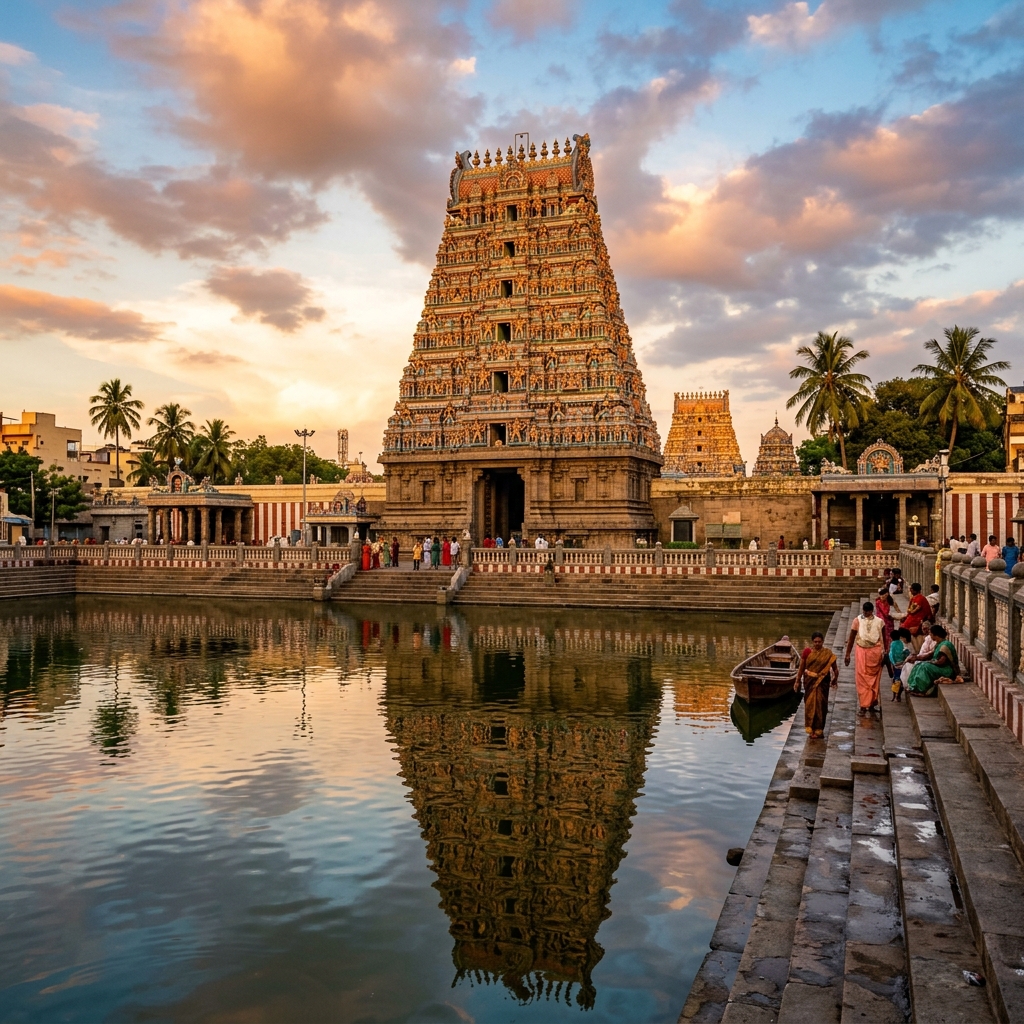
Thiruvakkarai Arulmigu Chandramouleswarar Temple is a historic 10th-century Chola granite temple and one of the revered 276 Paadal Petra Sthalams of Lord Shiva, glorified in the 7th-century Tamil Tevaram hymns by Thirugnanasambandar. Situated on the serene northern bank of the Varaha River in Villupuram district, Thiruvakkarai is globally renowned for its trio of 'Vakra' (inverted/crooked/unique) manifestations: the three-faced Vakra Lingam, the fierce Vakra Kali, and the unique Vakra Shani (Saturn).

The temple complex was grandly reconstructed in everlasting stone by the noble Chola Queen Sembiyan Mahadevi (mother of King Uttama Chola) in 967 CE. Featuring an offset Rajagopuram, an inner sanctum housing a rare Mukha Lingam, a dedicated shrine for Varadaraja Perumal (Vishnu) wielding the Prayoga Chakra, and a powerful sanctuary for Goddess Vakra Kali, Thiruvakkarai stands as a monument of intense spiritual power, architectural brilliance, and ancient epigraphical history.

Sthala Puranam & Authentic Legends

Slaying of Demon Vakrasura & Manifestation of Vakra Kali

According to the Sthala Puranam, an atrocious demon named Vakrasura obtained an extraordinary boon from Lord Shiva through intense penance: that no mortal, weapon, or god could slay him unless Lord Shiva Himself intervened. Emboldened by this invincibility, Vakrasura tormented the devas, rishis, and sages. Seeking relief, the celestial beings prayed to Lord Vishnu and Lord Shiva.

Lord Vishnu engaged Vakrasura in fierce battle and decapitated him using His divine discus, the Prayoga Chakra. However, Vakrasura's sister, Dhunmukhi, possessed the magical ability to generate thousands of demons from every drop of blood that fell to the earth. To stop Dhunmukhi, Goddess Parvati assumed her fierce form as Vakra Kali and drank every drop of Dhunmukhi's blood before it could touch the ground, eradicating the demoness. Having consumed the demoness's blood, Vakra Kali was overwhelmed with wrath (Ugra). To pacify Her, Lord Shiva manifested in front of Her as Chandramouleswarar, placing the gentle moon on His crest, thereby calming Her divine fury.

The Legend of the Vakra Lingam & Offset Geometry

Because Vakrasura worshipped Lord Shiva by placing the Lingam in an unusual angle, the Lingam assumed a unique three-faced form facing North (Mukha Lingam), known as Vakra Lingam. Uniquely, during the summer months, the Lingam turns cool and secretes tiny moisture droplets, while during cold winter months, the Lingam remains warm to the touch. Furthermore, every structural element of this temple—the main Rajagopuram entrance, the Nandhi statue, the sanctum axis, and the Saturn idol—is deliberately offset ('Vakra') from a straight linear alignment.

Nayanmar Visits & Tevaram Miracles

In the 7th century CE, the child-saint Thirugnanasambandar visited Thiruvakkarai. Overwhelmed by the Lord's presence and the pacified grace of Goddess Vakra Kali, he sang 11 sublime Tevaram verses praising Chandramouleswarar as the supreme cosmic healer who liberates devotees from all physical, mental, and planetary afflictions (Vakra Doshams).

Classical Literary Canon & Sacred Hymns

  • Tevaram (1st Thirumurai): Glorified by Thirugnanasambandar in 11 verses beginning with "Piraiyaru Sadaiyanai... " (பிறையாரும் சடையானை).
  • Tiruppugazh: Saint Arunagirinathar composed sacred Tamil Tiruppugazh verses in praise of Lord Murugan enshrined within the temple precinct.
  • Periya Puranam: Sekkizhar documents Sambandar's pilgrimage to Thiruvakkarai in the 12th-century Shaivite hagiography.

Epigraphical & Historical Events

  • Sembiyan Mahadevi Inscriptions (967 CE): Stone inscriptions on the southern wall of the inner sanctum record that Queen Sembiyan Mahadevi, mother of Uttama Chola, converted the ancient brick temple into a grand stone structure (Kattrali) and gifted gold ornaments, silver vessels, and lands for daily worship.
  • Rajaraja Chola I & Rajendra I Inscriptions: Record endowments of land (Devadana) for maintaining temple musicians, reciters of Tevaram (Oduvars), and perpetual lamps (Nanda Deepam).
  • Vijayanagara & Nayaka Grants: 15th and 16th-century inscriptions detail repairs to the outer pillared mandapams and temple tank walls.

Archaeo-Engineering & Scientific Marvels

Ancient metallurgical marvels, Siddha alchemical sciences, archaeo-engineering, and GI-tagged heritage:

  • Thermal Anomaly of Vakra Lingam: Scientific studies and priest traditions observe that the granite Lingam maintains a warm surface temperature during winter months and a cool, moist surface during peak summer heat.
  • Vakra Shani & Crow Alignment: The idol of Shani Bhagavan (Saturn) has his vehicle, the Crow, facing right instead of left, symbolizing the reversal of astrological planetary afflictions (Vakra Shani Nivarthi).
  • GSI National Fossil Wood Park: Located just 1 km from the temple is the Thiruvakkarai National Fossil Wood Park, maintained by the Geological Survey of India (GSI), containing 20-million-year-old petrified tree trunks from the Mio-Pliocene era.

Signature Rituals, Anomalies & Special Sevas

Authentic daily pooja timelines, spatika-lingam darshan hours, special sevas, and sacred temple anomalies:

  • Midnight Pournami Pooja (Full Moon Night): Thousands of devotees gather every Pournami (Full Moon night) at 12:00 AM midnight for the grand camphor illumination (Jothi Darshan) at the Vakra Kali shrine to seek removal of marriage obstacles, mental anxiety, and planetary doshams.
  • Vakra Kali Rahu Kalam Pooja: Special abhishekam and butter/sandalwood paste application to Vakra Kali during Rahu Kalam hours on Tuesdays and Sundays.
  • Varadaraja Perumal Prayoga Chakra Worship: Devotees worship Lord Vishnu holding the discus in ready position (Prayoga Chakra) for victory over court disputes and enemies.

What to See in the Temple (Visual Highlights)

🛕

Main Sanctum (Vakra Lingam)

Three-faced Mukha Lingam of Chandramouleswarar facing North.

🛕

Vakra Kali Shrine

Majestic eight-armed stone icon of Goddess Vakra Kali facing North with right leg elevated.

🛕

Goddess Amirthambigai Sanctum

Separate shrine dedicated to the benevolent mother Goddess Vadivambigai.

🛕

Varadaraja Perumal Shrine

Ancient Vishnu shrine located inside the Shiva temple complex, holding Prayoga Chakra.

🛕

Vakra Shani Shrine

Saturn shrine with reversed crow mount facing right.

🛕

Chola Sculpture Gallery

Exquisite 10th-century Sembiyan Mahadevi style reliefs of Dakshinamurthy, Brahma, Durga, and Bhikshatana on the outer sanctum walls (Koshtam).

Practical Visitor Logistics & Dress Code

Temple Opening Timings & Daily Hours

Daily: 6:00 AM – 12:30 PM & 4:00 PM – 8:30 PM. On Pournami (Full Moon Days): Open continuously from 6:00 AM to 12:00 Midnight.

Darshan & Special Entry Tickets

Free general queue; Special Darshan: ₹20 / ₹50; Pournami Special Pass: ₹100.

Dress Code & Special Rules

Men: Dhoti / Pants (Shirt upper cloth removal mandatory inside inner sanctum); Women: Saree / Salwar Kameez. Photography prohibited inside inner sanctums.

Accessibility & Senior Citizens

Ramp access provided up to the outer mandapam corridor.

Car Parking & Footwear Cloakroom

Dedicated parking area available near the North Rajagopuram entrance gate; footwear counter located adjacent to the main entrance.

Best Time to Visit & Festival Calendar

Seasonal weather guide, peaceful darshan timings, and annual Brahmotsavam festival dates:

  • Best Months: October to March (cooler weather); Pournami (Full Moon days every month).
  • Major Festivals: Monthly Pournami Midnight Pooja, Chithirai Brahmotsavam (April–May), Maha Shivaratri (Feb–March), Navaratri (Sept–Oct).

Transit, Accommodations & Prasadam Dining

How to Reach & Connectivity

  • Nearest Railway Station: Tindivanam Railway Station (TMV) - 25 km; Puducherry Railway Station (PDY) - 30 km; Villupuram Junction (VM) - 35 km.
  • Nearest Airport: Puducherry Airport (PNY) - 28 km; Chennai International Airport (MAA) - 130 km.
  • Last-Mile Local Transport: Direct Tamil Nadu State Transport (TNSTC) buses run from Tindivanam bus stand and Puducherry bus stand to Thiruvakkarai. Auto-rickshaws and private taxis available from Tindivanam.

Free Annadhanam & Local Veg Dining

  • Temple Prasadam: Puliyodarai (Tamarind Rice), Sundal, Chakarai Pongal, Vibhooti, Kumkum Prasadam.
  • Nearby Dining Spots: Named vegetarian restaurants in Tindivanam (e.g., Sri Hotel Vasanta Bhavan Tindivanam) and Puducherry town.

Accommodations & Lodging Hubs

  • State Tourism & Named Hotels: Hotel Tamil Nadu Puducherry (30 km), Grand Hotel D'Europe Puducherry (30 km), Hotel Woodlands Tindivanam (25 km).
  • Devasthanam Facilities: Basic pilgrim rest halls available at temple premises for Pournami visitors.

Nearby Heritage Spots (5–30 km Radius)

Combine your yatra with surrounding UNESCO heritage sites, Paadal Petra Sthalams & Divya Desams:

Thiruvakkarai National Fossil Wood Park

GSI Monument
1 km distance, geological park featuring 20

million-year-old petrified tree trunks.

Mailam Murugan Temple

15 km
Sacred & Heritage Spot

distance, famous hilltop temple dedicated to Lord Murugan atop a granite hill in Mailam.

Puducherry French Quarter & Promenade Beach

30 km
Sacred & Heritage Spot

distance, coastal heritage city with French architectural quarter and Sri Aurobindo Ashram.

Verified References & Source Bibliography

  • Early Chola Temples (845-970 A.D.) by S.R. Balasubrahmanyam (Orient Longman).
  • ASI South Indian Inscriptions, Volume XIX (Inscriptions of Sembiyan Mahadevi).
  • Tevaram Thirumurai Canon (1st Thirumurai, Thirugnanasambandar).
  • HR&CE Department Tamil Nadu Records for Arulmigu Chandramouleswarar Temple, Thiruvakkarai.

Community Photo Gallery (0)

No community photos uploaded yet.

Pilgrim Reflections (0)

No reflections logged for this destination yet.