
Explore Calendar Community THADAM+ My Thadam
Thiruvamathur - Abiramieswarar Temple
Paadal Petra Sthalams

Thiruvamathur - Abiramieswarar Temple

Thiruvamathur - Abiramieswarar Temple

Azhagiyanayanar, Abhirameswarar and the Ambal Muthambika The sthala vriksham is Vanni and the Theertham Kadamba Nadhi • Tamil Nadu, Nadu Naadu

Open in Maps My Thadam Check in

About the Sacred Destination

Presiding Deity
Azhagiyanayanar, Abhirameswarar and the Ambal Muthambika The sthala vriksham is Vanni and the Theertham Kadamba Nadhi
Consort & Sub-Shrines
Lord Abhirameswarar (Azhagiyanathar - Swayambhu Lingam with cow horn imprints) & Goddess Muthambigai (Muthambal / Soundaranayaki)
Era & Dynasty
Ancient Chola stone temple complex (9th–12th Century CE - Aditya I, Parantaka I, Rajaraja I & Kulothunga I).
Sacred Status & Classification
Paadal Petra Sthalam (#21 in Nadu Naadu / 276 Shaivite Shrines); Glorified by all three Nayanmars (Sambandar, Appar, Sundarar). Site of **Kamadhenu's Cow-Horn Miracle**.

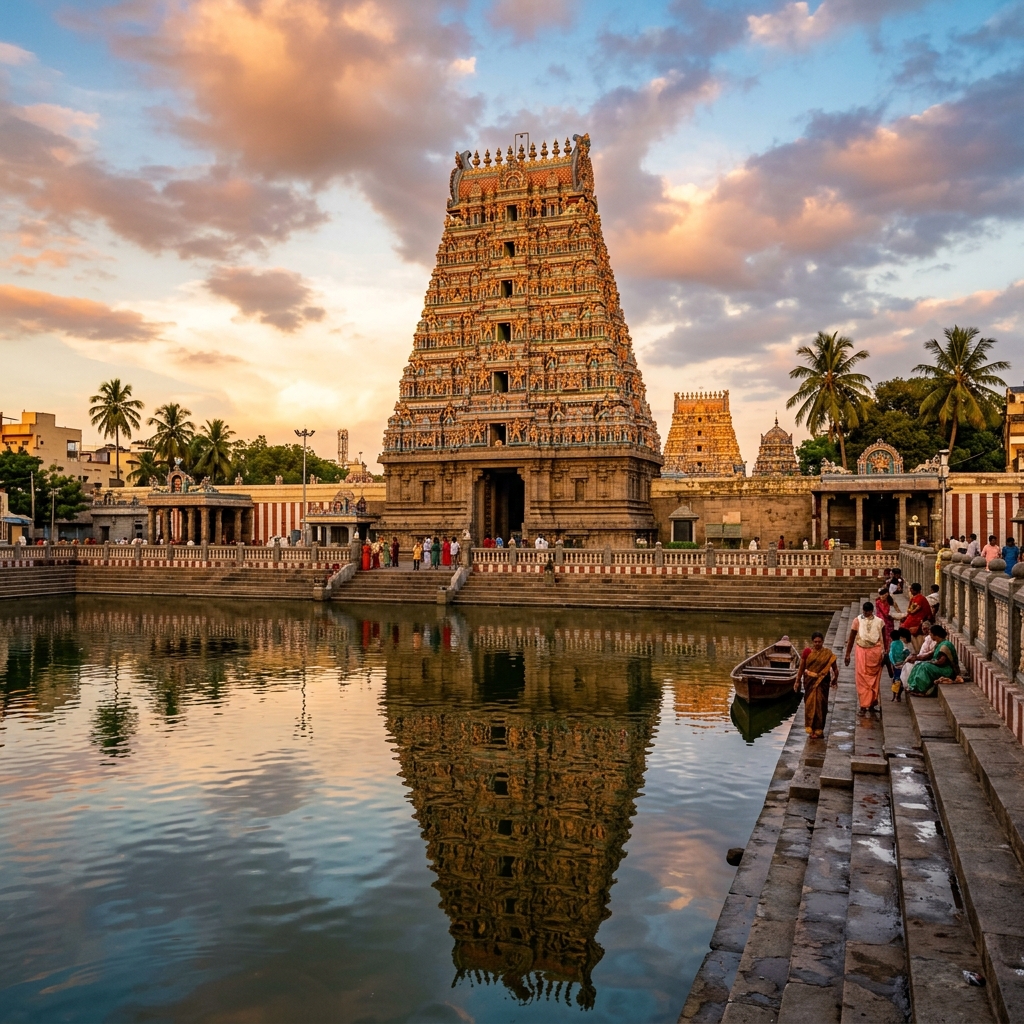
Thiruvamathur Arulmigu Abhirameswarar Temple (historically known as Thiru Aamathur) is one of the oldest, largest, and most poetically celebrated Paadal Petra Sthalams in the Nadu Naadu region of Tamil Nadu. Located just 6 km from Villupuram Junction, this sacred sanctuary derives its ancient name Aamathur (Aa = Celestial Cow, Mathur = Milk) from Kamadhenu, the divine cow who poured her holy milk over the Swayambhu Lingam to seek liberation from a sage's curse.

Enshrined in the 7th–9th century CE Tamil Tevaram hymns by child-saint Thirugnanasambandar, Saint Thirunavukkarasar (Appar), and Saint Sundaramurthy Nayanar, Thiruvamathur is structurally famous for its dual temple layout: Lord Abhirameswarar's east-facing sanctum and Goddess Muthambigai's dedicated west-facing temple complex situated across the street. The 7-acre temple complex features a towering 7-tiered Rajagopuram, an inner sanctum housing the Swayambhu Lingam retaining visible cow-horn and hoof imprints, the sacred Vanni tree (Sthala Vriksham), and the holy Pampa Theertham. Pilgrims visit Thiruvamathur to seek marital harmony, cow protection, freedom from mental anxiety, and spiritual progress.

Sthala Puranam & Authentic Legends

Kamadhenu's Milk Penance & Cow-Horn Imprints on the Lingam

According to the Sthala Puranam, Kamadhenu (the celestial wish-fulfilling cow) was cursed to lose her divine powers after failing to show proper reverence to Sage Vasishta. Seeking redemption, Kamadhenu descended to Earth and found a radiant self-born Shiva Lingam at Thiruvamathur.

Every morning, Kamadhenu stood over the Lingam and bathed it with her pure milk (Aa = Cow, Mathur = Milk/Churning). As she circumambulated the Lingam in intense ecstasy, her hooves and horns accidentally grazed the top of the stone Lingam. Overjoyed by her devotion, Lord Shiva appeared before Kamadhenu, absolved her curse, and declared: "To honor your pure love, I shall permanently bear your horn and hoof imprints upon My Lingam!" To this day, the top of the Lingam at Thiruvamathur retains visible natural indentations resembling cow horns.

Dual Shrines of Lord Abhirameswarar & Goddess Muthambigai

Uniquely among Tamil temples, Goddess Muthambigai resides in a separate, fully enclosed temple complex facing West, directly across the main road from Lord Abhirameswarar's east-facing sanctuary. Puranic lore records that Goddess Parvati performed penance inside an anthill (Valmikam) here to demonstrate the power of ascetism. Lord Shiva manifested before Her, took Her hand in divine marriage, and established Her as Muthambigai (Goddess of Pearl-like Grace).

Classical Literary Canon & Sacred Hymns

  • Tevaram (1st & 5th Thirumurai): Glorified by Thirugnanasambandar and Thirunavukkarasar (Appar) in soulful pathigams starting with "Vanthange thondargal paada... " (வந்தாங்கே தொண்டர்கள் பாட).
  • Tevaram (7th Thirumurai): Saint Sundarar composed 10 pathigams extolling Lord Abhirameswarar of Thiru Aamathur.
  • Periya Puranam: Sekkizhar details the pilgrimages of all three Nayanmars to Thiru Aamathur.

Epigraphical & Historical Events

  • Aditya Chola I & Parantaka I Inscriptions (9th–10th Century CE): Inscriptions carved into the sanctum wall document the conversion of the brick shrine into solid granite by Aditya Chola I and record land grants.
  • Rajaraja Chola I & Rajendra I Grants: Epigraphs document endowments of gold coins for maintaining daily morning and evening poojas, feeding pilgrims, and supporting Tevaram reciters (Oduvars).

Archaeo-Engineering & Scientific Marvels

Ancient metallurgical marvels, Siddha alchemical sciences, archaeo-engineering, and GI-tagged heritage:

  • Geological Petroglyphs on Swayambhu Lingam: Geological examination confirms natural quartz and basalt striations on the Lingam top that match the ancient cow-horn indentation descriptions.
  • Dual Temple Architectural Axis: Built on a precise east-west alignment connecting Lord Shiva's sanctum with Goddess Muthambigai's sanctum across the temple boulevard.

Signature Rituals, Anomalies & Special Sevas

Authentic daily pooja timelines, spatika-lingam darshan hours, special sevas, and sacred temple anomalies:

  • Kamadhenu Cow Milk Abhishekam: Special holy bathing performed for Lord Abhirameswarar with pure cow milk on Mondays for cattle health, agricultural prosperity, and childlessness relief.
  • Four Daily Kala Poojas: Morning Kalasanthi, Midday Uchikalam, Evening Sayarakshai, and Night Ardha Jamam.
  • Muthambigai Valmika Pooja: Special Friday archana performed for Goddess Muthambigai with pearl garlands and lotus flowers for marital harmony.

What to See in the Temple (Visual Highlights)

🛕

Main Sanctum (Garbhagriha)

Housing the sacred Swayambhu Lingam of Lord Abhirameswarar bearing cow-horn indentations.

🛕

Goddess Muthambigai Temple

Dedicated west-facing temple complex across the street.

🛕

Kamadhenu Relief

Sculpted stone relief depicting Kamadhenu pouring milk over the Shiva Lingam.

🛕

Sthala Vriksham (Vanni Tree)

Ancient sacred Vanni tree inside the temple courtyard.

🛕

Pampa Theertham

Ancient temple water tank located near the main gopuram entrance.

Practical Visitor Logistics & Dress Code

Temple Opening Timings & Daily Hours

Morning: 6:00 AM – 12:00 PM; Evening: 4:30 PM – 8:30 PM.

Darshan & Special Entry Tickets

Free general queue available; Special Darshan: ₹20 / ₹50.

Dress Code & Special Rules

Traditional Indian attire (Men: Dhoti / Pants; Women: Saree / Salwar Kameez).

Accessibility & Senior Citizens

Step-free access provided across outer mandapam corridors.

Car Parking & Footwear Cloakroom

Dedicated parking area available in front of the main Rajagopuram entrance; footwear counter at main gate.

Best Time to Visit & Festival Calendar

Seasonal weather guide, peaceful darshan timings, and annual Brahmotsavam festival dates:

  • Best Months: October to March (pleasant climate).
  • Major Festivals: Maha Shivaratri (Feb–March), Margazhi Arudra Darshan (Dec–Jan), Navaratri (Sept–Oct), Monthly Pradosham.

Transit, Accommodations & Prasadam Dining

How to Reach & Connectivity

  • Nearest Railway Station: Villupuram Junction (VM) - 6 km (major junction connecting Chennai, Trichy, Salem, and Madurai).
  • Nearest Airport: Puducherry Airport (PNY) - 28 km; Tiruchirappalli International Airport (TRZ) - 140 km; Chennai Airport - 160 km.
  • Last-Mile Local Transport: City buses, auto-rickshaws, and taxis available 24/7 from Villupuram railway station and Villupuram main bus stand (6 km).

Free Annadhanam & Local Veg Dining

  • Temple Prasadam: Puliyodarai, Ven Pongal, Sundal, Vibhooti Prasadam.
  • Nearby Dining: Pure vegetarian dining available near Villupuram bus stand and railway station.

Accommodations & Lodging Hubs

  • Named Hotels: Hotels and lodges in Villupuram town center (6 km) such as Hotel Balaji, Hotel Grand, and Hotel Kampan.

Nearby Heritage Spots (5–30 km Radius)

Combine your yatra with surrounding UNESCO heritage sites, Paadal Petra Sthalams & Divya Desams:

Panayapuram Panangatteeswarar Temple

8 km
Sacred & Heritage Spot

distance, famous Paadal Petra Sthalam for eye cure.

Gramam Sivalokanathar Temple

20 km
Sacred & Heritage Spot

distance, historic Paadal Petra Sthalam.

Gingee Fort

30 km
Sacred & Heritage Spot

distance, famous historic hill fort complex.

Verified References & Source Bibliography

  • Tevaram Thirumurai Canon (1st, 5th & 7th Thirumurai).
  • Periya Puranam by Sekkizhar (Sambandar, Appar & Sundarar Puranams).
  • ASI South Indian Inscriptions, Volume XIX (Inscriptions of Aditya Chola I at Thiruvamathur).

Community Photo Gallery (0)

No community photos uploaded yet.

Pilgrim Reflections (0)

No reflections logged for this destination yet.