
Explore Calendar Community THADAM+ My Thadam
Thiruvanmiyur-Marundeeswarar Temple
Paadal Petra Sthalams

Thiruvanmiyur-Marundeeswarar Temple

Thiruvanmiyur-Marundeeswarar Temple

Marundeeswarar, Oushadapureeswarar and the Ambal Chokka Nayaki, Tripura Sundari The sthala vriksham is Vanni and the Theertham Siva Ganga Sambandar and Appar composed the Pathigam • Chennai, Thondai Naadu Temples

Open in Maps My Thadam Check in

About the Sacred Destination

Presiding Deity
Marundeeswarar, Oushadapureeswarar and the Ambal Chokka Nayaki, Tripura Sundari The sthala vriksham is Vanni and the Theertham Siva Ganga Sambandar and Appar composed the Pathigam
Consort & Sub-Shrines
Sri Marundeeswarar (Oushadapureeswarar) & Goddess Tripurasundari
Era & Dynasty
Pallava origins (7th C CE) with grand Chola stone expansions by Rajendra Chola I, Kulothunga I, and Vijayanagara Kings
Sacred Status & Classification
Paadal Petra Sthalam (Thondai Nadu Shrine #24 / Shrine #287 of 276 Shaivite Shrines); **Medical & Health Healing Sthalam**; Sage Valmiki Liberation Site

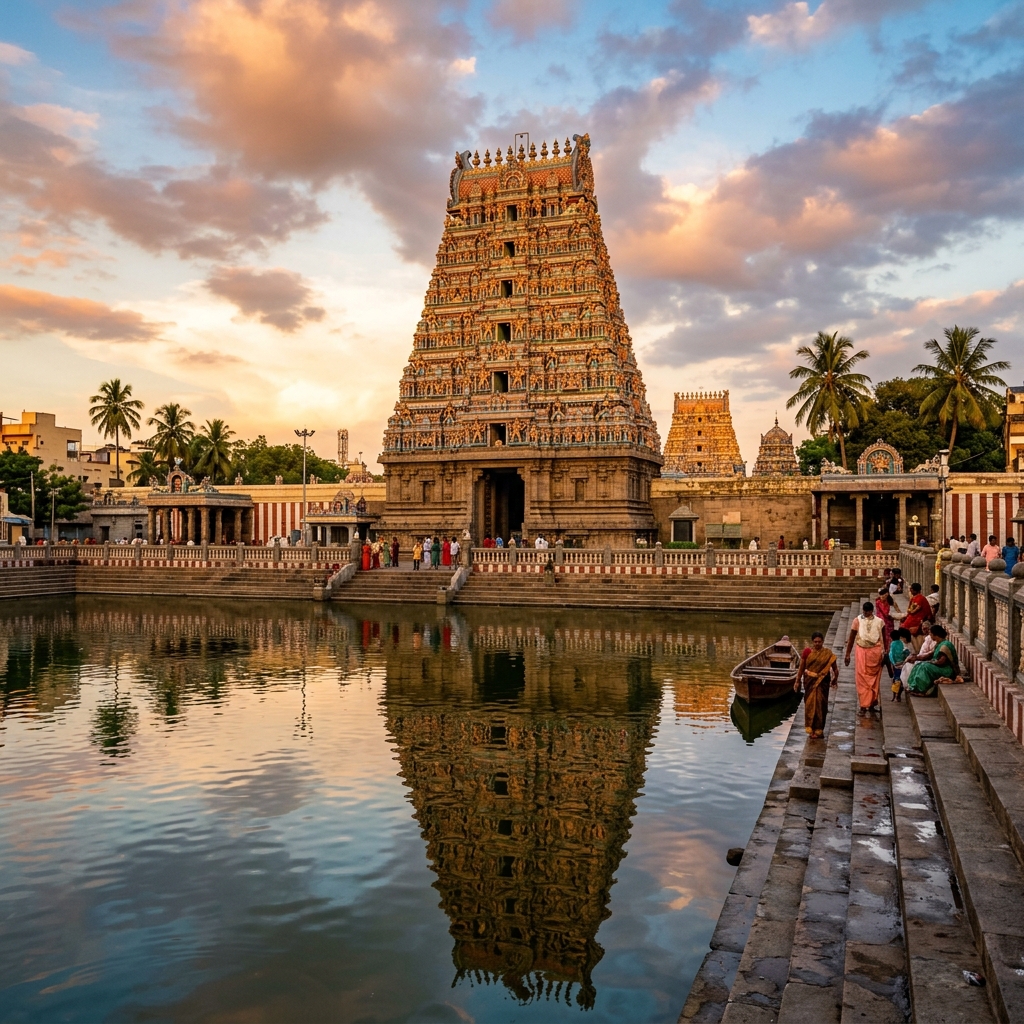
Thiruvanmiyur Arulmigu Marundeeswarar Temple is one of the most prominent Paadal Petra Sthalams in South Chennai. Immortalized in the 7th-century Tevaram hymns by Saint Thirugnanasambandar and Saint Appar, this ancient temple is famous throughout India as the supreme sanctuary for divine healing, where Lord Shiva taught Sage Agastya the secrets of herbal Siddha medicine (Marundhu).

Spanning an expansive 1-acre granite complex with twin 5-tiered Rajagopurams (East & West), Chola pillared assembly halls, the sacred Vanni tree (Sthala Vriksham), and the serene Shiva Ganga Theertham tank, Thiruvanmiyur is a major pilgrimage center. Devotees visit this sacred sanctuary to pray for complete physical healing, relief from chronic illnesses, and spiritual peace.

Sthala Puranam & Authentic Legends

Lord Shiva's Medical Secrets to Sage Agastya (Marundeeswarar)

According to the Sthala Puranam, Sage Agastya sought divine guidance from Lord Shiva to cure illnesses afflicted upon humanity. Lord Shiva manifested at Thiruvanmiyur beneath the Vanni tree and taught Agastya the secret medicinal properties of herbs, roots, and minerals (Marundhu in Tamil / Oushadam in Sanskrit). Because the Lord imparted the divine science of healing here, He received the titles Marundeeswarar ("The Divine Healer / Lord of Medicine") and Oushadapureeswarar. Devotees suffering from ailments offer milk for Abhishekam over the Lingam and receive sacred ash (Vibhooti) mixed with herbal powder (Marundhu Prasadam) for divine healing.

Sage Valmiki's Penance & Name Origin (Thiruvanmiyur)

Sage Valmiki, the legendary author of the epic Ramayana, performed intense penance under the Vanni tree at this shrine to seek liberation from past sins. Moved by his devotion, Lord Shiva manifested before Valmiki and granted him eternal mukthi. The town was originally named Thiru-Valmiki-Oor ("The Sacred Abode of Valmiki"), which over centuries evolved into Thiruvanmiyur. A separate shrine dedicated to Sage Valmiki stands directly across the East Coast Road opposite the main temple.

Kamadhenu's Cow-Hoof Impression

The celestial cow Kamadhenu worshipped Lord Shiva here by pouring milk over the Swayambhu Lingam. While walking in the dark, Kamadhenu accidentally stepped on the Lingam, leaving a visible cow-hoof notch mark on the upper surface of the Lingam.

Classical Literary Canon & Sacred Hymns

This sacred shrine is enshrined in the Tevaram (2nd Thirumurai by Sambandar, 6th Thirumurai by Appar).

  • Tevaram Hymn by Saint Thirugnanasambandar:

> "வண்டிரைக் கும்மலர் புன்னையுஞ் சூழ்ந்தவான் மியூர் > கண்டிரைக் கும்மருந் தீச்சரத் தேயுறை காரியனை > தொண்டிரைக் கும்மனத் தால்நினை வார்களைத் தொல்வினை > விண்டிரைக் குந்துயர் தீர்க்கும்எம் மானே." > > Translation: "Lord Marundeeswarar residing at Thiruvanmiyur surrounded by honeybee-frequented Punnai groves grants immediate relief from all ancient karmic diseases to those who meditate upon Him!"

The temple is also extolled in Sekkizhar's 12th-century Periya Puranam.

Epigraphical & Historical Events

  • Chola Stone Inscriptions: Over 30 stone inscriptions carved on the inner Garbhagriha walls record royal grants by Rajendra Chola I (1012–1044 CE) and Kulothunga Chola I. Grants detail endowments of wet lands for daily medical prasadam distribution and perpetual lamps.
  • Vijayanagara Inscriptions: Record the 16th-century construction of the twin 5-tiered Rajagopurams.

Archaeo-Engineering & Scientific Marvels

Ancient metallurgical marvels, Siddha alchemical sciences, archaeo-engineering, and GI-tagged heritage:

  • Cow-Hoof Scar Iconography: Physical notch mark on the upper crown of the granite Swayambhu Lingam, validating the ancient Kamadhenu legend.
  • Healing Vibhooti-Marundhu Tradition: Unique temple tradition where sacred ash is consecrated with 108 herbal ingredients during special poojas.

Signature Rituals, Anomalies & Special Sevas

Authentic daily pooja timelines, spatika-lingam darshan hours, special sevas, and sacred temple anomalies:

  • Six Daily Kala Poojas: Conducted as per Kamika Agamic rites: Ushathkalam (6:00 AM), Kalasanthi (8:00 AM), Uchikalam (12:00 PM), Sayarakshai (5:00 PM), Irandam Kalam (7:00 PM), and Ardha Jamam (8:30 PM).
  • Herbal Prasadam Distribution: Daily distribution of consecrated Marundhu Prasadam (herbal powder with sacred ash) to sick pilgrims.
  • Panguni Uthiram Brahmotsavam: Grand 10-day annual festival featuring chariot procession and float festival (Theppotsavam).

What to See in the Temple (Visual Highlights)

🛕

Main Sanctum (Garbhagriha)

Enshrines the sacred Swayambhu Lingam of Sri Marundeeswarar.

🛕

Goddess Tripurasundari Shrine

Separate south-facing shrine dedicated to Goddess Thirupurasundari.

🛕

Sage Valmiki Shrine

External shrine across ECR road dedicated to Sage Valmiki.

🛕

Shiva Ganga Theertham

Sacred temple tank located on the northern side.

🛕

Twin Rajagopurams

5-tiered East and West entrance gopurams.

Practical Visitor Logistics & Dress Code

Temple Opening Timings & Daily Hours

Morning: 6:00 AM – 12:00 PM; Evening: 4:00 PM – 8:30 PM

Darshan & Special Entry Tickets

Free general entry queue; Special Darshan Ticket: ₹20 / ₹50

Dress Code & Special Rules

Traditional Indian attire mandatory (Dhoti/Shirt for men; Saree/Salwar Kameez for women)

Accessibility & Senior Citizens

Ground-level layout throughout outer prakaram with wheelchair ramps

Car Parking & Footwear Cloakroom

Dedicated parking lot near the West Gopuram entrance along ECR Road; footwear counters near both entrance gates

Best Time to Visit & Festival Calendar

Seasonal weather guide, peaceful darshan timings, and annual Brahmotsavam festival dates:

  • Best Months: October to March (cooler winter climate ideal for coastal temple visits)
  • Major Festivals:
  • Panguni Uthiram Brahmotsavam (March–April): 10-day annual festival featuring float festival.
  • Maha Shivaratri (Feb–March): Four-kala night long abhishekam and Veda parayanam.
  • Navaratri Festival (Sept–Oct): 9-day celebration at Goddess Tripurasundari shrine.

Transit, Accommodations & Prasadam Dining

How to Reach & Connectivity

  • Nearest Railway Station: Thiruvanmiyur MRTS Station - 1 km; Chennai Egmore (MS) - 12 km; Chennai Central (MAS) - 13 km
  • Nearest Airport: Chennai International Airport (MAA) - 12 km
  • Last-Mile Local Transport: Direct Chennai MTC buses (Routes 29C, 19B, 599, 91, 588, M1 series) run every minute from all parts of Chennai to Thiruvanmiyur Bus Depot / Temple Stop (100m from temple)

Free Annadhanam & Local Veg Dining

  • Temple Prasadam: Kovil Puliyodarai, Sakkarai Pongal, Sundal, and Herbal Marundhu Prasadam served at temple counter. Free daily Annadhanam served at 12:15 PM
  • Specific Pure-Veg Dining Spots: Hotel Saravana Bhavan (Thiruvanmiyur ECR Junction - 0.2 km); Hotel Sangeetha Veg (Thiruvanmiyur Bus Depot - 0.3 km); Hotel Adyar Ananda Bhavan (A2B ECR - 0.5 km)

Accommodations & Lodging Hubs

  • Hotels in Thiruvanmiyur / OMR (1–3 km): Hotel Lemon Tree OMR (2 km); Hotel Ginger OMR (2.5 km); Hotel Formula1 OMR (3 km)

Nearby Heritage Spots (5–30 km Radius)

Combine your yatra with surrounding UNESCO heritage sites, Paadal Petra Sthalams & Divya Desams:

Elliot's Beach & Besant Nagar Promenade

2.5 km
Sacred & Heritage Spot

North; Scenic beach and promenade

Ashtalakshmi Temple & Arupadai Veedu Murugan Temple

2.5 km
North

East; Famous beachfront temples

Kalakshetra Foundation

1 km
South; World

renowned academy of Bharatanatyam arts

Verified References & Source Bibliography

  • Tevaram Thirumurai Canon (2nd & 6th Thirumurai by Sambandar & Appar)
  • Periya Puranam by Sekkizhar
  • ASI South Indian Inscriptions (Vol. III & IX, Inscriptions of Thiruvanmiyur)
  • HR&CE Devasthanam Archives, Arulmigu Marundeeswarar Temple, Thiruvanmiyur

Community Photo Gallery (0)

No community photos uploaded yet.

Pilgrim Reflections (0)

No reflections logged for this destination yet.